Hi this is Team Merchant Navy Decoded !!!
Please fill the below form with your query and we will get back to you in next 12 hours.
Rest assured your data is safe with us !!!🙂
Ask Your Query| For Beginner | For Professional |
|---|---|
| GME | Engine Side |
| G.P. Rating | Deck Side |
| ETO | G.P. Rating |
| IMUCET & Sponsorship | Combo Offers |
| Free Course | MEO |
| Free Course |
| For Beginner | For Professional |
|---|---|
| GME | Engine Side |
| G.P. Rating | Deck Side |
| ETO | G.P. Rating |
| IMUCET & Sponsorship | Combo Offers |
| Free Course | MEO |
| Free Course |
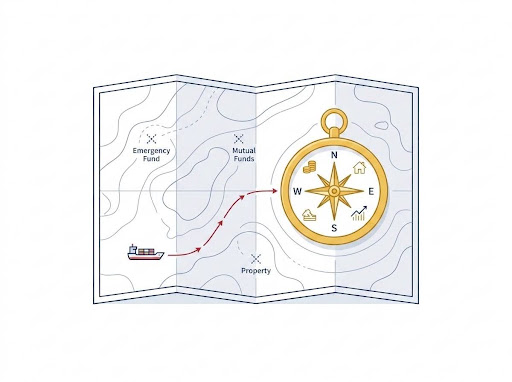
Many seafarers earn well during sailing contracts but feel unsure about where to invest their money. One person may suggest property, another may recommend mutual funds, while someone else may say fixed deposits are the safest choice. This confusion often leads seafarers to keep all their money in one bank account or invest a large amount in one asset. There is no single investment option that works perfectly for every seafarer. The right investment depends on goals, risk capacity, residential status, tax position, and liquidity needs.
A seafarer’s income pattern is different from a regular shore-based employee. Salary may come during the contract, followed by several months without onboard income. There may also be sudden expenses for exams, medical needs, family responsibilities, travel, or delays in joining the next vessel. This is why seafarers should not invest without planning. Some money should remain safe and accessible, some money can be invested for long-term growth, and some money may be used for major goals like property purchase.
Keeping the entire sea salary in one place can create problems. A large property purchase may leave very little emergency cash. Keeping everything in fixed deposits may provide stability but may not support long-term wealth creation. Investing everything in stocks may expose the seafarer to high market risk. A balanced approach is usually better. Diversification helps divide money across safety, growth, liquidity, and long-term goals. It does not remove risk completely, but it reduces dependency on one investment.
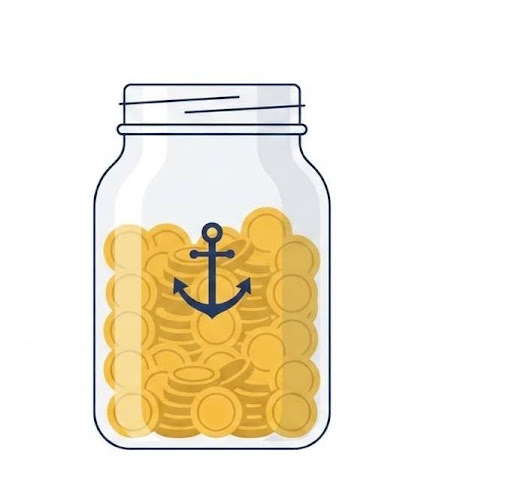
Before investing aggressively, seafarers should create an emergency fund. This fund should cover family expenses, medical needs, travel, certification, exams, loan EMIs, and the gap between contracts. Since joining dates can be delayed, emergency money should not be locked in risky or illiquid investments. A bank account, liquid fund, or short-term fixed deposit may be used depending on risk and access needs. The goal of an emergency fund is not high return. Its main purpose is safety and quick availability.
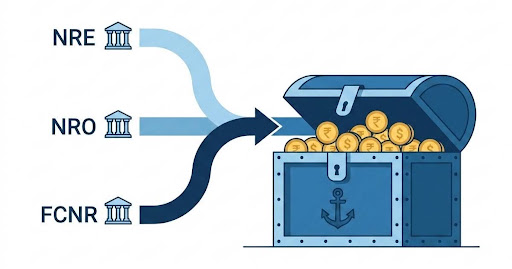
Fixed deposits provide stability and predictable interest. They can be useful for emergency reserves, short-term goals, and money that should not be exposed to market fluctuations. Seafarers commonly use NRE, NRO, and FCNR deposits depending on residential status and source of funds. NRE and FCNR interest may be exempt in India for eligible non-residents, while NRO interest is taxable in India. The Income Tax Department explains that NRE interest is exempt under Section 10(4)(ii), while NRO interest is taxable.
NRE fixed deposits are generally used when foreign earnings are transferred to India through banking channels. They are maintained in Indian rupees and may be useful for seafarers who want to keep foreign salary in India while preserving repatriability. RBI’s non-resident account FAQ explains that NRE accounts are repatriable and can be used for permitted investments in India. However, seafarers should check residential status, bank rules, premature withdrawal terms, and tax treatment before opening or renewing large deposits.
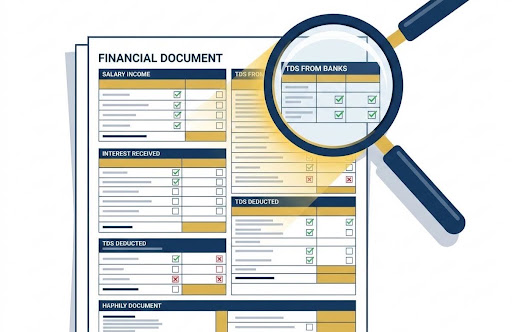
NRO fixed deposits are generally used for Indian income such as rent, pension, dividends, Indian interest, or other domestic receipts. NRO interest is taxable in India and may be subject to TDS. The final tax liability depends on total taxable income, deductions, applicable rates, and ITR filing. Seafarers should check Form 26AS, AIS, interest certificates, and bank statements before filing their return. An NRO FD can provide stability, but it should not be confused with tax-free NRE interest.
FCNR deposits are maintained in accepted foreign currencies. They may help seafarers reduce currency-conversion risk because the deposit is not maintained in Indian rupees like an NRE fixed deposit. FCNR can be useful for seafarers who earn in foreign currency and may need funds abroad later. However, the interest rate, currency risk, maturity rules, premature withdrawal charges, and bank-specific terms should be checked carefully. FCNR should be selected based on currency needs, not only because it sounds safer than other options.
Mutual funds can help seafarers invest across multiple companies, sectors, or debt instruments without choosing every investment personally. SEBI’s mutual fund FAQ says non-resident Indians can also invest in mutual funds, with necessary details available in scheme documents. Seafarers can invest through SIP or lump sum after completing KYC, FATCA, PAN, and bank requirements. Mutual funds may be useful for long-term goals, but returns are market-linked and not guaranteed. Scheme selection should match time horizon and risk capacity.
A SIP can help seafarers build investment discipline because money is invested regularly. This can be useful for long-term goals such as retirement, children’s education, buying a home, or building wealth after sea service. However, seafarers should choose SIP amounts carefully because income may be contract-based. During leave periods, the bank account should still have enough balance for SIPs, EMIs, insurance, and family expenses. SIPs should not be started only because a fund recently gave high returns.
Seafarers often receive accumulated salary after completing contracts and may want to invest a lump sum. This can work, but it should be planned carefully. Putting a large amount into equity mutual funds at one time can expose the money to market volatility. Depending on the goal, a seafarer may consider staggered investment, asset allocation, or lower-risk options for short-term money. Mutual funds are useful, but they should not be treated like fixed deposits or guaranteed-return products.
Direct stocks allow investors to buy ownership in individual companies. They may offer strong long-term growth, but they require research, patience, and monitoring. SEBI’s NRI investment material states that an NRI having an NRE or NRO bank account can invest in Indian securities, subject to applicable rules. For seafarers, direct stock investing can be challenging because internet access onboard may be limited. Beginners should avoid buying stocks only because of social media tips, friends’ advice, or short-term market excitement.

Seafarers may also consider IPOs, but IPO investment should not be treated as guaranteed profit. A company listing can rise, fall, or remain volatile after listing. Before applying for an IPO, seafarers should understand the business, valuation, risk factors, lock-in if any, and investment route. NRI participation can depend on demat account, bank account, PAN, KYC, and applicable securities rules. IPOs should be treated as high-risk equity exposure, not as a shortcut to quick wealth.

Real estate is a popular investment among Indian seafarers. Many use their sailing income to buy a flat, house, shop, office, or plot. Property can create rental income and may appreciate over time. However, real estate is less liquid than financial investments. A mutual fund may be redeemed relatively quickly, but selling property can take months. Seafarers should not invest all available cash in property only because relatives or brokers describe it as a guaranteed investment.
If a seafarer qualifies as NRI or OCI under FEMA rules, property type matters. RBI’s property FAQ says NRIs and OCIs can purchase immovable property in India other than agricultural land, farmhouse, or plantation property. This means residential and commercial property may generally be possible, but agricultural land and similar restricted property require caution. Seafarers should verify title, land classification, approvals, payment route, seller details, TDS, taxes, registration documents, and repatriation rules before buying property.
Rental property can create regular income, but it also creates tax and documentation responsibilities. Rental income from property in India may be taxable in India, even when the seafarer is working outside India. TDS, municipal taxes, loan interest, standard deduction, repairs, and ITR reporting should be checked. If the seafarer is not in India, rent collection, maintenance, tenant verification, repairs, and legal follow-up may also become difficult. A property investment should be planned beyond only expected appreciation.
Government securities and high-quality bonds may provide a relatively conservative investment route. They may suit seafarers who want regular income or lower volatility than equity investments. However, all bonds are not equally safe. Government bonds, corporate bonds, tax-saving bonds, and market-linked debt products have different risks, interest-payment structures, maturity periods, and tax treatment. A bond should not be purchased only because it offers a higher interest rate than an FD. Higher return may come with higher credit or liquidity risk.
Gold is often seen as a safe asset in Indian families. Seafarers may invest in physical gold, gold ETFs, gold mutual funds, or sovereign gold bonds where eligible. Gold can help diversify a portfolio, but it should not become the entire investment plan. Physical gold has storage, purity, making charges, and liquidity concerns. Gold prices can also remain flat or volatile for long periods. Seafarers should treat gold as a diversification tool, not as the only wealth-building strategy.
Public Provident Fund and small savings schemes are popular among resident Indians, but seafarers should be careful if they become non-resident. National Savings Institute FAQ states that NRIs are not authorised to make investments in National Savings Products. If a seafarer already has a PPF or other small savings account from resident days, they should check the latest scheme rules, bank or post office guidance, and CA advice before contributing, extending, or closing the account. Do not assume old rules continue automatically.
The bank account used for investment can affect taxation, repatriation, and documentation. NRE funds are generally used for foreign earnings and are repatriable. NRO accounts are generally used for Indian income and have remittance conditions. RBI’s FAQ states that NRO balances of NRIs or PIOs are remittable up to USD 1 million per financial year, along with other eligible assets, subject to conditions. Seafarers should not randomly mix NRE and NRO funds without understanding the source and future use.
Foreign sailing income may have a different tax treatment from income earned through Indian investments. Interest, rent, dividends, mutual fund gains, stock gains, and property capital gains from Indian assets may still be taxable in India depending on residential status and source of income. TDS is not always final tax. If excess TDS is deducted, refund may be possible through ITR. If tax deducted is lower than the final liability, additional tax may be payable. Records should be maintained properly.
Seafarers should check AIS and Form 26AS before filing ITR. The Income Tax Department states that SFT provides a reporting mechanism for specified entities to provide information about material financial transactions, including reporting related to listed securities and units of mutual funds. This means investment transactions may appear in tax records. Seafarers should match bank statements, mutual fund reports, demat statements, capital gain statements, TDS records, rental income, and Form 26AS before filing.
Seafarers should keep salary slips, employment contracts, remittance advice, NRE and NRO bank statements, FCNR details, mutual fund statements, demat statements, capital gain reports, property documents, rent agreements, FD certificates, interest certificates, bond statements, gold investment records, Form 26AS, AIS, TDS certificates, and ITR acknowledgements. These documents help prove source of funds, investment route, tax treatment, and repatriation eligibility. Good documentation becomes especially useful when the seafarer is onboard during tax season or compliance follow-up.
The biggest mistake is investing the full sea salary in one asset. Some seafarers buy property without emergency funds. Others keep all money in FDs and miss long-term growth. Some enter stocks without research or invest in mutual funds only by looking at recent returns. Many seafarers also ignore residential status, NRE/NRO route, KYC, tax, TDS, AIS, and repatriation. Investment should not be based only on friends, brokers, relatives, or social media suggestions. Planning matters.
A sensible plan may divide money into different buckets. Emergency money can remain in a savings account or short-term FD. Short-term goals can use safer instruments. Long-term goals can use mutual funds or other growth investments based on risk capacity. Property can be considered after emergency funds and documentation are ready. Stocks can be added only if the seafarer understands risk and research. The exact allocation depends on age, rank, family responsibilities, loans, contract stability, and goals.
Seafarers should take professional help before large property purchases, major mutual fund redemptions, stock portfolio restructuring, NRO repatriation, foreign remittance, tax refund claims, or complex NRE/NRO transactions. A financial advisor can help with goal planning, risk profiling, asset allocation, and product selection. A CA can help with residential status, taxation, TDS, capital gains, ITR filing, and documentation. Professional help is especially useful when the seafarer has foreign salary, Indian income, multiple accounts, and large investments.
A high salary does not automatically create long-term wealth. Wealth is built by dividing money wisely, controlling risk, maintaining an emergency fund, and investing regularly for clear goals. Do not invest the entire sea salary in property, stocks, mutual funds, or fixed deposits. Each investment has a role, and every investment carries some risk, tax treatment, or compliance requirement. Before investing, understand where the money is going, how easily it can be withdrawn, how returns are taxed, and whether repatriation is possible.
Taxation planning for seafarers should not only be considered at the end of the year while filing the return. It should include proper assessment of residential position, Indian income, foreign income, NRE and NRO accounts, investments, TDS, capital gains, repatriation, and long-term wealth planning. Download Sailor Pro app – Built for Seafarers, an Initiative by Merchant Navy Decoded, to stay more organised and confident in your financial planning.
The best investment options for seafarers may include emergency funds, fixed deposits, mutual funds, stocks, property, bonds, and gold. The right choice depends on goals, risk capacity, residential status, tax position, and liquidity needs.
Yes, seafarers can invest in mutual funds if KYC, PAN, bank account, and regulatory requirements are completed. NRI seafarers should check NRE/NRO account route, FATCA, fund-house restrictions, taxation, and repatriation before investing.
Yes, seafarers can invest in stocks through permitted bank, demat, and trading account routes. However, stocks require research and risk management. Beginners should avoid investing only on tips or social media recommendations.
Yes, seafarers can generally buy residential or commercial property in India, subject to FEMA rules, state laws, title verification, taxes, and payment conditions. NRI/OCI seafarers should avoid restricted agricultural land, farmhouses, and plantation property.
Fixed deposits can be useful for safety, emergency funds, and short-term goals. NRE, NRO, and FCNR deposits have different tax and repatriation rules, so seafarers should choose based on source of funds and residential status.
Gold can be used as a diversification tool, but it should not become the entire investment plan. Seafarers should understand storage, tax, liquidity, price fluctuation, and product type before investing.
Seafarers who are residents may invest subject to PPF rules. If a seafarer becomes non-resident, they should check the latest small savings rules and bank or post office guidance before contributing or extending the account.
Foreign earnings are usually routed through NRE accounts, while Indian income is usually routed through NRO accounts. FCNR may be used for foreign-currency deposits. The account route can affect tax, repatriation, and documentation.
Yes, many investment returns may be taxable in India, including NRO interest, rent, dividends, capital gains from mutual funds, stocks, and property. Tax treatment depends on residential status, investment type, and tax law.
Yes, professional advice is useful for large investments, property purchases, mutual funds, stocks, NRE/NRO accounts, repatriation, capital gains, TDS, ITR filing, and long-term planning.
Disclaimer :- The opinions expressed in this article belong solely to the author and may not necessarily reflect those of Merchant Navy Decoded. We cannot guarantee the accuracy of the information provided and disclaim any responsibility for it. Data and visuals used are sourced from publicly available information and may not be authenticated by any regulatory body. Reviews and comments appearing on our blogs represent the opinions of individuals and do not necessarily reflect the views of Merchant Navy Decoded. We are not responsible for any loss or damage resulting from reliance on these reviews or comments.
Reproduction, copying, sharing, or use of the article or images in any form is strictly prohibited without prior permission from both the author and Merchant Navy Decoded.
Decoded Discount Alert! up to 50% OFF
Use Coupon Code Deep50