Hi this is Team Merchant Navy Decoded !!!

Please fill the below form with your query and we will get back to you in next 12 hours.

Rest assured your data is safe with us !!!🙂

Ask Your Query

Wheatstone Bridge

Wheatstone Bridge

The Wheatstone bridge is an important electrical circuit that can be used to accurately measure unknown electrical resistances. It is commonly used in electrical and electronic systems to measure resistances due to its accuracy when the circuit is balanced.

This principle is also used in many measuring devices such as resistance based sensors and strain gauges. This is useful knowledge for engineering students who may be studying electrical measurements.

What is a Wheatstone Bridge?

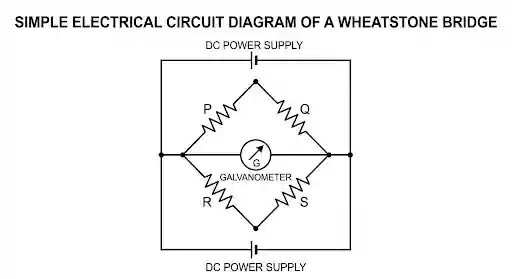
A Wheatstone bridge is a circuit consisting of four resistors connected together to form a diamond shape. A DC power supply is used to supply power to the circuit between two diagonally opposite points. A Galvanometer or suitable voltage measuring device will be connected between the other two points.

Three of the resistances may be known or variable. The fourth resistance will be the unknown resistance. The Wheatstone Bridge compares the ratio of two resistances. Once the circuit is balanced there will be no potential difference between each point of the galvanometer therefore no current can flow.

Construction of a Wheatstone Bridge

The main components of a Wheatstone bridge are:

  • Four resistors: These form the four arms of the bridge circuit
  • DC power supply: Provides electrical energy to the circuit
  • Galvanometer: Detects small currents and indicates whether the bridge is balanced
  • Unknown resistance: The resistance value that needs to be determined
  • Connecting wires and switches: Complete and control the circuit

The arrangement of these components allows the unknown resistance to be calculated from the known resistance values when the bridge is balanced.

Table of Contents

Working Principle

The Wheatstone bridge compares the ratio of two branches. We can explain how it works using the balanced/unbalanced conditions.

1. Balanced Condition

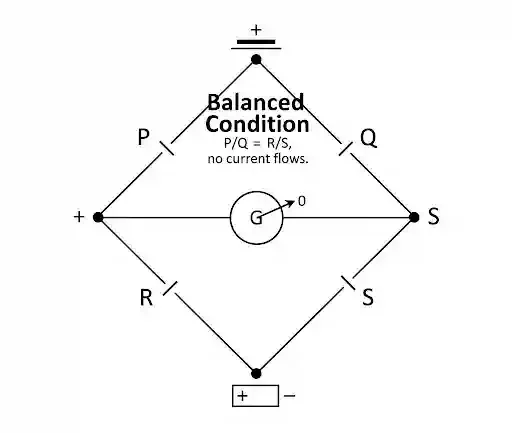
Balanced Condition

When the circuit is balanced the potential difference between the two points that connect to the galvanometer will be equal and therefore no current will flow.

Say our four resistors are P, Q, R and S. At balance;

P/Q = R/S

We can rearrange this to get;

S= (Q x R)/P

Where S is our unknown resistance. As long as we know what P, Q and R are, we can calculate the unknown resistance.

2. Unbalanced Condition

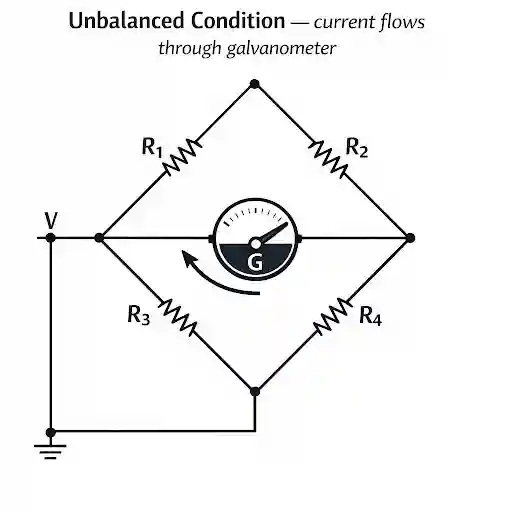
Unbalanced Condition

If the ratio of the resistances aren’t equal then there will be a potential difference between the points connecting to the galvanometer. Current will flow through the galvanometer.

The direction of the current will tell us which point has the higher potential. We can then alter the resistances until there is no current flowing through the galvanometer showing the circuit is balanced.

Example

Say our known resistances are;

P = 2 Ω

Q = 4 Ω

R = 6 Ω

At balance;

S= (Q x R)/P

S= (4 x 6)/2

S=12 Ω

We can see that our unknown resistance is 12Ω.

Applications

The Wheatstone bridge can be used for a variety of applications.

  1. Measuring unknown resistance – The Wheatstone bridge can be used to measure unknown resistances.
  2. Strain Gauges – Strain gauges change resistance when stretched or compressed. The Wheatstone bridge can be used to measure small changes in resistances. This can be used in load cells.
  3. Temperature – Resistance based sensors such as RTDs can be used in the Wheatstone bridge circuit to measure temperature changes.
  4. Industrial – The Wheatstone bridge is used in measuring circuits to measure pressure, force and displacement using resistance based sensors.
  5. Lab experiments – The Wheatstone bridge is commonly used in engineering labs to demonstrate how to measure resistances.

Advantages of a Wheatstone Bridge

  • Provides accurate resistance measurement when properly balanced
  • Offers good sensitivity to small resistance changes
  • Uses a straightforward circuit arrangement
  • Can be used with different resistance-based sensors
  • Reduces dependence on directly measuring small currents through the unknown resistance

Limitations of a Wheatstone Bridge

  • The basic circuit is less suitable for measuring extremely low resistances because wire and contact resistances can introduce errors
  • Changes in temperature can affect the resistance values and measurement accuracy
  • Accurate results depend on stable components and reliable electrical connections
  • The traditional null balance method may require manual adjustment and can take time.

Conclusion

The Wheatstone bridge is an important electrical circuit that can be used to accurately measure resistances. This works by comparing the ratio of two resistances. Once the circuit is balanced there will be no current flowing through the galvanometer. The Wheatstone bridge can be used in many applications such as strain gauges, temperature sensors and industrial. Knowing how this circuit works will give engineers a good base of knowledge on how to measure electrical resistances.

Frequently Asked Questions (FAQs)

To accurately measure unknown resistances.

The potential difference between the galvanometer points will be equal and no current will flow.

Traditionally a galvanometer is used to determine if current is flowing through the detection branch.

Yes, if resistance based temperature sensors are used such as RTDs.

The balance equation for the resistor configuration mentioned in this article is P/Q=R/S.

Disclaimer :- The opinions expressed in this article belong solely to the author and may not necessarily reflect those of Merchant Navy Decoded. We cannot guarantee the accuracy of the information provided and disclaim any responsibility for it. Data and visuals used are sourced from publicly available information and may not be authenticated by any regulatory body. Reviews and comments appearing on our blogs represent the opinions of individuals and do not necessarily reflect the views of Merchant Navy Decoded. We are not responsible for any loss or damage resulting from reliance on these reviews or comments.

Reproduction, copying, sharing, or use of the article or images in any form is strictly prohibited without prior permission from both the author and Merchant Navy Decoded.

DIWALI SALE

Decoded Discount Alert! up to 50% OFF

DIWALI SALE

Decoded Discount Alert! up to 50% OFF

Use Coupon Code Deep50

Days
Hours
Seconds
0
Would love your thoughts, please comment.x
()
x