Hi this is Team Merchant Navy Decoded !!!
Please fill the below form with your query and we will get back to you in next 12 hours.
Rest assured your data is safe with us !!!🙂
Ask Your Query| For Beginner | For Professional |
|---|---|
| GME | Engine Side |
| G.P. Rating | Deck Side |
| ETO | G.P. Rating |
| IMUCET & Sponsorship | Combo Offers |
| Free Course | MEO |
| Free Course |
| For Beginner | For Professional |
|---|---|
| GME | Engine Side |
| G.P. Rating | Deck Side |
| ETO | G.P. Rating |
| IMUCET & Sponsorship | Combo Offers |
| Free Course | MEO |
| Free Course |
A boiler is a closed pressure vessel in which water is heated and vaporized by means of a suitable heat source. The steam produced by the boiler may have various applications onboard ships, in power plants, industries and other engineering systems. In marine engineering, boilers are primarily used to heat fuel oil, cargo, domestic water and accommodation spaces as well as to supply steam to various auxiliary systems.
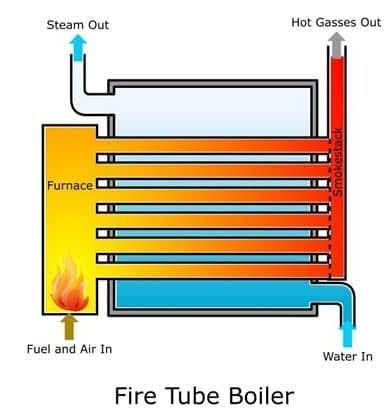
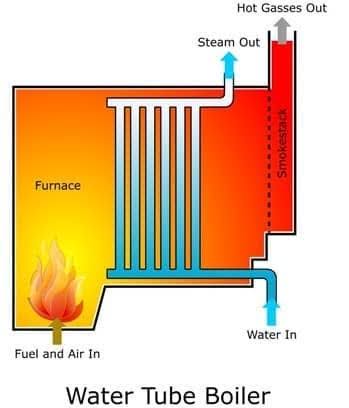
One of the most basic ways of classifying boilers is according to the relative flow paths of water and hot gases. On this basis, boilers are divided into fire tube boilers and water tube boilers.

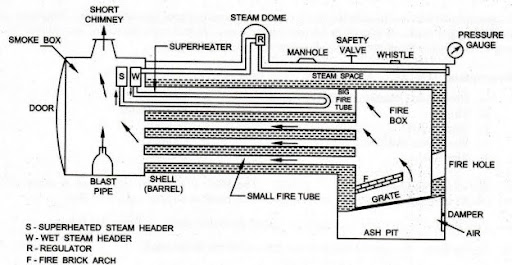
In a fire tube boiler, hot gases produced by the combustion of fuel flow through tubes, while water surrounds the outside of these tubes. The heat is transferred from the hot gases through the tube walls to the surrounding water causing the water to heat and produce steam.
Main features of fire tube boilers:

In a water tube boiler, the flow is reversed. The water flows through tubes while the hot combustion gases flow over the tubes and at the same time heat the water which flows in the tubes.
Main features of water tube boilers:
Another classification is based on the position of the furnace in relation to the boiler shell or heating surfaces. On this basis, boilers are classified as internally fired and externally fired.
In an internally fired boiler, the furnace or combustion chamber is located inside the boiler structure. Fuel is burned within the boiler, and the heat produced is transferred to the surrounding water through the heating surfaces.
The furnace is therefore an integral part of the boiler arrangement.
Characteristics:

In an externally fired boiler, the furnace is located outside the main boiler shell or heating section. The hot gases generated in the external furnace are directed over or around the boiler heating surfaces to transfer heat to the water.
Characteristics:
Boilers can also be classified according to the method by which water circulates through their heating surfaces. The two main types are natural circulation boilers and forced circulation boilers.

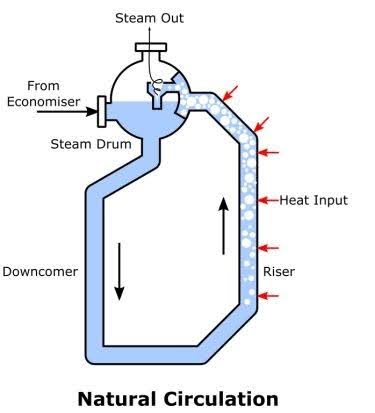
A natural circulation boiler circulates water without the use of a mechanical circulation pump. The circulation is produced by the difference in density between hot and cold water.
When water inside the generating tubes is heated, its temperature increases and its density decreases. The lighter hot water and steam water mixture rises through the tubes. At the same time cooler and denser water moves downward through the downcomers. This continuous movement creates natural circulation.
Advantages:

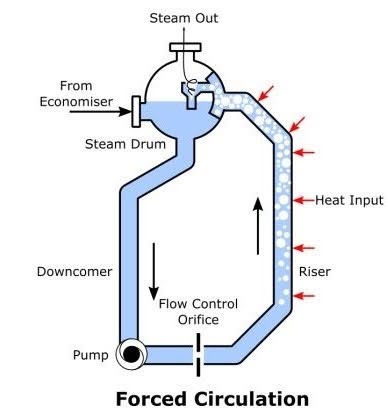
In a forced circulation boiler, water circulation is maintained or assisted by a circulation pump. The pump forces water through the boiler tubes at the required flow rate.
Forced circulation allows better control of water flow and can be useful in compact boiler designs where natural circulation may not provide sufficient flow.
Advantages:
The source of heat supplied to the boiler is particularly important. On this basis, boilers can be classified as fired boilers, exhaust gas boilers and composite boilers.
A fired boiler generates heat by burning fuel in a furnace. The fuel is supplied to a burner, where it is mixed with air and combusted. The heat produced by combustion is transferred to the boiler water through the heating surfaces.
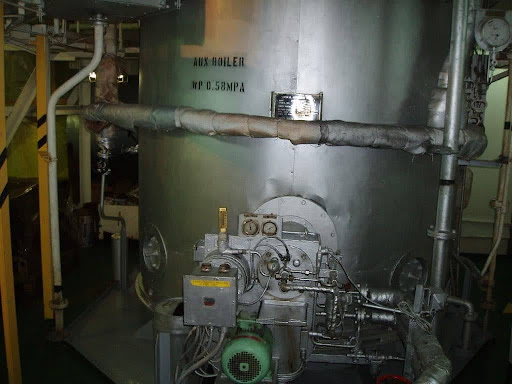
On ships, an auxiliary fired boiler is commonly used when steam is required while the main engine is stopped or when exhaust gas heat is insufficient.
Uses include:
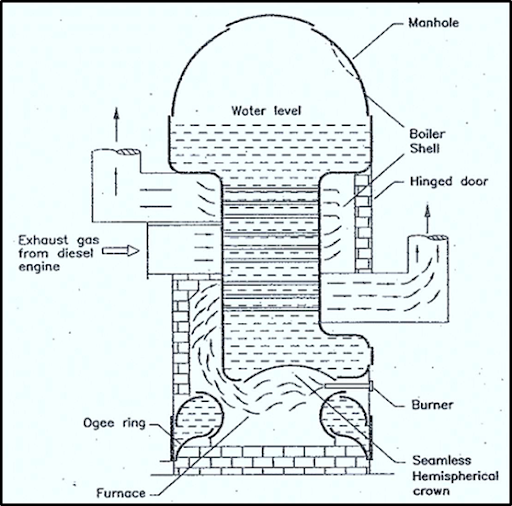
An exhaust gas boiler uses the heat contained in the exhaust gases from the main engine or another exhaust source to generate steam.
Large marine diesel engines release a considerable amount of heat with their exhaust gases. Instead of allowing all this heat to escape through the funnel, an exhaust gas boiler can recover part of it and use it to produce steam.
Advantages:

A composite boiler combines the functions of an exhaust gas boiler and a fired boiler in one arrangement.
When the main engine is operating, exhaust gas heat can be used to generate steam. If the main engine is stopped or operating at a low load, the oil fired burner can be used to produce the required steam.
Main advantages:
Composite boilers are particularly useful on ships because steam demand may continue even when the main engine is not operating.
Boilers are essential for meeting various steam requirements on ships. Their classification based on flow of gases and water, furnace position, water circulation and heat supply helps engineers understand their construction and operation. Selecting the appropriate boiler type ensures safe, reliable and efficient steam generation under different shipboard operating conditions.
They are fire tube boilers and water tube boilers.
In an internally fired boiler, the furnace is internal but in an externally fired boiler, the furnace is internal.
It is a boiler in which steam is naturally circulating due to its lower density than water without using a circulation pump.
An exhaust gas boiler is a boiler in which exhausts are used by exhausting the waste heat from the main engines. The exhaust heat is used to make the steam.
A composite boiler is a boiler in which there is a combination of an exhaust gas heating system and an oil fired system. Therefore steam can be produced by using the waste heat or the fuel.
Disclaimer :- The opinions expressed in this article belong solely to the author and may not necessarily reflect those of Merchant Navy Decoded. We cannot guarantee the accuracy of the information provided and disclaim any responsibility for it. Data and visuals used are sourced from publicly available information and may not be authenticated by any regulatory body. Reviews and comments appearing on our blogs represent the opinions of individuals and do not necessarily reflect the views of Merchant Navy Decoded. We are not responsible for any loss or damage resulting from reliance on these reviews or comments.
Reproduction, copying, sharing, or use of the article or images in any form is strictly prohibited without prior permission from both the author and Merchant Navy Decoded.
Decoded Discount Alert! up to 50% OFF
Use Coupon Code Deep50