Hi this is Team Merchant Navy Decoded !!!
Please fill the below form with your query and we will get back to you in next 12 hours.
Rest assured your data is safe with us !!!🙂
Ask Your Query| For Beginner | For Professional |
|---|---|
| GME | Engine Side |
| G.P. Rating | Deck Side |
| ETO | G.P. Rating |
| IMUCET & Sponsorship | Combo Offers |
| Free Course | MEO |
| Free Course |
| For Beginner | For Professional |
|---|---|
| GME | Engine Side |
| G.P. Rating | Deck Side |
| ETO | G.P. Rating |
| IMUCET & Sponsorship | Combo Offers |
| Free Course | MEO |
| Free Course |
One specific measurement that gets checked on every unit, every overhaul, without exception: tappet clearance.
It looks like a small thing. A tiny gap, measured in fractions of a millimetre, between two pieces of metal that aren’t even supposed to touch. But get it wrong in either direction, and the consequences range from noisy running to a burnt valve.
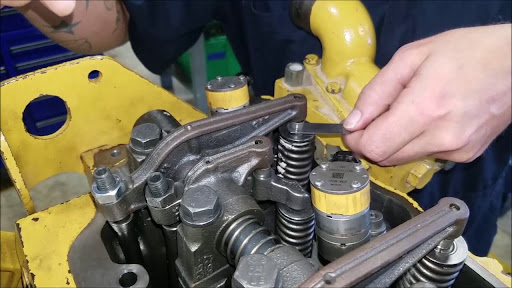
Tappet clearance, also called valve lash, is the small gap between the top of the valve stem and the rocker arm (or cam follower) when the valve is fully closed and the engine is cold.
There’s no permanent mechanical link between the valve and the rocker arm in a four-stroke engine. The rocker arm is pushed by the pushrod, which is pushed by the cam follower riding on the camshaft and that whole chain needs a deliberate gap somewhere in it, or the valve would never be able to fully close. That gap is the tappet clearance.
The core reason is thermal expansion.
Every part in that valve trains the valve stem, the pushrod, the rocker arm itself is metal, and metal grows as it heats up. An engine checked cold and set with zero clearance would, once running at full temperature, have those expanded parts holding the valve very slightly open all the time. A valve that never fully seats is a valve that burns, leaks compression, and lets combustion gas blow past exactly where it shouldn’t.
Tappet clearance is the deliberately built-in allowance for that expansion, so the valve can still close fully and seal properly once everything’s hot.
Get it wrong in either direction, and it shows up differently:
Clearance | What happens |
Too tight | Valve doesn’t fully seat once hot: Loss of compression,burnt valve seat,blow-by, reduced power |
Too loose | Valve opens late and closes early : Noisy operation,impact wear on the rocker gear,reduced Valve opening duration,poori scavenging or combustion |
Intake and exhaust valves usually get different clearance values too, not the same setting for both. The exhaust valve runs hotter and expands more, so it typically needs a larger clearance than the intake valve always confirm both values against the specific engine’s manual rather than assuming they match.
Before starting: the engine must be stopped and genuinely cold. Checking clearance on a warm engine gives a reading that won’t hold once the engine cools back down, defeating the entire point of the measurement.
Step by step:-
Most fuel pumps have a mark on the pump body or a sleeve marking showing the start of injection. Because injection happens close to TDC, this gives a usable reference though it’s worth knowing this is technically the injection TDC, not the exact mechanical TDC, and can sit a few degrees before true TDC depending on the engine’s injection timing design.
Open the cam case cover for that unit and look at the cam follower position. When the follower is sitting on the base circle of the cam the round, unlifted portion both valves for that cylinder are closed, which is exactly the condition needed to check tappet clearance.
Already covered above as part of the normal procedure, but it’s worth restating here specifically because it doesn’t depend on the flywheel at all. A pushrod that turns freely by hand confirms both valves are closed for that unit, independent of any external marking.
Near the very end of the exhaust stroke and the very start of the intake stroke, both valves are slightly open at once; this is called valve overlap. Rotating the engine until you can feel or see that overlap condition on a given cylinder gives you a reliable reference point: turning the engine one further full revolution from there brings that same cylinder to its actual firing (compression) TDC. This works entirely off valve movement, with no flywheel reference needed at all.
The most accurate method, and the one typically used to actually recalibrate a flywheel that’s suspected of being wrong, or after major repair work. A dial gauge is inserted into the cylinder through the indicator cock or with the injector removed, and the engine is turned slowly on turning gear. The gauge needle moves in one direction, stops, and reverses and the exact moment it stops and changes direction is true mechanical TDC. It’s slower than the other methods and not something done for routine checks, but it’s the one method that doesn’t rely on any external marking or a fuel system reference at all.
If TDC for one cylinder is confirmed by any of the methods above, and the engine’s firing order and the angular spacing between cylinders are known, the TDC position for every other cylinder can be calculated and marked temporarily from that single confirmed reference useful when working through an entire engine’s tappet clearances in one session rather than re-establishing TDC from scratch for every single unit.
Tappet clearance is a small measurement doing an important job: giving the valve train room to expand with heat without ever stopping the valve from fully closing when it matters. Taking it correctly means confirming genuine compression-stroke TDC not just glancing at a flywheel mark using whichever method actually fits the situation, checking the right clearance value for each valve, and rechecking the setting after the locknut goes back on. Whether the flywheel is clearly marked or not, there’s always a reliable way to find true TDC it just takes knowing which method to reach for.
It’s the small gap between the top of the valve stem and the rocker arm when the valve is fully closed and the engine is cold. It’s called valve lash because that gap is deliberate “slack” built into the valve train specifically to accommodate thermal expansion.
Because every part in the valve train expands as the engine heats up. With zero clearance, that expansion would hold the valve slightly open once the engine reached working temperature, preventing it from fully seating and leading to burnt valves and loss of compression.
The exhaust valve runs hotter than the intake valve and expands more as a result, so it typically needs a larger clearance to compensate. The exact values always come from the manufacturer’s manual rather than a general rule.
Check that the pushrod for that unit turns freely by hand; this confirms the cam follower is on the base circle of the cam and both valves are genuinely closed, meaning you’re at compression stroke TDC rather than exhaust stroke TDC or valve overlap.
Inserting a dial gauge into the cylinder through the indicator cock or injector hole and slowly turning the engine on turning gear. The exact point where the gauge needle stops and reverses direction is true mechanical TDCÂ this is also the method typically used to recalibrate a flywheel’s markings after major repair work.
Disclaimer :- The opinions expressed in this article belong solely to the author and may not necessarily reflect those of Merchant Navy Decoded. We cannot guarantee the accuracy of the information provided and disclaim any responsibility for it. Data and visuals used are sourced from publicly available information and may not be authenticated by any regulatory body. Reviews and comments appearing on our blogs represent the opinions of individuals and do not necessarily reflect the views of Merchant Navy Decoded. We are not responsible for any loss or damage resulting from reliance on these reviews or comments.
Reproduction, copying, sharing, or use of the article or images in any form is strictly prohibited without prior permission from both the author and Merchant Navy Decoded.
Decoded Discount Alert! up to 50% OFF
Use Coupon Code Deep50