Hi this is Team Merchant Navy Decoded !!!

Please fill the below form with your query and we will get back to you in next 12 hours.

Rest assured your data is safe with us !!!🙂

Ask Your Query

Sulzer RTA & RT-flex Engine Reversing

Modern ships equipped with Fixed Pitch Propellers (FPP) depend entirely on the main engine reversing system to move the vessel astern. Unlike ships fitted with Controllable Pitch Propellers (CPP), where the blade angle changes to reverse thrust, an FPP always produces thrust according to its direction of rotation. Therefore, to move the ship backward, the main engine itself must rotate in the opposite direction.

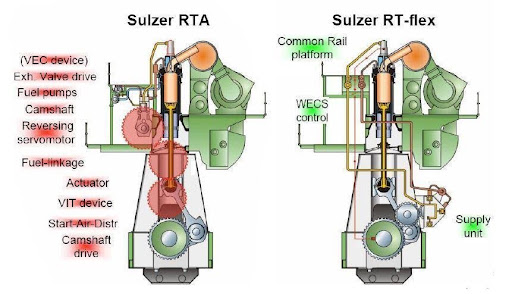
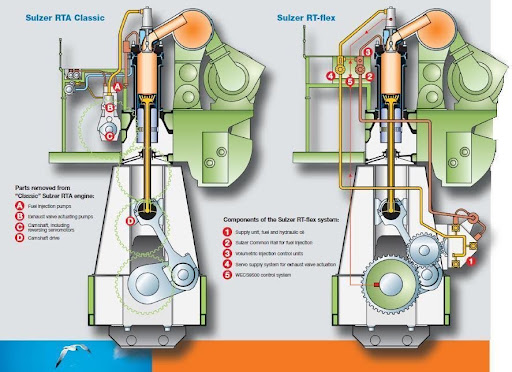
Among the most widely used low-speed two-stroke marine diesel engines are the Sulzer RTA and Sulzer RT-flex engine series. Although both engines perform the same task of reversing the crankshaft direction, their methods are entirely different.

The Sulzer RTA engine uses a hydraulic cam-sleeve mechanism to change fuel injection timing mechanically, whereas the Sulzer RT-flex engine employs an advanced electronically controlled common rail system that eliminates the need for mechanical camshaft movement.

In our blog, we’ll explore the complete working principle, reversing procedure, common failures, maintenance practices, and frequently asked questions related to Sulzer engine reversing.

What is Main Engine Reversing?

Main engine reversing is the process of changing the rotational direction of a marine diesel engine so that the propeller rotates in the opposite direction, producing astern thrust.

This operation is required during:

  • Berthing
  • Unberthing
  • Emergency stopping
  • Crash astern manoeuvres
  • Harbour navigation
  • Restricted water operations

Sulzer RTA Engine Reversing Working Principle

Sulzer RTA & RT-flex Engine Reversing

The Sulzer RTA engine is a mechanically controlled low-speed two-stroke diesel engine fitted with a camshaft.

Instead of moving the entire camshaft, Sulzer engineers designed a hydraulic cam-sleeve arrangement.

Each fuel pump cam is mounted on a rotatable sleeve around the camshaft.

When reversing is ordered:

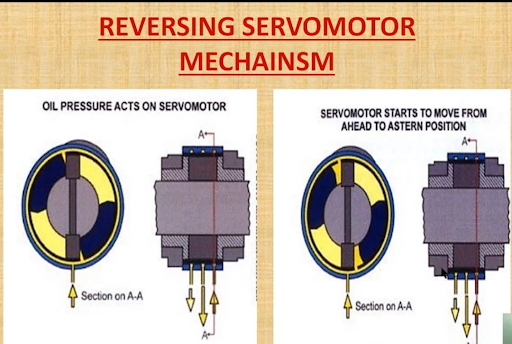
  • Hydraulic oil operates a reversing servomotor.
  • The servomotor rotates the cam sleeves through a predetermined angle.
  • This changes the fuel injection timing from ahead to astern.
  • The starting-air distributor simultaneously changes the firing order.
  • The engine can then start and run in the opposite direction.

An important feature of the Sulzer RTA design is that the exhaust valve cam is symmetrical about Bottom Dead Centre (BDC). Because of this symmetrical profile, it generally does not require repositioning during reversing, simplifying the mechanism compared with some other engine designs.

Table of Contents

Major Components of the Sulzer RTA Reversing System

Reversing servomoter mechainsm

The hydraulic reversing system consists of several important components:


  • Hydraulic reversing servomotor
  • Hydraulic oil supply system
  • Rotatable cam sleeves
  • Lost-motion mechanism
  • Fuel injection cams
  • Position sensors
  • Microswitches
  • Hydraulic control valves
  • Starting-air distributor
  • Engine control unit and interlocks

Each component must operate correctly for successful reversing.

Step-by-Step Sulzer RTA Engine Reversing Procedure

Step 1 – Receive Astern Command

The bridge telegraph sends an astern command to the engine control room.

The engineer on watch confirms the manoeuvring order and ensures that the propulsion system is ready.

Step 2 – Reduce Engine Load

Engine speed is gradually reduced while maintaining safe operating conditions.

Load is removed carefully to avoid thermal and mechanical stress.

Step 3 – Stop the Engine

The engine is brought to a complete stop.

The control system confirms:

  • 0 RPM
  • Engine stationary
  • Safe to reverse

No cam movement is permitted while the crankshaft is rotating.

Step 4 – Activate the Hydraulic Reversing System

Hydraulic oil is supplied to the reversing servomotor.

The servomotor rotates the cam sleeves through the required lost-motion angle.

Fuel injection timing changes from ahead timing to astern timing.

Step 5 – Verify Cam Sleeve Position

Position sensors and microswitches verify:

  • Ahead position released
  • Astern position achieved

Both mechanical and electrical confirmations must agree.

Step 6 – Reverse Starting-Air Distributor

The starting-air distributor changes the firing order.

Compressed air will now enter cylinders in the correct astern sequence.

Step 7 – Verify Safety Interlocks

Before fuel admission, the engine control system checks:

  • Hydraulic oil pressure
  • Lubricating oil pressure
  • Starting-air pressure
  • Cam sleeve position
  • Engine speed
  • Cylinder safety alarms
  • Overspeed protection

Any abnormality prevents engine starting.

Step 8 – Admit Starting Air

Starting air rotates the crankshaft in the astern direction.

As the engine reaches firing speed, fuel injection begins using the new timing.

Step 9 – Combustion Begins

The engine fires successfully in reverse rotation.

The governor gradually increases speed.

The vessel begins moving astern.

Sulzer RT-flex Engine Reversing Working Principle

Sulzer RT-flex Engine Reversing Working Principle

The Sulzer RT-flex engine represents the next generation of marine propulsion technology.

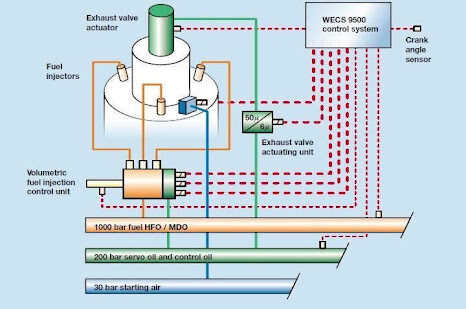
Unlike the RTA engine, RT-flex engines eliminate the mechanical camshaft completely.

Instead, they use:

  • Common rail fuel injection
  • Electronic Engine Control Unit (ECU)
  • Solenoid-operated actuators
  • Electronically controlled exhaust valves
  • Electronic starting-air control

When an astern command is received, the ECU automatically changes:

  • Fuel injection timing
  • Fuel injection quantity
  • Exhaust valve timing
  • Starting-air firing sequence

Since there are no mechanical cams to reposition, reversing becomes faster, smoother, and more precise.

Step-by-Step Sulzer RT-flex Engine Reversing Procedure

The RT-flex engine simplifies reversing considerably.

Sulzer RT-flex Engine Reversing Procedure

The sequence is:

  1. Bridge orders astern.
  2. Engine load reduces.
  3. Engine stops at 0 RPM.
  4. ECU selects astern operating mode.
  5. Fuel injection change electronically.
  6. Exhaust valve timing changes automatically.
  7. Starting-air valves receive new firing sequence.
  8. ECU checks all sensors.
  9. Starting air rotates engine astern.
  10. ECU injects fuel electronically.
  11. Engine accelerates smoothly in reverse.

No mechanical cam movement occurs.

Common Reversing Problems and Their Causes

Problem

Possible Cause

Recommended Action

Engine refuses to reverse

Cam sleeves not moving

Check hydraulic pressure and servomotor

No astern indication

Faulty microswitch

Inspect and calibrate position sensors

Starting air ineffective

Air distributor fault

Test distributor timing

Engine trips immediately

Safety interlock active

Identify and rectify alarm condition

RT-flex engine will not start astern

ECU fault

Run diagnostics and inspect sensors

Maintenance of Sulzer Reversing System

Hydraulic System

  • Monitor hydraulic oil cleanliness regularly.
  • Replace hydraulic oil filters as per maintenance schedule.
  • Check hydraulic system pressure before manoeuvring.
  • Inspect hydraulic hoses and pipelines for leaks or damage.
  • Repair any hydraulic oil leaks immediately.

Cam Sleeve Mechanism (Sulzer RTA)

  • Exercise the cam sleeves periodically to prevent sticking.
  • Lubricate all moving parts according to the manufacturer’s recommendations.
  • Inspect cam sleeve splines for wear or corrosion.
  • Verify smooth operation of the hydraulic servomotor.

Position Sensors and Microswitches

  • Calibrate position sensors at regular intervals.
  • Test microswitches for proper operation.
  • Inspect electrical wiring and connectors for damage or loose connections.
  • Replace faulty sensors immediately to avoid false interlocks.

Starting-Air System

  • Drain condensate and moisture from air receivers regularly.
  • Test starting-air valves for correct opening and closing.
  • Verify starting-air pressure before manoeuvring.
  • Inspect the starting-air distributor for proper timing and operation.

Frequently Asked Questions (FAQs)

The Sulzer RTA engine uses a hydraulic cam-sleeve mechanism to mechanically change fuel injection timing, whereas the RT-flex engine uses an electronic common rail system and ECU to control fuel injection, exhaust valve timing, and starting-air sequencing without moving mechanical cams.


Reversing while the crankshaft is still rotating can result in incorrect fuel injection timing and severe mechanical damage. Both mechanical and electronic control systems require the engine to be completely stationary before changing operating direction.

Hydraulic cam sleeves allow the fuel injection timing to shift between ahead and astern operation without moving the complete camshaft, providing a reliable and efficient reversing mechanism.


The most common causes include low hydraulic oil pressure, stuck cam sleeves, faulty position sensors, malfunctioning starting-air valves, hydraulic leaks, ECU faults (RT-flex), and active safety interlocks.

Engineers should maintain clean hydraulic oil, replace filters regularly, inspect and exercise cam sleeves, calibrate position sensors, test starting-air valves, verify hydraulic pressure, and perform routine ECU diagnostics on RT-flex engines to ensure dependable reversing performance.


Disclaimer :- The opinions expressed in this article belong solely to the author and may not necessarily reflect those of Merchant Navy Decoded. We cannot guarantee the accuracy of the information provided and disclaim any responsibility for it. Data and visuals used are sourced from publicly available information and may not be authenticated by any regulatory body. Reviews and comments appearing on our blogs represent the opinions of individuals and do not necessarily reflect the views of Merchant Navy Decoded. We are not responsible for any loss or damage resulting from reliance on these reviews or comments.

Reproduction, copying, sharing, or use of the article or images in any form is strictly prohibited without prior permission from both the author and Merchant Navy Decoded.

DIWALI SALE

Decoded Discount Alert! up to 50% OFF

DIWALI SALE

Decoded Discount Alert! up to 50% OFF

Use Coupon Code Deep50

Days
Hours
Seconds
0
Would love your thoughts, please comment.x
()
x