Hi this is Team Merchant Navy Decoded !!!

Please fill the below form with your query and we will get back to you in next 12 hours.

Rest assured your data is safe with us !!!🙂

Ask Your Query

Smoke Sensors Onboard

Smoke Sensors Onboard

With smoke detection, timing  is everything. A pressure transducer that reports a bit late is an annoyance. A smoke sensor that reports late can be the difference between a small smouldering fault and a fire the crew can no longer handle on their own. So these sensors aren’t there to confirm a fire everybody can already see. They’re there to catch the first signs of one, before there’s flame, before there’s heat, and often before there’s smoke you could spot by eye.

“Smoke detector” is also a loose label. It covers several different ways of detecting a fire, and each suits a different stage of a fire and a different kind of space. That’s why a ship doesn’t just use one type everywhere. No single method catches every kind of fire equally well.

What a Fire Actually Gives Off

It helps to be clear about what the detector is looking for, because it changes as the fire develops. Very early on, usually while something is smouldering or overheating, a fire gives off tiny particles you can’t see. As it goes on, those particles get bigger and turn into visible smoke. Flame and serious heat come last. Different detectors are tuned to different points along that line.

Ionization Smoke Detectors

Ionization Smoke Detectors

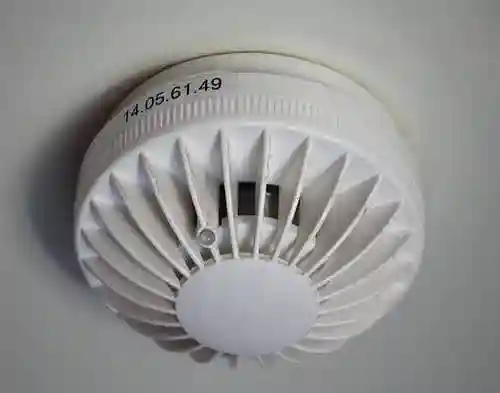
Inside an ionization detector there’s a small chamber with a tiny radioactive source in it. The source charges up the air in the chamber, so a weak electric current flows steadily across a gap. That steady current is the normal, “all clear” condition.

When combustion particles drift in, they stick to the charged air molecules and the current drops. The detector sees the drop and sets off the alarm. Even very fine particles, the ones you’d never see, are enough to do this.

That’s the strength of an ionization detector. It’s good at picking up fast, flaming fires early, before much visible smoke has formed. The weakness is the opposite kind of fire. A slow, smouldering one gives off bigger, thicker particles, and an ionization chamber isn’t as quick to react to those. These detectors can also be set off by cooking fumes and other fine airborne particles, so they’re a poor fit for spaces where that’s likely to happen.

Photoelectric (Optical) Smoke Detectors

A photoelectric detector uses light instead. There’s a light source and a light-sensitive receiver inside a chamber, and in clean air the beam doesn’t reach the receiver directly. Two designs are common.

In the scattering type, smoke entering the chamber bounces some of the light toward the receiver, and that sudden bit of extra light triggers the alarm. In the obscuration type it works the other way round. The receiver normally sees the beam, and smoke passing through blocks part of it. The receiver sees a drop in light and the alarm goes off.

Either way, the detector is reacting to visible smoke, which is why photoelectric types are good with slow, smouldering fires that make lots of smoke well before there’s any real flame or heat. They’re a good partner to ionization detectors, and that’s a big reason ships carry both. They also trip less often from very fine particles, though heavy dust or steam can still set them off.

Table of Contents

Beam-Type (Projected Beam) Smoke Detectors

A point detector watches one spot. A beam detector watches a whole line across a space. A transmitter sends a light beam across the compartment to a receiver or a reflector, and if smoke crosses the beam anywhere along the way, the signal weakens. When it weakens past a set level, the alarm goes off.

This is the practical choice for big open spaces like large cargo holds or machinery spaces. Covering those with enough point detectors would be a lot of hardware, and smoke spreading through a big volume may never get thick enough at any single point to trigger one quickly. It will cross a beam that spans the whole space.

The trade-off is location. A beam detector tells you there’s smoke somewhere along its path, not exactly where. That isn’t a flaw. It’s just a different question from the one a point detector answers.

Aspirating Smoke Detection

Aspirating Smoke Detection

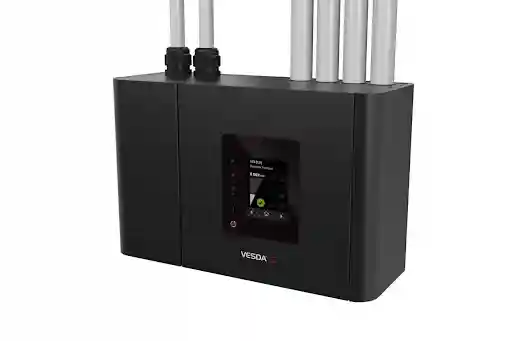
Most detectors wait for smoke to come to them. An aspirating system goes and fetches it. A network of small pipes pulls air from the protected space back to a central unit, which has a very sensitive optical or laser-based chamber for analysis.

Because it’s actively sampling, it can pick up combustion particles at concentrations far lower than a normal point or beam detector would register, and one central unit can watch several sampling points. That makes it a good fit for machinery spaces, control rooms and other places where an early warning is worth far more than the cost of the odd false alarm. A few minutes of extra warning can be the difference between a small fault and a developing fire.

The price is complexity. The pipework has to be designed and looked after properly. If a sampling pipe gets blocked or damaged, coverage can quietly get worse long before anything shows up as a fault.

Alarm Panel and Zoning

Alarm Panel and Zoning

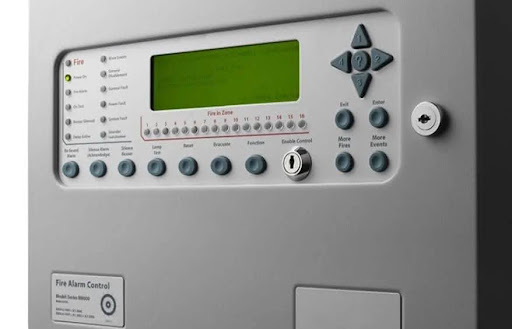
All of these detectors report to a central fire alarm panel. That panel is what turns a single detector’s signal into something the crew can act on: an audible and visual alarm, an indication of which zone the detector is in, and in many systems a log of the event.

Zoning matters more than it looks. Detectors are grouped by compartment or area so the alarm doesn’t just say “fire somewhere.” It points the crew to a small area to search, and in the first few minutes of a fire every minute spent searching is a minute lost.

The panel also keeps an eye on the detector circuits themselves, checking for open or short circuits. If a detector fails or gets disconnected, the panel shows a fault. Otherwise you could have a hole in your coverage and not find out until the day you needed it.

Testing, Maintenance and Nuisance Alarms

A detector nobody has tested is one nobody can vouch for. That’s why detectors are tested at regular intervals with an approved test aerosol or a test unit suited to that detector’s type. The test shouldn’t only prove the sensor responds. It should prove the whole chain works, from detector to panel to alarm. A detector that senses perfectly but feeds a faulty circuit is no better than one that doesn’t sense at all.

Nuisance alarms are the other side of it. A detector that keeps false alarms in a particular space is more than an irritation. People start to ignore it, and that’s the last thing you want from a fire alarm. So detector types are chosen to suit the space. A galley, an engine room and an open cargo hold all need different thinking, and you shouldn’t just fit whatever happens to be in the store.

Conclusion

Looked at together, these detectors work as a team. Ionization detectors are tuned for the fine particles from a fast, flaming fire. Photoelectric detectors are tuned for the thicker, visible smoke from a slow, smouldering one. Beam detectors give up pinpoint location to cover big open spaces. Aspirating systems accept extra complexity in return for very early warning where it counts. None of it works without a panel that turns signals into zoned alarms, and regular testing that proves the whole system still works. Once you know what each detector is built to catch, the way they’re spread around a ship starts to make sense.

Frequently Asked Questions (FAQs)

Ionization detectors react best to the fine particles from fast, flaming fires. Photoelectric detectors react best to the thicker smoke from slow, smouldering ones. Using both covers more types of fire.

In large open spaces such as big cargo holds or machinery spaces. Smoke may never get thick enough at one point to trip a point detector quickly, but it will still cross a beam that covers the whole space.

It actively draws air through a pipe network to a sensitive central unit instead of waiting for smoke to reach a fixed detector, so it can sense particles at much lower concentrations.


So a failed or disconnected detector shows up as a fault. Without that check, there could be a gap in coverage that nobody notices until it matters.

Frequent false alarms make people trust the system less, which can slow the response when a real alarm sounds.

Disclaimer :- The opinions expressed in this article belong solely to the author and may not necessarily reflect those of Merchant Navy Decoded. We cannot guarantee the accuracy of the information provided and disclaim any responsibility for it. Data and visuals used are sourced from publicly available information and may not be authenticated by any regulatory body. Reviews and comments appearing on our blogs represent the opinions of individuals and do not necessarily reflect the views of Merchant Navy Decoded. We are not responsible for any loss or damage resulting from reliance on these reviews or comments.

Reproduction, copying, sharing, or use of the article or images in any form is strictly prohibited without prior permission from both the author and Merchant Navy Decoded.

DIWALI SALE

Decoded Discount Alert! up to 50% OFF

DIWALI SALE

Decoded Discount Alert! up to 50% OFF

Use Coupon Code Deep50

Days
Hours
Seconds
0
Would love your thoughts, please comment.x
()
x