Hi this is Team Merchant Navy Decoded !!!

Please fill the below form with your query and we will get back to you in next 12 hours.

Rest assured your data is safe with us !!!🙂

Ask Your Query

Ship Automation Systems: Boiler Water Level Control, Autopilot and Beyond

Ship Automation Systems

A system quietly corrects itself before any human notices anything wrong. A generator’s voltage dips for a fraction of a second and recovers before the lights even flicker. A ship’s head drifts half a degree off course and the rudder eases back before the officer of the watch has finished their cup of coffee. That’s automation doing exactly what it’s meant to, not replacing judgment, but handling the constant, fast, repetitive correction that no human watch could sustain hour after hour.

Ship Automation Systems

Ship automation isn’t one system  it’s a collection of purpose-built control loops scattered across the vessel, each solving a specific problem: keeping a boiler’s water level correct despite steam demand that changes by the second, keeping a ship’s heading steady despite wind and sea state that never stop pushing it off course, starting a standby generator before a blackout actually happens. Two of these  boiler water level control and autopilot  are worth understanding in real depth, because between them they illustrate almost everything else in shipboard automation.

What Makes a System "Automated" Rather Than Just Instrumented

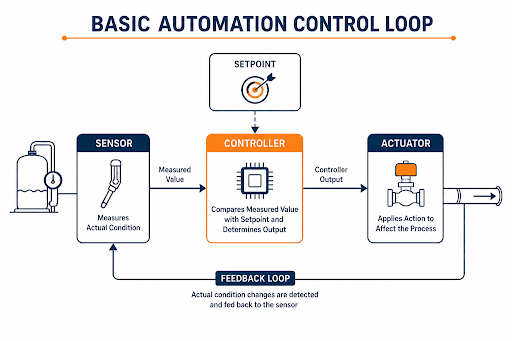
A gauge that shows you a reading is instrumentation. Automation is what happens when that reading feeds into a controller that compares it against a setpoint and takes corrective action on its own : Opening a valve, adjusting a rudder, starting a pump without waiting for a person to interpret the number and respond. Most shipboard automation follows the same basic loop: a sensor measures the actual condition, a controller compares it to the desired setpoint, and an actuator makes the correction, continuously, faster and more consistently than manual control could sustain.

Basic automation control loop

Quick pointer: Whenever you’re trying to understand an unfamiliar automated system on board, look for these three pieces first – What’s being measured, What it’s being compared against, and What physically moves in response. Nearly every automation system on a ship reduces to that same structure once you strip away the specific hardware.

Boiler Water Level Control: Single, Two, and Three Element Systems

Boiler water level looks like it should be simple to control : Measure the level, add water when it’s low  but marine boilers complicate this with two phenomena that make a naive control approach actively dangerous: Swell and Shrinkage.

When steam demand suddenly increases, boiler pressure drops. That drop causes steam bubbles already in the water to expand, and the measured level can rise even though the actual mass of water hasn’t increased, that’s swell. A simple level-only controller reads this as “level too high” and cuts back feed water, which is exactly the wrong response to rising steam demand. 

When demand falls back to normal, pressure recovers, the bubbles collapse, and the level drops suddenly  shrinkage  right as incoming feed water is colder and further discourages bubble formation, compounding the drop. A controller that only watches level can end up feeding water in exactly the wrong direction at exactly the wrong moment, right when accurate control matters most.

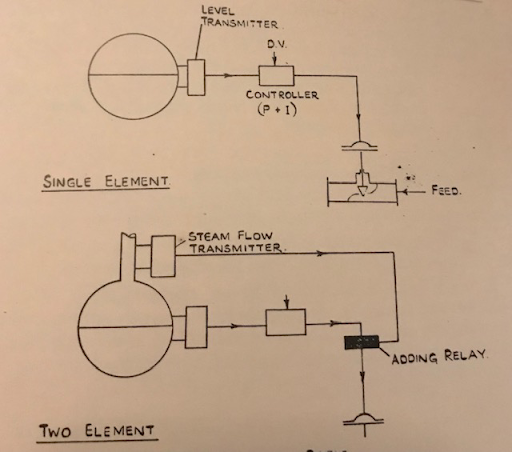
Single element control uses only the water level signal – Proportional-plus-integral control comparing measured level against setpoint. It’s the simplest arrangement and works acceptably on smaller boilers with steady, low steam demand, but it’s vulnerable to exactly the swell and shrinkage problem above.

Two element control adds a second signal: Steam flow. By measuring how much steam is actually leaving the boiler, the controller can anticipate feed water demand from load changes directly, rather than waiting for the (potentially misleading) level signal to catch up. This gives a genuinely faster, more accurate response to load changes than level alone.

Boiler Water Level Control

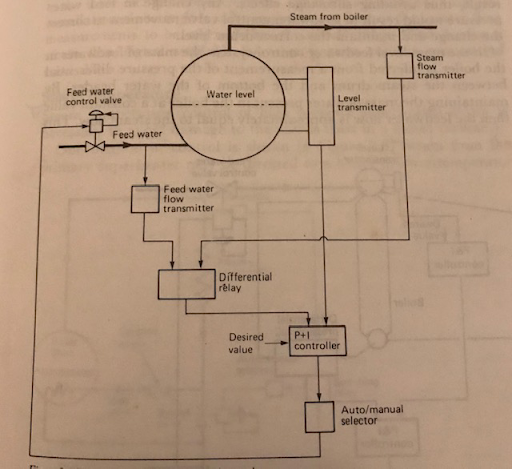
Three element control adds a third signal: Feed water flow itself. This closes the loop completely; the controller now knows the measured level, how much steam is leaving, and how much water is actually entering, and can correct for feed water pressure variations that would otherwise throw off the two-element system’s accuracy. Because it uses steam flow to anticipate demand before the level signal reflects it, three-element control is often described as feedforward control, and it’s the standard on marine boilers precisely because these vessels produce large volumes of high-pressure steam from a comparatively small water volume conditions where swell and shrinkage effects are pronounced and fast-moving.

Three element control

Quick pointer: Most well-designed marine boiler controllers don’t just pick one mode and stay there; many fall back automatically from three-element to two-element if the feed water flow signal fails, and further down to single-element if steam flow measurement is lost too. Knowing which mode your boiler is actually operating in after an instrument fault matters, because control behaviour genuinely changes between them.

Table of Contents

Autopilot: Keeping the Ship on Course Without a Hand on the Wheel

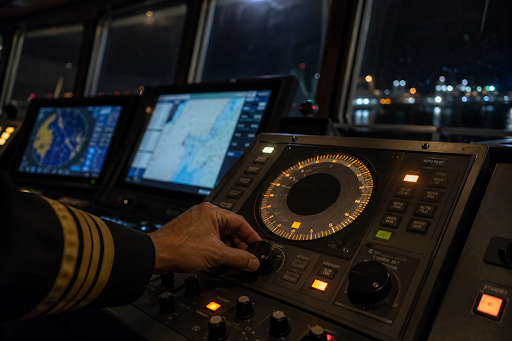
Autopilot

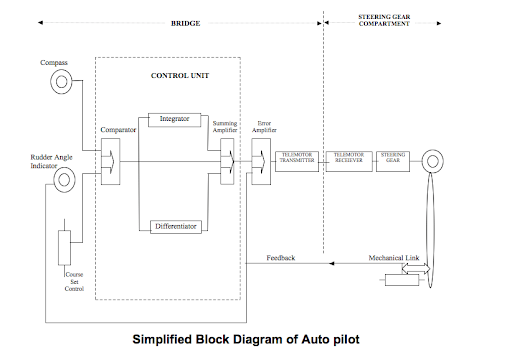
Simplified block diagram

An autopilot solves a conceptually similar problem to boiler water level control comparing a measured value against a setpoint and correcting continuously  but applied to the ship’s heading instead of a water level, using the rudder instead of a feed valve.

The core loop works like this: A heading sensor, almost always a gyrocompass for its stability and accuracy (with a magnetic compass as fallback), continuously reports the ship’s actual heading. The control unit compares this against the set course, calculates the heading error and determines the rudder angle needed to correct it. That command goes to the drive unit  hydraulic for larger vessels, electric motor-driven on smaller ones which physically moves the rudder. A rudder position feedback signal closes the loop, letting the controller know the actual rudder angle achieved rather than just assuming its command was carried out.

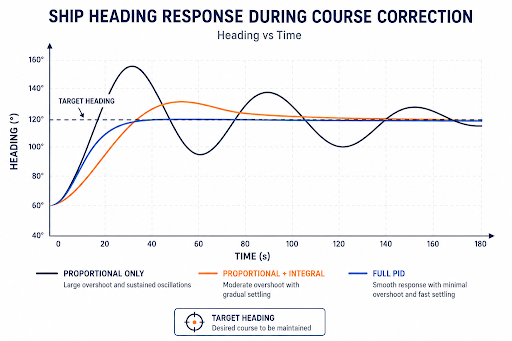
PID control sits at the heart of most modern autopilots  Proportional, Integral and Derivative terms working together to translate heading error into a rudder response that’s both responsive and stable:

  • The proportional term applies rudder correction in proportion to how far off course the ship currently is.
  • The integral term corrects for persistent small errors that a purely proportional response would leave uncorrected, such as a steady set from current or wind.
  • The derivative term anticipates and dampens the rate of change, preventing the kind of overcorrection that would otherwise have the ship’s head swinging back and forth across the desired course.

ship heading response during course correction

Adaptive autopilots go a step further, automatically adjusting their own gain (essentially, how aggressively they respond to a given heading error) based on changing ship speed and sea conditions, rather than requiring an officer to manually retune the response every time conditions change significantly.

Track control, available on more capable systems, moves beyond simply holding a heading; it follows a pre-programmed route across multiple waypoints, correcting not just heading but cross-track deviation from the planned line, effectively steering the passage plan itself rather than a single compass course.

Quick pointer: Autopilot is a heading-keeping and, on capable systems, track-following aid  it is not collision avoidance and it does not interpret traffic. Watchkeeping obligations don’t relax just because the autopilot is engaged; if anything, the officer’s attention is freed up specifically so it can go toward the things the autopilot can’t do, not toward disengaging from the situation.

Other Automation Systems Worth Knowing

Boiler water level and autopilot are two clear examples of the same underlying idea, but shipboard automation extends well beyond them:

  • Unmanned Machinery Space (UMS) systems : The broader framework that allows an engine room to run without continuous manual watchkeeping, built on alarm monitoring, automatic standby equipment start, and remote control capability, all backed by classification society notation requirements.
  • Alarm and monitoring systems:- Continuously scan machinery parameters across the vessel and alert the duty engineer or officer to any reading outside normal range, forming the safety backbone that makes reduced manning arrangements viable in the first place.
  • Automatic standby generator start:- 

Detects an impending overload or an unexpected trip of the running generator and starts, synchronises, and loads a standby unit automatically, preventing a blackout that would otherwise follow a single generator failure.

  • Auto-synchronising equipment:-  Matches a generator’s voltage, frequency, and phase to the running busbar before closing it onto load, a task that demands precision and speed a manual operator would struggle to match consistently.
  • Remote control of the main engine : Allows the bridge (or, in UMS operation, the engine control room) to control engine speed and direction directly, incorporating the same interlock logic covered in the manoeuvring diagram, without requiring a manual engine room throttle response to every telegraph order.
  • Automatic Voltage Regulators (AVRs) : Continuously adjust generator excitation to hold output voltage steady despite changing electrical load, the electrical equivalent of the same setpoint-correction loop running throughout this entire topic.

Safety Considerations Across Automated Systems

  • Automation reduces routine workload, not responsibility. Every system covered here still depends on a human recognising when its behaviour looks wrong, and intervening , an automated system running quietly and incorrectly for hours is a genuinely worse outcome than an obvious failure that gets noticed immediately.
  • the fallback behaviour of every automated system you rely on. Boiler water level control degrading from three-element to single-element, or an autopilot losing its primary gyrocompass input, changes how the system will behave; that’s worth understanding before it happens, not while it’s happening.
  • Alarm systems require genuine attention, not habituation. A monitoring system that generates frequent nuisance alarms trains watchkeepers to dismiss alerts quickly, which is exactly the wrong habit for the one alarm that matters.
  • Manual override capability must stay genuinely functional. Every automated system on board exists alongside a manual fallback for a reason, and that fallback is only useful if it’s tested and familiar rather than theoretical.

Maintenance and Testing

  • Test boiler water level control changeover between element modes periodically, confirming the system actually falls back correctly rather than assuming the manufacturer’s design behaves as documented.
  • Verify autopilot performance against manual steering periodically, and confirm gyrocompass and magnetic compass agree within expected tolerance, since heading accuracy is only as good as the sensor feeding it.
  • Test automatic standby generator start and auto-synchronising equipment on a routine schedule  this is a system whose failure is invisible until the exact moment it’s needed most.
  • Keep alarm system setpoints reviewed and current, adjusting for any equipment changes rather than leaving thresholds set for machinery configurations that no longer reflect the vessel’s actual condition.
  • Confirm UMS-related systems meet classification society periodic testing requirements, since UMS notation itself depends on demonstrated, ongoing reliability rather than a one-time certification.

Conclusion

Boiler water level control and autopilot look like completely different systems solving completely different problems, but they’re built from the same idea: Measure the real condition, compare it to where it should be and correct continuously, faster and more consistently than a person watching a single gauge or wheel ever could. The same structure runs through generator auto-start, voltage regulation, and remote engine control. Understanding one automated loop in real depth  as this post has tried to do with boiler water level control and autopilot specifically  makes every other automated system on the ship considerably easier to read, because the underlying pattern rarely changes even when the hardware does.

Frequently Asked Questions (FAQs)


Two-element control uses water level and steam flow, allowing the controller to anticipate feed water demand from load changes rather than waiting for the level signal alone. Three-element control adds feed water flow as a third input, correcting for feed water pressure variations as well, and is the standard on marine boilers because of how pronounced swell and shrinkage effects are in high-pressure, relatively low water volume marine boiler drums.


Swell is a temporary rise in measured water level caused by expanding steam bubbles when boiler pressure drops during a sudden increase in steam demand. Shrinkage is the opposite effect when demand falls and pressure recovers. Both can mislead a simple level-only control system into responding in the wrong direction at exactly the moment accurate control matters most.

A gyrocompass, valued for its stability and accuracy, with a magnetic compass typically available as a fallback if the gyrocompass fails, since redundancy in heading input is a core safety principle in marine navigation systems.

The proportional term applies rudder correction based on how far off course the ship currently is, the integral term corrects for persistent small errors a proportional response alone would leave uncorrected, and the derivative term dampens the rate of correction to prevent the ship’s head from overcorrecting and swinging back and forth across the desired course.

No  autopilot is a heading-keeping and, on more capable systems, track-following aid, not a collision avoidance or decision-making system. Watchkeeping duties, including regular position verification and monitoring the vessel’s actual track and heading, remain fully in effect while the autopilot is engaged.

Disclaimer :- The opinions expressed in this article belong solely to the author and may not necessarily reflect those of Merchant Navy Decoded. We cannot guarantee the accuracy of the information provided and disclaim any responsibility for it. Data and visuals used are sourced from publicly available information and may not be authenticated by any regulatory body. Reviews and comments appearing on our blogs represent the opinions of individuals and do not necessarily reflect the views of Merchant Navy Decoded. We are not responsible for any loss or damage resulting from reliance on these reviews or comments.

Reproduction, copying, sharing, or use of the article or images in any form is strictly prohibited without prior permission from both the author and Merchant Navy Decoded.

DIWALI SALE

Decoded Discount Alert! up to 50% OFF

DIWALI SALE

Decoded Discount Alert! up to 50% OFF

Use Coupon Code Deep50

Days
Hours
Seconds
0
Would love your thoughts, please comment.x
()
x