Hi this is Team Merchant Navy Decoded !!!

Please fill the below form with your query and we will get back to you in next 12 hours.

Rest assured your data is safe with us !!!🙂

Ask Your Query

MERCHANT NAVY FOR PCB STUDENTS

MERCHANT NAVY FOR PCB STUDENTS

However, even if you took up PCB (Physics, Chemistry, and Biology) in Class 11 and 12, it doesn’t necessarily mean that you have to forsake your career ambitions in the maritime world altogether. If you are fond of ships, seas, and the international nature of the industry, there are some ways to go about achieving your goal.

However, before you start sending out your applications, I would like to tell you one thing, which you should definitely be aware of. The vast majority of direct entry programs for getting a job as a deck officer or a marine engineer in the Merchant Navy require Physics, Chemistry, and Mathematics (PCM). Normally, if you have biology instead of mathematics, you will be ineligible for these programs after Class 12.

Nevertheless, this doesn’t mean that you have no way out. There are some training programs at the rating level to consider, or you might want to take a different path in your career.

Can PCB Students Join the Merchant Navy After Class 12?

Yes, PCB students have some access to different entry points within the maritime sector, but they are not eligible for all Merchant Navy courses.

To begin with, it is necessary to learn the distinction between a deck officer, marine engineer, rating, and a maritime professional on the shoreside.

Here is a general overview:

Course or career route

Can a PCB student apply directly after Class 12?

B.Sc. Nautical Science

Generally no; mathematics is required.

Diploma in Nautical Science (DNS)

Generally no; mathematics is required.

B.Tech/B.E. Marine Engineering

Generally no; PCM is required

Electro-Technical Officer (ETO)

Not through the standard direct Class 12 PCB route

GP Rating

May be possible based on Class 10 qualifications and the applicable admission rules

Shore-based shipping careers

Depends on the specific course and job requirements

The GP Rating route deserves particular attention. Some approved pre-sea rating courses have entry requirements based on Class 10 qualifications, including science and mathematics. A student who passed PCB in Class 12 can, therefore, pursue this path if he/she fulfills the necessary criteria.

However, your admission does not depend only on the fact that you have studied math in Class 10. Your age, marks, English language skills, physical fitness, and present criteria for admission in the training institute are also significant factors.

Before depositing admission charges, make sure of the current criteria for admission in the required course and training institute.

Students preparing to join the merchant navy after the 10th or 12th without PCM can explore SMVDM’s Academy preparation resources. Students Apply now with SMVDM to begin your preparation with the right guidance and study resources. 

Why Are PCM Subjects Required for Most Merchant Navy Courses?

You might wonder why mathematics is necessary when physics and chemistry are already part of the PCB curriculum. This is because each of these professionals has certain responsibilities to fulfill aboard ships.

Deck officers perform tasks such as navigation, ship handling, cargo handling, and ensuring safety on the ship. They study subjects like navigation calculations, distance calculations, speed calculations, time calculations, positioning, etc.

Marine engineers work on engines, machinery, electrical systems, and auxiliary equipment on the ship. They study technical subjects like engineering mathematics, mechanics, thermodynamics, and others.

All these subjects of study stem from mathematics. This is why PCM is one of the criteria of eligibility for courses such as B.Sc. Nautical Science, DNS, and Marine Engineering. There are plenty of subjects of study that can help one in science and medicine, biology being one of them. However, for the mentioned criteria, biology cannot replace mathematics.

If you are in Class 10 and know that you want to be a deck officer or a marine engineer in the future, then choosing PCM in Class 11 is a must. If you have already done Class 12 with PCB, don’t think that all the maritime opportunities are closed. Instead, apply only for those positions you truly are qualified to fill.

Table of Contents

Can PCB Students Join B.Sc. Nautical Science or DNS?

This is one of the most asked questions by students who want to join the Merchant Navy after 12th. As per standard eligibility criteria, PCB alone is not sufficient for direct admission to B.Sc. Nautical Science or DNS.

B.Sc. Nautical Science

B.Sc. Nautical Science is an undergraduate course of three years that trains students to work in the deck department.

The Indian Maritime University’s 2026–27 prospectus lists the following major academic requirement.

  • A minimum average of 60% in physics, chemistry, and mathematics.
  • At least 50% marks in English in Class 10 or Class 12.
  • A valid IMU-CET rank.
  • Compliance with the applicable age, medical, and other admission conditions.

The prospectus also outlines some relaxations for eligible SC/ST applicants. It is advisable to read the entire admission guidelines before making an application. PCB students lack Class 12 Mathematics; therefore, they cannot satisfy the PCM requirement.

Diploma in Nautical Science (DNS)

A second way into the deck department is DNS. It also offers pre-sea training and is a route to professional qualification for deck officers.

The common IMU qualification criteria are:

  • Physics, Chemistry, and Mathematics for Class 12
  • 60% in math, physics, and chemistry (min.
  • As per published course requirements, English must be at least 50% in class 12.

Compliance with the appropriate entrance examination, sponsorship, and other requirements of admission.

Attention: Do not confuse the requirements for the two courses’ English language proficiency. The specific requirement may vary from one course to another.

What About Marine Engineering and the ETO Course?

Students who are interested in machinery, electrical systems, and technical work often ask about marine engineering and the electro-technical officer route. These courses have specific academic requirements as well.

Marine Engineering

Marine engineering is concerned with the machinery and technical systems that enable ships to run. Topics include thermodynamics, fluid mechanics, electrical systems, and marine machinery. A four-year course in marine engineering calls for a 12th pass in physics, chemistry, and mathematics. Therefore, a student of PCB does not get direct admission into this course after 12th through the regular admission process.

Electro-Technical Officer (ETO)

The normal route of ETO training requires a relevant electrical or electronics engineering qualification subject to the applicable DGS requirements. This is not a direct entry course for Class 12 PCB. A PCB student interested in electrical systems would need to first investigate an eligible educational path. Do not take a course in something unrelated with the idea that it will automatically qualify you for ETO training.

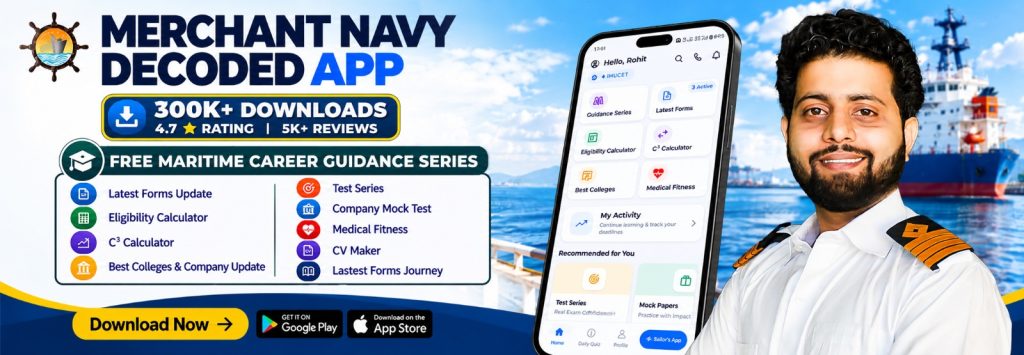
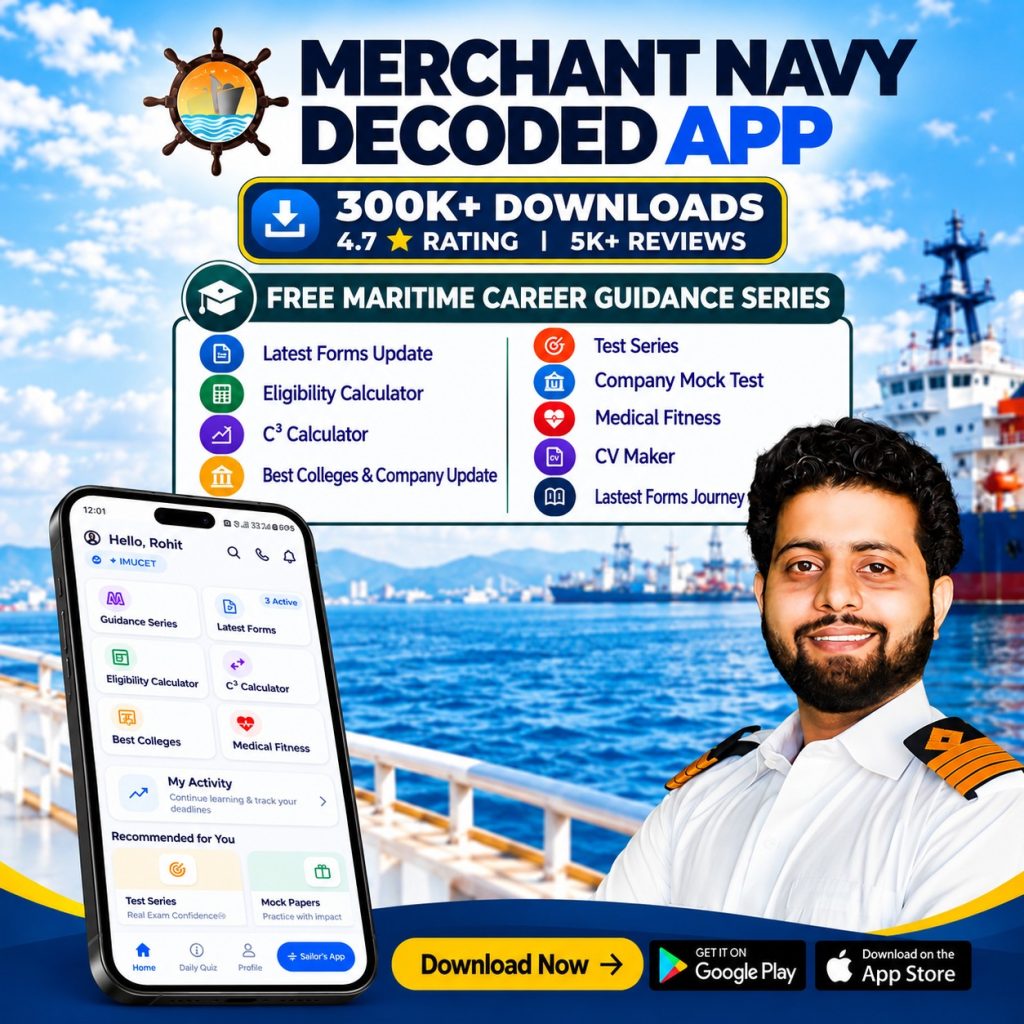
Merchant Navy Decoded App for Aspirants

For students preparing for the Merchant Navy, keeping track of courses, colleges, entrance exams, and application forms can become confusing. The  Merchant Navy Decoded app is designed to bring several of these resources together in one place.

Other Maritime Careers PCB Students Can Consider

The Merchant Navy is one component of the larger maritime sector. In the shipping companies, there are employees who are engaged in commercial operations, logistics, documentation, safety, administration, and other shore-based functions. There are some of these professions that could potentially be suitable for the PCB students, based on the qualifications required for the job.

Shipping and logistics

The shipping and logistics industry is responsible for the transportation, documentation, shipment, and other related processes in logistics. The programs can be found at the undergraduate level, like logistics, supply chain management, business management, or shipping management. Requirements depend on the university.

Port and cargo operations

It is also necessary to have specialists who will be capable of coordinating the activities related to the cargo, documentation, scheduling, and other elements of the port operations. Some of the job roles may be demanding certain educational qualifications or experience, while others can fit candidates from a wide range of fields.

Maritime administration and commercial operations

Apart from that, there are also departments in the offices of the shipping companies that deal with customer service, commercial documents, procurement, claims, and other activities. There are degree programs that will help PCB students develop their communication, analytical, computer, and business skills.

How PCB Students Should Plan Their Next Steps

It would be best if you were able to determine the type of maritime career that you wish to pursue before taking your course.

If you want to have your career on board ships, the first step that should be taken will be to ensure that you are eligible to undertake a rating-level course. In case you want to be a deck officer or a marine engineer, the mathematics requirement needs to be known to you.

Here is a practical checklist:

  1. See your marks for Class 10. Your past marks in mathematics and sciences may have an impact on some rating-level courses.
  2. Set your target position. Rating, deck officer, marine engineer, and shore-based shipping careers have different routes to take.
  3. Know the present-day eligibility requirements. It is recommended to get the necessary information from the IMU and DGS websites instead of just relying on social media.
  4. Check the course approval. Get to know whether the course and the training institution are approved.
  5. Get acquainted with all the costs involved. Know the costs of tuition, accommodation, uniforms, medical examination, and other costs.
  6. Study the opportunities of recruitment well. In case the course guarantees employment or sponsorship, get the information in writing.
  7. Do medical checks in advance. This will help you to save yourself from wasting money where you do not qualify for a seagoing job.

Frequently Asked Questions (FAQs)

A PCB student may be able to register for an examination where permitted, but appearing for IMU-CET does not make them eligible for every course. Admission eligibility is assessed separately for each program, and the standard B.Sc. Nautical Science and DNS routes require PCM.

No, it is not possible, as no private institution can overlook the necessary eligibility requirements for the approved course. It is recommended that one checks the approval and the entry requirements for the course before making any payments.

It will depend on the mode of entry being used, as some programs have varied academic requirements, while other specific marks are required in specific subjects.

It will depend on the job being offered, the necessary qualifications and certificates, physical condition, and other regulatory requirements.

No, but it should not be taken for granted as a direct or indirect route. It is recommended that one ask IMU whether a certain qualification can meet the entry requirements.

Maybe, yes. The cruise ships hire people in various categories, like hospitality, food service, guest relations, entertainment, the technical department, and others. Different positions have different qualifications and different methods of recruitment, and not all the positions on the cruise ships are those of Merchant Navy officers.

No. First select the course that you qualify for or can qualify for to get admission to, and then select your coaching or entrance examination preparation based on the criteria of that course.

Disclaimer :- The opinions expressed in this article belong solely to the author and may not necessarily reflect those of Merchant Navy Decoded. We cannot guarantee the accuracy of the information provided and disclaim any responsibility for it. Data and visuals used are sourced from publicly available information and may not be authenticated by any regulatory body. Reviews and comments appearing on our blogs represent the opinions of individuals and do not necessarily reflect the views of Merchant Navy Decoded. We are not responsible for any loss or damage resulting from reliance on these reviews or comments.

Reproduction, copying, sharing, or use of the article or images in any form is strictly prohibited without prior permission from both the author and Merchant Navy Decoded.

DIWALI SALE

Decoded Discount Alert! up to 50% OFF

DIWALI SALE

Decoded Discount Alert! up to 50% OFF

Use Coupon Code Deep50

Days
Hours
Seconds
0
Would love your thoughts, please comment.x
()
x