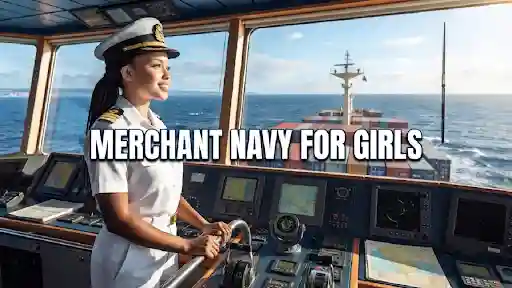
Merchant Navy presents a career option for girls that wish to work at sea, explore various parts of the world, and build their career in the field of shipping. It allows a number of opportunities in the fields of navigation, marine engineering, ship management, and also a number of land-based jobs within the maritime industry.
However, this career choice raises a number of queries among students. Can a girl join the Merchant Navy after the 12th class? What are the subjects to be chosen? Any particular eligibility criterion? Do you need sponsorship? What about the women who serve on ships?
The answer is girls can build their careers in the Merchant Navy and serve as deck officers, marine engineers, and other qualified maritime professionals. All they need is to choose the correct course and understand the medical requirement and recruitment process.
Can Girls Join the Merchant Navy?
Yes, girls can join the Merchant Navy in India. Women can get trained for professional roles in merchant vessels and work in different parts of the maritime sector. Women can get trained for professional roles in merchant vessels and work in different parts of the maritime sector.
The Directorate General of Shipping (DGS) of India, which is responsible for maritime training and seafarer-related issues in the country, has taken certain initiatives to promote the participation of women in the field of shipping. It has also come up with certain guidelines on fair treatment and gender discrimination during seafarer recruitment and employment. It has also come up with certain guidelines on fair treatment and gender discrimination during seafarer recruitment and employment.
Some of the career options available for girls are
Deck Officer: Navigational, ship operation, and cargo-related responsibilities.
Marine Engineer: Engages in work related to the ship’s engine and machinery.
Electro-Technical Officer (ETO): Deals with electrical, electronic, and automation-related systems in ships.
Shore-Based Maritime Professional: Works with shipping firms, ports, maritime training, ship management, or any other technical field.
Best Merchant Navy Courses for Girls After Class 12
Girls who have completed Class 12 with Physics, Chemistry, and Mathematics (PCM) can consider several courses. The two main pathways are the deck department and the engine department.
B.Sc. Nautical Science
Bachelor of Science in Nautical Science is a three-year undergraduate program meant for individuals who would like to become deck officers.
The program includes subjects such as navigation, seamanship, handling of cargo, stability of ships, meteorology, maritime law, and operations of ships.
Upon completion of the necessary training and exams, one can start his or her career as a deck cadet and become an officer later on. This program can be appropriate for girls who love navigation and leadership.
Diploma in Nautical Science (DNS)
The diploma in nautical science is another way to a career as a deck officer.
The pre-sea course is usually a one-year duration. This is then followed by the necessary on-the-job training and the examinations that follow. This pathway may lead to a B.Sc. (Applied Nautical Science) degree and the necessary professional certification upon the successful completion of all requirements.
Sponsorship is especially crucial for the DNS route. Candidates should be made aware of the sponsoring company’s terms, training arrangements, and selection process prior to accepting an offer.
Students preparing for DNS Sponsorship can also explore JMDI Academy’s preparation resources. Students Apply now with JMDI Academy to begin your preparation with the right guidance and study resources.
B.Tech. Marine Engineering
Young girls who have an interest in machinery, engines, and technical problems can think about B.Tech. Marine Engineering.
It is a four-year undergraduate degree course in which students learn about marine engines, thermodynamics, electrical engineering, marine machinery, and maintenance.
Upon completion of the course, the candidate needs to go through the necessary professional courses and certificates to become a marine engineer at sea.
Other Routes
Graduate Marine Engineering (GME) or Electro-technical Officer (ETO) training programs are also an option for students who have an appropriate engineering degree depending upon eligibility for that course.
GME is a way for eligible engineering graduates to get into the marine engineering field. ETO (Electrical Training for Officers) prepares individuals for electrical/electronics operations aboard ships.
It’s not directly an option available for every 12th-class student. Kindly go through the admission criteria of that specific course, as the previous qualifications differ for these courses.
Table of Contents
Eligibility Criteria for Girls in the Merchant Navy
Eligibility depends on the course, institute, sponsoring company, and applicable regulations. The following are common requirements for entry-level deck and marine engineering programs.
Educational Qualification
for B.Sc. Nautical Science & DNS include:
Completion of Class 12th or equivalent with Physics, Chemistry, and Mathematics.
Aggregate of 60% marks in PCM according to the specified minimum eligibility criteria.
Aggregate of 50% marks in English at either Class 10th or 12th.
PCM in class 12th is also required for admission in B.Tech. Marine Engineering; however, individual colleges may have additional admission criteria.
Certain shipping firms may also demand higher marks and/or special entrance exams; always check the admission brochures.
Age Limit
Age limits vary from course to course and institution to institution. Age limits vary from course to course and institution to institution. Some courses provide additional age relaxation for women applicants, though the age requirement and the date from which the age is to be calculated must be verified. Do not take it for granted that all institutes have the same age limit or relaxation policy.
IMU-CET
The Indian Maritime University Common Entrance Test is a crucial entrance test for a number of maritime courses. The candidates must find out if their course and institution require the IMU CET test. They must also read the existing admission notice.
TheCrack IMUCET book is another useful preparation resource for students targeting IMU-CET. It can help you practice important concepts and questions and strengthen your preparation with focused revision.
Medical Fitness
Medical fitness is an extremely crucial criterion for employment at sea. Candidates are required to go through the prescribed medical examination conducted by a medically certified practitioner appointed by the Directorate General of Shipping. Vision, hearing, physical fitness, and other medical fitness criteria are evaluated on the basis of the respective standards.
Color vision is an extremely significant factor for those who wish to take up careers on the deck because navigation and safety measures on board are based on colors. Do not limit your eyesight examination to a routine one and do not assume that wearing glasses would automatically rule you out from eligibility for the course.
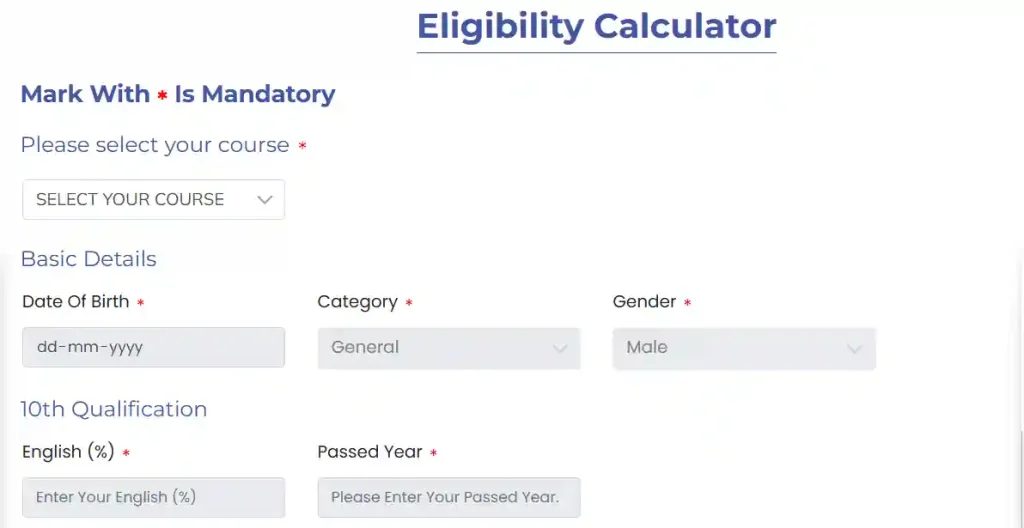
A useful feature is the eligibility calculator. Instead of manually trying to work out whether your marks meet the requirements of a particular Merchant Navy course, you can use the calculator to check your eligibility based on your academic details.
Merchant Navy Colleges for Girls
Girl students have the chance to visit the institutes that offer recognized courses in accordance with the career pathway chosen. The following are some of the maritime institutes that can be considered by girls to learn more about:
Indian Maritime University (IMU): Learn more about their campus and available B.Sc. Nautical Science and Marine Engineering courses.
Tolani Maritime Institute (TMI): Find out about the maritime courses and admission process for the same.
Anglo-Eastern Maritime Academy: Learn more about the currently available courses and their admission requirements.
AMET University: Study about the available maritime courses and admission process for the same.
Samundra Institute of Maritime Studies (SIMS): Learn about the available training courses and their eligibility requirements.
The above is just a tentative list and not a ranking and no guarantee that all the institutes will offer all the courses to all the candidates in the year 2026 admission cycle. It is advisable to check out whether the selected colleges are authorized by DGS for your chosen course, course fee, medical, hostel, training, and the conditions of company sponsorship.
Girls should also inquire about the training opportunities at sea and availability of berths for cadets.
Prepare for Your Merchant Navy Journey With Merchant Navy Decoded App
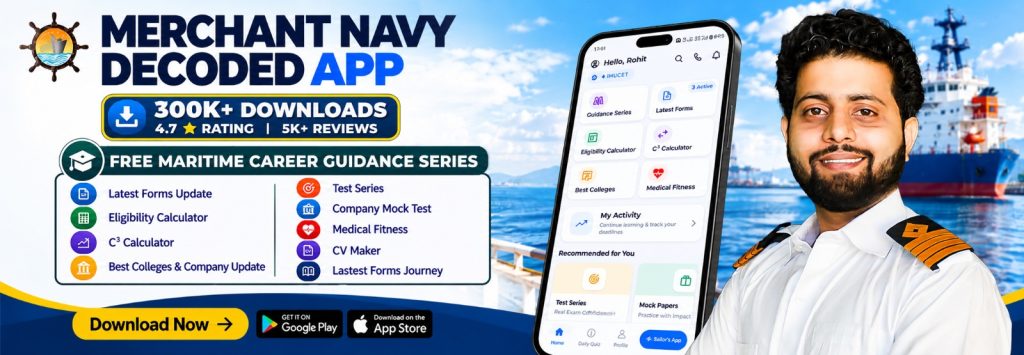
If you are planning to join the Merchant Navy, having the right information and preparation resources can make the process easier. The Merchant Navy Decoded appbrings several useful tools for students preparing for IMUCET and exploring Merchant Navy career options.
The app includes test series for IMUCET preparation, which can help students practice questions and improve their exam performance.
If you are confused about how to start a career in the Merchant Navy, this video from Merchant Navy Decoded can help you understand the process in a simple way. It covers the basic eligibility, courses, entrance exams, sponsorship, and important steps students should know before choosing this career.
Merchant Navy Salary for Girls
There is no separate pay scale simply because a lady has applied for the job. The pay will be determined by the job, the company, the ship, the experience, and the contract.
These figures are just an approximation.
Position
Illustrative monthly salary
Deck Cadet
$450-$700
Junior Deck Officer
$2,400 – $4,500
Chief Officer
$6,000 – $12,000
Captain / Master
$10,000 to $25,000+
Junior Marine Engineer
$800– $1,500
Senior Marine Engineer
$8,000 – $25,000+
The above figures do not necessarily represent offers of employment. In fact, remuneration varies significantly from one company to another. An increase in salary is dependent on gaining the necessary experience, taking the examination, getting certification, and promotions. Some jobs on board ships provide accommodation and food while at work. However, one must still check his/her own contract as to what is included.
It is also to remember that increased pay for officers generally comes from years of training, experience, and professional development.
Life at Sea for Girls
The conditions prevailing at sea in a commercial vessel are quite unlike those on land.
A seafarer has to abide by the routines, regulations, and practices devised by the ship owners or the managers of the ship. Working hours vary depending on one’s duties and tasks; it can involve tough work because of reasons like harbor operations, emergencies, or adverse weather conditions.
Some issues concerning women who will be working at sea can include :
Being away from their loved ones for a long time.
Adjusting to watches and shifts.
Working and living with the same crew in close quarters.
Dealing with tiredness and being mentally and physically prepared to do the job.
Getting to know the new culture, new ports, and places where one works.
In addition to that, it will also depend on the employer, type of ship, type of crew, and management. Aspirants need to inquire about the facilities available on board, communication facilities, complaint procedures, anti-harassment policy, and medical care facilities provided by the company for its crew.
It is important to have a decent work environment for everyone on board the ship.
Career Growth in the Merchant Navy
The Merchant Navy offers structured career progression, although the exact pathway depends on the department and professional qualifications.
Deck Department
A typical progression is:
Deck Cadet → Third Officer → Second Officer → Chief Officer → Captain (Master)
Candidates must complete the required sea service, examinations, and certifications to advance.
Engine Department
A typical progression is:
Trainee Marine Engineer → Fourth Engineer → Third Engineer → Second Engineer → Chief Engineer
Promotion depends on professional competence, sea time, examinations, and the relevant certification requirements.
Yes. PCM students can apply for eligible deck and marine engineering programs, subject to the course’s academic, age, medical, and admission requirements.
There is generally no separate examination based solely on the gender of the applicant. Depending on the course, IMU-CET or company-specific examinations may be taken.
The answer is dependent on the eyesight criteria and those set out by the chosen department and course. Instead of assuming that a girl is eligible or not for being in the Merchant Navy based on spectacles, she must visit a doctor approved by DGS.
Yes. Based on their experience and qualification, sailors may opt for careers in ship management, marine surveying, port management, maritime training, technical service, and many more.
It could be a good idea for someone who wants to take up international shipping and work onboard ships. But remember that onboard living revolves around professional commitments. Candidates must be prepared to spend long periods away from their family.
Disclaimer :- The opinions expressed in this article belong solely to the author and may not necessarily reflect those of Merchant Navy Decoded. We cannot guarantee the accuracy of the information provided and disclaim any responsibility for it. Data and visuals used are sourced from publicly available information and may not be authenticated by any regulatory body. Reviews and comments appearing on our blogs represent the opinions of individuals and do not necessarily reflect the views of Merchant Navy Decoded. We are not responsible for any loss or damage resulting from reliance on these reviews or comments.
Reproduction, copying, sharing, or use of the article or images in any form is strictly prohibited without prior permission from both the author and Merchant Navy Decoded.