Hi this is Team Merchant Navy Decoded !!!

Please fill the below form with your query and we will get back to you in next 12 hours.

Rest assured your data is safe with us !!!🙂

Ask Your Query

Main Engine Spares Order

Main Engine Spares Order

If you’ve sailed as a marine engineer or stood beside a Chief Engineer during a spares audit, you already know one truth: a ship without the right main engine spare on board is a ship one breakdown away from disaster. For every marine engineer, cadet, or ship management professional searching for clarity on how main engine spares orders actually work, this guide breaks down the process, the regulations, and the best practices that keep vessels moving safely across the world’s oceans.

Why Main Engine Spares Management Matters More Than Ever

Main Engine Spares Management

The main engine is the heart of any merchant vessel. A single failure, a cracked cylinder liner, a worn fuel injector, a damaged turbocharger bearing   can leave a ship dead in the water, trigger costly off-hire charges, and in the worst cases, endanger the crew and cargo. With global shipping under pressure from tighter schedules, IMO decarbonization rules, and rising fuel and maintenance costs, efficient spares ordering and inventory control has become a core competency for every marine engineer, not just a paperwork exercise for the Chief Engineer.

What Are Main Engine Spares?

Main Engine Spares

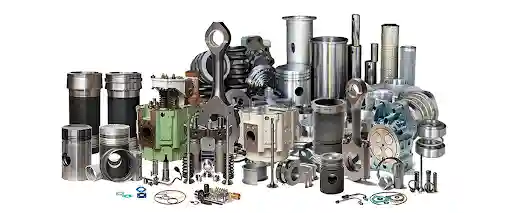
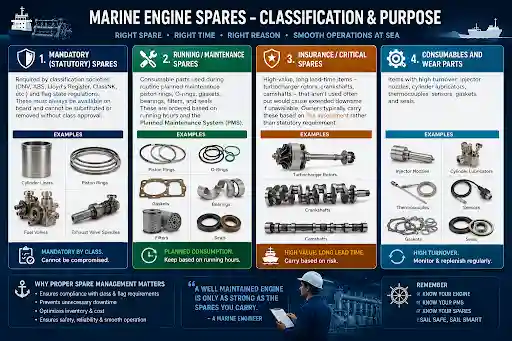
Main engine spares are the replacement parts and components kept on board (or ordered from a supplier) to maintain, repair, or overhaul the ship’s propulsion machinery. These typically fall into a few key categories:

1. Mandatory (Statutory) Spares

Required by classification societies (DNV, ABS, Lloyd’s Register, ClassNK, etc.) and flag state regulations. These must always be available on board and cannot be substituted or removed without class approval. Examples include a spare set of cylinder liners, piston rings, fuel valves, and exhaust valve spindles depending on engine type and class notation.

2. Running/Maintenance Spares

Consumable parts used during routine planned maintenance   piston rings, O-rings, gaskets, bearings, filters, and seals. These are ordered based on running hours and the Planned Maintenance System (PMS).

3. Insurance/Critical Spares

High-value, long lead-time items, turbocharger rotors, crankshafts, camshafts that aren’t used often but would cause extended downtime if unavailable. Owners typically carry these based on risk assessment rather than statutory requirement.

4. Consumables and Wear Parts

Items with high turnover: injector nozzles, cylinder lubricators, thermocouples, sensors, gaskets, and seals.

Table of Contents

The Main Engine Spares Ordering Process, Step by Step

Step 1: Identify the Requirement

The requirement is usually flagged through one of three routes:

  • Planned Maintenance System (PMS) alerts based on running hours or calendar intervals
  • Chief Engineer’s inspection during routine checks or after an abnormality
  • Class survey or dry-dock planning, where upcoming overhauls dictate spares needed in advance

Step 2: Raise the Requisition

The Chief Engineer (or 2nd Engineer under supervision) raises a spare parts requisition through the ship’s procurement or PMS software (commonly AMOS, IDEA, ShipNet, or K-Flex/K-Sync platforms), specifying:

  • Part name and maker’s part number
  • Engine make and model (MAN B&W, WinGD, Wärtsilä, etc.)
  • Quantity required
  • Urgency level (routine / urgent / critical for safety)
  • Delivery port and vessel ETA

Step 3: Technical Verification

The ship management or technical superintendent ashore cross-checks the requisition against the maker’s spare parts catalogue, drawing numbers, and existing stock levels to avoid duplicate ordering.

Step 4: Vendor Selection and Purchase Order

Procurement teams source the part from OEM-approved suppliers or authorized dealers, comparing price, lead time, and port of delivery. A Purchase Order (PO) is issued, and delivery is coordinated to the next suitable port   often timed with bunkering or crew change to save on logistics costs.

Step 5: Delivery, Receipt, and Inspection

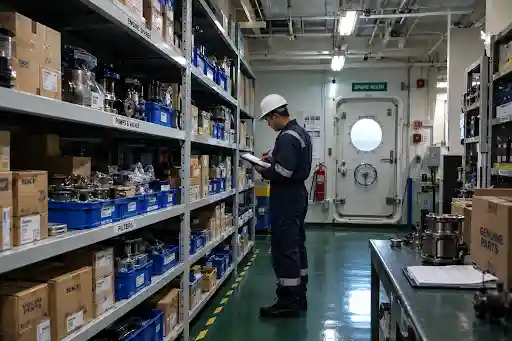
On arrival, the spare is inspected against the packing list and maker’s certificate, checked for damage, and entered into the ship’s spare parts inventory register with updated stock and running-hour data.

Step 6: Documentation and Class Record Update

For mandatory spares, the ship’s spare parts inventory list and class certificate must be updated to reflect the current onboard status, which is checked during PSC (Port State Control) and class surveys.

Common Challenges in Main Engine Spares Procurement

  • Long lead times for OEM parts, especially turbocharger components and crankshaft-related spares
  • Port accessibility   not every port has efficient customs clearance or ship chandler support for heavy spares
  • Budget constraints from owners/operators trying to control OPEX
  • Counterfeit or non-OEM parts entering the supply chain, risking engine damage and warranty issues
  • Communication gaps between vessel and shore-based procurement teams causing delayed or wrong orders
  • Currency fluctuations and customs duties affecting cost and delivery timelines across different flag states

Best Practices for Marine Engineers Managing Spares Orders

Best Practices for Marine Engineers Managing Spares Orders
  1. Maintain an accurate, updated spare parts inventory   cross-check physical stock against the PMS system every month, not just before audits.
  2. Order early, not urgently   track running hours and plan requisitions well ahead of scheduled overhauls.
  3. Always verify part numbers against the maker’s manual, not just historical PO records, since engine modifications can change spec.
  4. Use OEM-approved or class-approved suppliers to avoid compatibility and warranty issues.
  5. Keep clear communication logs with the technical superintendent to prevent duplicate or missed orders.
  6. Factors in port logistics   align spares delivery with bunkering calls or crew change ports to reduce agency and freight costs.
  7. Train junior engineers on the requisition process so ordering knowledge isn’t concentrated in one person.

Frequently Asked Questions (FAQs)

 Main engine spares are replacement components kept onboard or ordered to maintain, repair and overhaul the ship’s main propulsion machinery. They include items such as piston rings, cylinder liners, fuel valves, bearings, gaskets, seals and turbocharger components.

 Main engine spares are generally divided into mandatory spares, running and maintenance spares, critical or insurance spares, and consumable or wear parts. The required inventory depends on the engine type, vessel operation, maintenance schedule and applicable requirements.

 The Chief Engineer is generally responsible for managing main engine spares. Depending on the vessel’s procedures, the Second Engineer may prepare the requisition under the Chief Engineer’s supervision. The shore-based technical team and procurement department then verify and process the order.

The requisition should include the engine maker and model, part name, manufacturer’s part number, quantity, required delivery date, urgency and delivery port. The information should be checked against the manufacturer’s manual or spare-parts catalogue to avoid ordering an incorrect component.

 Effective spares management helps prevent unexpected machinery breakdowns, reduce vessel downtime and avoid operational delays. Maintaining accurate inventory and ordering critical components well in advance ensures that essential parts are available when required.


Disclaimer :- The opinions expressed in this article belong solely to the author and may not necessarily reflect those of Merchant Navy Decoded. We cannot guarantee the accuracy of the information provided and disclaim any responsibility for it. Data and visuals used are sourced from publicly available information and may not be authenticated by any regulatory body. Reviews and comments appearing on our blogs represent the opinions of individuals and do not necessarily reflect the views of Merchant Navy Decoded. We are not responsible for any loss or damage resulting from reliance on these reviews or comments.

Reproduction, copying, sharing, or use of the article or images in any form is strictly prohibited without prior permission from both the author and Merchant Navy Decoded.

DIWALI SALE

Decoded Discount Alert! up to 50% OFF

DIWALI SALE

Decoded Discount Alert! up to 50% OFF

Use Coupon Code Deep50

Days
Hours
Seconds
0
Would love your thoughts, please comment.x
()
x