Hi this is Team Merchant Navy Decoded !!!

Please fill the below form with your query and we will get back to you in next 12 hours.

Rest assured your data is safe with us !!!🙂

Ask Your Query

Loads in an Electrical Circuit

Introduction 

Within an electrical circuit, an electrical load may be present. This is any device/component that takes electrical energy and converts it into other forms of energy. Examples of energy conversion include light, heat, sound, and mechanical energy.

On board ships, electrical loads include lighting, motors, heating, pumps, compressors, navigation equipment and control panels. Knowledge of the different types of electrical load is useful to marine engineers to allow safe and efficient electrical operation.

Understanding different types of electrical loads is important for learning how electrical circuits work. To develop a better understanding of electrical circuit diagrams and their practical applications onboard ships, explore the Electrical Circuit Diagram Course by Merchant Navy Decoded.

Electrical Load

Loads in an Electrical Circuit

For example, when a lamp connects to a battery, the lamp becomes the load, converting electrical energy into light and thermal energy.

Power used in a DC electrical load can be calculated below:

P = V x I

Where:

P = Electrical power (Watts)

V = Voltage (Volts)

I = Current (Amps)

If a 12V lamp draws 2A of current:

P = 12 x 2 = 24W

Therefore, 24W of electrical energy is used.

The Merchant Navy Decoded App offers useful learning resources and services for seafarers. Through MND Flix, marine engineers can explore practical courses covering various shipboard machinery and systems. The app also provides MMD exam support, financial guidance, STCW Course Finder, and other helpful resources for a career in the Merchant Navy.

Principle Of Operation

Depending on the type of load, the principle of operation varies.

However, generally:

  • Voltage is supplied by an electrical source
  • The load is connected to the source, by conductors
  • Current will flow through the load, when the circuit is closed
  • Electrical energy is converted into other forms of energy
  • This energy is used for its intended purpose

Examples of this include electrical motors converting electrical energy to mechanical energy and electrical heating devices converting electrical energy to thermal energy.

Types of Electrical Load

There are different types of electrical loads. These can depend on the type of energy they convert and their electrical properties.


1. Resistive Load

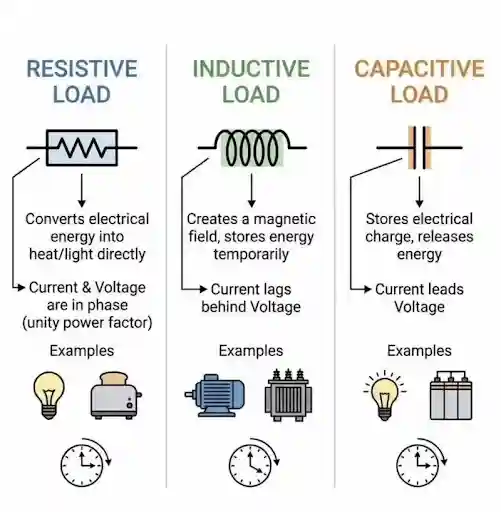
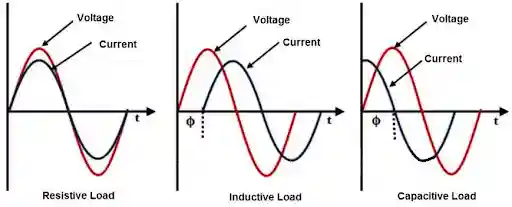
Resistive loads contain resistors. Electrical energy will be transferred to thermal/ light energy. In an AC purely resistive circuit, voltage and current will be in phase, meaning they reach maximum and minimum values at the same point in time.

Examples:

  • Heating devices
  • Incandescent lamps
  • Electric kettle
  • Heating devices using resistance

Applications on board ship:

  • Heating in galleys
  • Water heating
  • Electric cooking
  • Heating of spaces

2. Inductive Load

Inductive loads contain coils. When there is a current within the coils, a magnetic field is produced. In a purely inductive AC circuit, current will lag voltage by 90 degree. However, real inductive loads include some resistance, therefore generally current will lag voltage by less than 90 degree.

Examples:

  • Electric motors
  • Transformers
  • Inductive coils
  • Solenoid valves

Applications on board ship:

  • Main and auxiliary machinery motors
  • Pumps
  • Fans and blowers
  • Air compressors
  • Refrigeration compressor

3. Capacitive Load

Capacitive loads contain capacitors which allow electrical energy to be stored within an electric field. In a purely capacitive AC circuit, current will lead voltage by 90 degree. In real circuits, the phase difference will depend on the components.

Examples:

  • Capacitor banks
  • Power factor correction
  • Electronic circuits with capacitors

Applications on board ship:

  • Power factor correction
  • Filtering circuits
  • Control and electronics

Capacitive Load

4. Electronic Load

Electronic loads contain electronic components. These include diodes, transistors, ICs and power conversion equipment.

Current draw may vary depending on operation and internal control systems.

Examples:

  • Computers
  • PLCs
  • LED lighting
  • Battery charging
  • Communication devices

Applications on board ship:

  • Monitoring equipment in engine rooms
  • Navigation
  • Alarm panels
  • Automation

Table of Contents

Classification Of Load

Electrical loads can be separated based on the electric supply required.


1. Direct Current (DC) Load

DC loads are operated using direct current.

Examples:

  • Emergency lighting (using batteries)
  • DC motors
  • Alarming circuits
  • Electronic controls
  • Communication

2. Alternating Current (AC) Load

AC loads are operated using alternating currents. The current changes direction and magnitude periodically.

Examples:

  • AC motors
  • Pumps and compressors
  • Cooling systems
  • Heaters
  • Ventilation Fans

Key Characteristics Of Loads

Key electrical characteristics can explain how well a load operates.

  • Voltage – Voltage required for the load to function
  • Current – Current drawn by the load
  • Resistance – Resistance to the flow of current
  • Power – Rate electrical energy is used
  • Power Factor – Ratio of real power to apparent power. Indicates how efficiently electrical energy is used in an AC circuit
  • Frequency – Number of full cycles of AC per second, in Hz. Important for correct operation of AC equipment

Series and Parallel Loads

Depending on the circuit, electrical loads can be connected in series or parallel circuits.

1. Series Circuit

Series Circuit

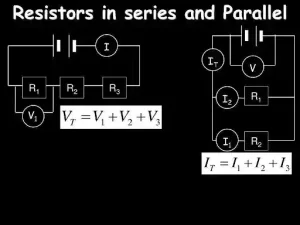
In a series circuit, loads are connected in sequence.

Characteristics:

  • Current flowing through all loads is equal
  • Voltage provided by the source is split between loads
  • If a load in the circuit becomes an open circuit, nothing in the circuit will operate

Example: 2 resistors in series.

2. Parallel Circuit

In a parallel circuit, loads are connected between the same 2 points in the circuit, creating separate current pathways.

Characteristics:

  • Voltage provided is the same for all loads
  • Current is split between different loads
  • If one load in the circuit becomes an open circuit, the remaining loads in parallel can still operate

Example: Lighting systems with multiple lamps, so that they can operate independently.

Many distribution circuits on board ships include parallel loads to allow individual equipment to operate independently.

Applications Of Electrical Loads On Board Ship

Applications Of Electrical Loads On Board Ship

Electrical loads can be found in many places on board ships. 

They are fundamental to operations;

  • Lighting – Powering lighting in cabins, engine rooms and on deck
  • Motors – Operating pumps, fans, compressors and other machinery
  • Heating – Providing heat to water, galley equipment and other systems.
  • Cooling – Operating compressors and cooling equipment
  • Navigation – Powering radar, GPS, communication and other navigation equipment
  • Automation – Operating PLCs, sensors, transmitters and monitoring
  • Emergency equipment – Emergency lighting, alarms and critical back up systems

Common Problems and Maintenance

Electrical loads may develop faults due to overloading, insulation failure, overheating or poor electrical connections.


Common problem

Possible cause

Excessive current

Overloading or short circuit

Overheating

High current or poor ventilation

Low performance

Low supply voltage

Motor vibration

Misalignment or bearing damage

Insulation failure

Ageing, moisture or overheating

Frequent tripping

Overload or electrical fault

Maintenance

  • Ensure key loads are operating at correct voltages and current draws
  • Check connections are secure and not overheating
  • Check motor temperatures and vibrations
  • Check insulation resistance regularly
  • Ensure electrical panels are cleaned and dry
  • Ensure protective equipment is appropriate and functioning correctly
  • Do not overload equipment
  • Follow manufacturers guidelines for maintenance

Conclusion

Although hydraulic valves can look like little metal blocks they all have a specific function. Directional valves direct oil, check valves only allow flow in one direction, flow control valves set a speed, throttle check valves only allow flow in one direction and counterbalance valves hold and control a load that wants to run away. Knowing what each valve does and keeping the oil clean will make operating and fault finding on a hydraulic system on deck much more predictable.

Frequently Asked Questions (FAQs)

An electrical load is a device that consumes electrical energy and converts it into another form of energy, such as heat, light or mechanical energy.

The three basic types are resistive, inductive and capacitive loads.

A resistive load mainly converts electrical energy into heat or light, such as an electric heater or incandescent lamp.

An inductive load contains coils or windings that produce a magnetic field, such as electric motors and transformers.

AC loads operate using alternating current, while DC loads operate using direct current.

It helps prevent overloading, identify abnormal power consumption and maintain the safe operation of shipboard electrical equipment.

Disclaimer :- The opinions expressed in this article belong solely to the author and may not necessarily reflect those of Merchant Navy Decoded. We cannot guarantee the accuracy of the information provided and disclaim any responsibility for it. Data and visuals used are sourced from publicly available information and may not be authenticated by any regulatory body. Reviews and comments appearing on our blogs represent the opinions of individuals and do not necessarily reflect the views of Merchant Navy Decoded. We are not responsible for any loss or damage resulting from reliance on these reviews or comments.

Reproduction, copying, sharing, or use of the article or images in any form is strictly prohibited without prior permission from both the author and Merchant Navy Decoded.

DIWALI SALE

Decoded Discount Alert! up to 50% OFF

DIWALI SALE

Decoded Discount Alert! up to 50% OFF

Use Coupon Code Deep50

Days
Hours
Seconds
0
Would love your thoughts, please comment.x
()
x