Hi this is Team Merchant Navy Decoded !!!

Please fill the below form with your query and we will get back to you in next 12 hours.

Rest assured your data is safe with us !!!🙂

Ask Your Query

Limit Switches Onboard

Limit Switches Onboard

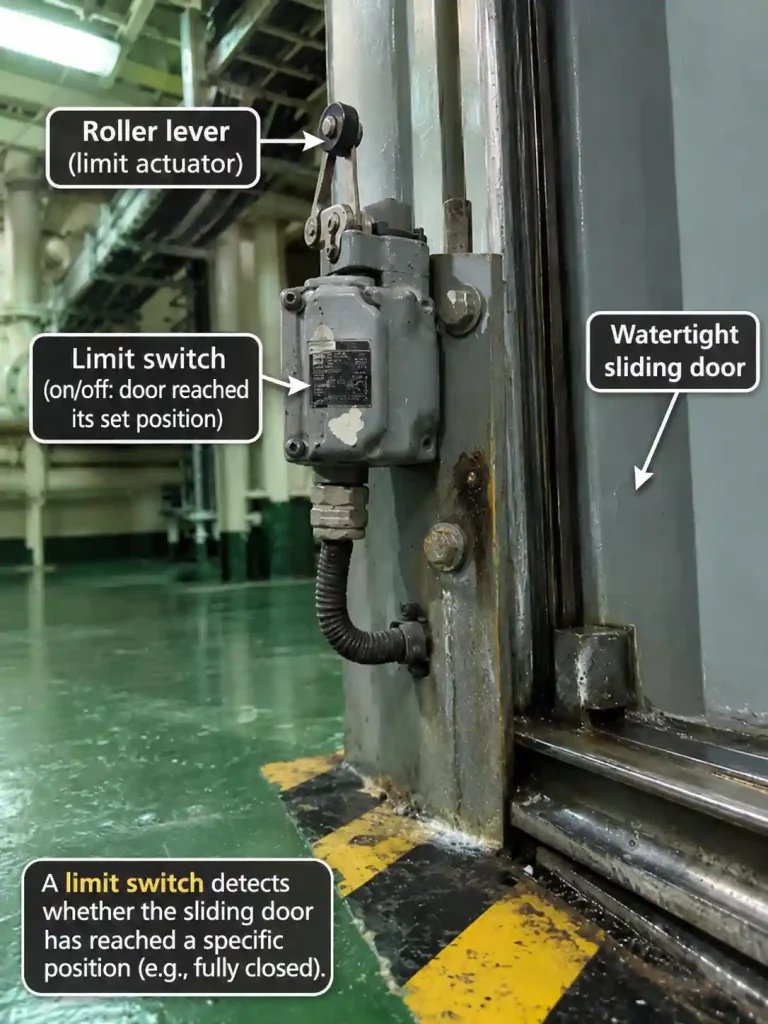
There are many moving components onboard a ship that require stopping at certain points. Examples include closing watertight doors, opening hatch covers, rudders swinging to one side, opening fully or closing fully. It is important to know when these items are at their end point so someone on the bridge or control room knows and to stop the mechanism providing power. This is where limit switches come in. They aren’t glamorous but are small devices that can tell you that ‘this has reached this point’. They are very important from a safety perspective.

Want to understand how limit switches, sensors, and automation systems work onboard ships? Enhance your practical knowledge of marine automation, control systems, and troubleshooting with the Automation Course by MND FLIX. Build a stronger understanding of shipboard automation and improve your technical skills.

How Limit Switch Functions

Limit switches are very simple devices. They are fitted within a control circuit and contain electrical contacts. A moving component such as the door, valve stem or cam on a shaft will come into contact with the actuator of the limit switch. This could be a lever, button or roller. The contacts will then change state. If the contacts were closed they will now be open and vice versa. This change in the contacts will cause something to happen within the control circuit. This could be stopping a motor, turning on an indicator, sounding an alarm or stopping something else from happening.

Most switches will have two sets of contacts. One set will be normally open (NO) meaning they will be open until the switch is actuated. The other set will be normally closed (NC). Depending on what you want to happen within the circuit you will wire the correct set of contacts. Often safety circuits will use NC contacts to ensure that if there is a break in the wiring or failure of the switch, the machine will stop. This is because it will look like it has reached its limit. Having a fail safe circuit is much better than having one that fails silently.

Many mechanical switches use a snap action design. This means that the contacts don’t slowly move with the actuator but stay in place until they suddenly snap into place when the actuator reaches a certain point. This creates a clear signal and reduces any arcing that may occur.

Mechanical Limit Switches

Mechanical Limit Switches

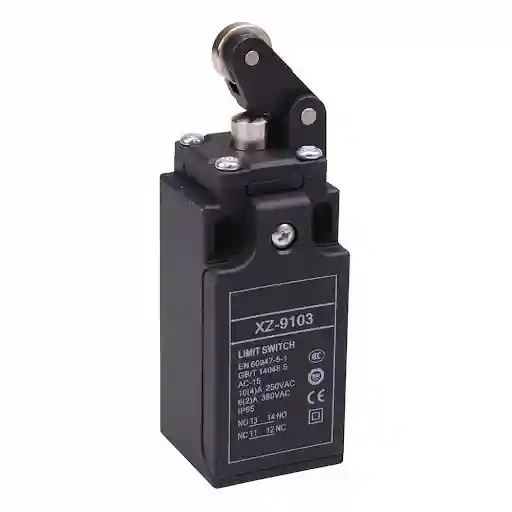
This is the most common type of limit switch. The actuator is physically moved and causes the contacts inside to change state. There are a few common types of actuators:-

  • Roller Lever – The actuator has a small wheel on the end of the lever. This allows a cam or moving part to roll over it causing little damage to both components. This is commonly found on sliding doors and anything else with a set travel.
  • Push Button/Plunger – The actuator is pushed straight in by the moving part. This is a small and accurate actuator so can be used when something needs to hit it head on. For example a valve stem.
  • Whisker/Flexible Rod – This actuator has a thin springy wire. This can be pushed from many directions. This can be useful if the target isn’t very accurate.
  • Mechanical switches are simple, cheap and can carry a good amount of current. They can easily be tested using the multi-meter and your fingers. The downside is they are contact based. This means the moving parts will suffer from wear. In a harsh environment with lots of salt water and vibrations they can suffer from corrosion and sticking. They can also suffer from misalignment. If the bracket is bumped it can cause the switch to trip too early, too late or not at all.

Table of Contents

Proximity (Contactless) Limit Switches

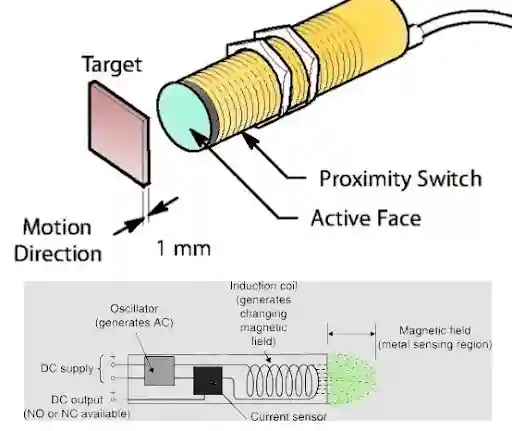
Sometimes you don’t want anything touching the switch. Proximity switches can detect a target without any contact. There are a few common types:-

  • Inductive – These can detect metal. They create a small electromagnetic field. When a metal target comes close to them the field changes causing the switch to change state. These are very common on ships. They can be used for valve positions and to know if there is a metal part on a rotating shaft. They will only detect metal.
  • Capacitive – These can detect a change in capacitance. This means they can detect non-metallic objects and even liquids. This makes them useful for level detection. They can however be affected by moisture and dirt.
  • Magnetic/Reed – The moving component will have a magnet attached to it. The sensor detects the magnetic field. Reed switches have two thin metal contacts enclosed within a glass tube. When a magnet is brought close they attract together. They are simple and sealed. They are often used for hatch and door positions or pneumatic cylinders.
  • Photoelectric – These use a light beam. When something interrupts or reflects the light beam the switch changes state. They have a long range so are useful for detecting something from a distance.

Proximity switches will last longer in harsh environments as there is no contact to cause wear. They also change state quickly. They do however need a power source and usually only carry a small current (so they are used to send a signal to a relay or PLC input rather than directly to a motor). They are also more affected by environmental factors such as temperature and electrical interference than a simple mechanical switch.

Rotary Cam Limit Switches

Rotary Cam Limit Switches

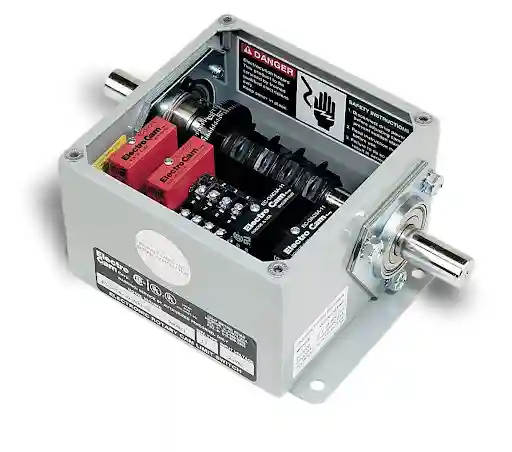
If you need to know how far something has turned then a rotary cam switch would be a good option. The shaft is driven by the moving part of the machinery. This could be via a gear. As it rotates a number of adjustable cams press onto switches at certain angles. Each cam can be set to trip at different points.

These are commonly found on winches, cranes, windlasses and steering gears. They allow you to have multiple set points from one device. For example a crane hoist might have one switch to slow the hoist as it reaches the top and another to stop altogether. They can be adjusted onboard depending on the machinery.

Where They Can Be Found

Once you start looking they are everywhere! Some important places to find them include:

  • Watertight and Fire Doors – The switches will tell you if the door is closed. This will also show on the indication panel on the bridge.
  • Hatch Covers – Tells you if the cargo hatch is fully open/closed.
  • Steering Gear – Limit switches will prevent the rudder from exceeding its limits at the extreme ends. They work alongside mechanical stops.
  • Valves – Position switches will tell the control system if the valve is open, closed or in-between.
  • Cranes, Winches & Windlasses – These set the limit to the travel. This will stop the hook hitting the top of its travel.
  • Fire Dampers – Tells you if the damper has closed.

Common Issues

Despite being simple devices they can suffer from many issues due to harsh environments:-

  • Moisture – The main issue will be water and salt. If the switch doesn’t have a good seal then moisture will get in and cause corrosion to the contacts. Cable glands may have been left loose or the housing cracked allowing water to get in over time.
  • Misalignment – The switch can get misaligned due to vibrations and knocks. This can cause the bracket to bend or the actuator to move causing it to trip at the wrong point. Always check the physical installation of the switch if it seems to be tripping in the wrong place.
  • Mechanical switches can suffer from sticking. This can be caused by corrosion or paint and dirt around the actuator. The contacts can also burn/pit over time. Especially if they are carrying a high load. Another common issue is a broken or loose wire at the terminal. Check the wiring first!

Conclusion

Limit switches are used to tell the system that something has reached a certain point. Depending on the situation there are different types available. Mechanical switches are simple, straightforward and easy to test. Proximity switches have no moving parts to cause wear. Rotary cam switches offer multiple set points from one shaft. It depends on what is moving, where it is and how harsh the environment is. Choosing the correct switch, installing it correctly and ensuring the seals and wiring are in good condition will mean it will do its job for years without anyone noticing.

Frequently Asked Questions (FAQs)

A limit switch detects when a moving part reaches a certain point and causes the electrical contacts to change state. This will stop a motor, provide an indication or cause an alarm.

Normally open contacts will be open until the switch is actuated and then will close. Normally closed contacts will be closed until the switch is actuated and then will open. Often safety circuits will use normally closed contacts as a break in the wiring will be seen as a fault.

If you don’t want anything touching, the environment is harsh and would cause wear on a mechanical actuator or you require fast switching. Inductive switches are good for detecting metal. Capacitive switches can detect non-metallic objects.

They can provide you with multiple set points from one shaft. This can slow the machinery near the end of travel.

Most commonly due to the bracket or actuator being out of alignment due to vibrations or knocks. Ensure the switch is installed correctly.

Disclaimer :- The opinions expressed in this article belong solely to the author and may not necessarily reflect those of Merchant Navy Decoded. We cannot guarantee the accuracy of the information provided and disclaim any responsibility for it. Data and visuals used are sourced from publicly available information and may not be authenticated by any regulatory body. Reviews and comments appearing on our blogs represent the opinions of individuals and do not necessarily reflect the views of Merchant Navy Decoded. We are not responsible for any loss or damage resulting from reliance on these reviews or comments.

Reproduction, copying, sharing, or use of the article or images in any form is strictly prohibited without prior permission from both the author and Merchant Navy Decoded.

DIWALI SALE

Decoded Discount Alert! up to 50% OFF

DIWALI SALE

Decoded Discount Alert! up to 50% OFF

Use Coupon Code Deep50

Days
Hours
Seconds
0
Would love your thoughts, please comment.x
()
x