Hi this is Team Merchant Navy Decoded !!!
Please fill the below form with your query and we will get back to you in next 12 hours.
Rest assured your data is safe with us !!!🙂
Ask Your Query| For Beginner | For Professional |
|---|---|
| GME | Engine Side |
| G.P. Rating | Deck Side |
| ETO | G.P. Rating |
| IMUCET & Sponsorship | Combo Offers |
| Free Course | MEO |
| Free Course |
| For Beginner | For Professional |
|---|---|
| GME | Engine Side |
| G.P. Rating | Deck Side |
| ETO | G.P. Rating |
| IMUCET & Sponsorship | Combo Offers |
| Free Course | MEO |
| Free Course |
The merchant navy is an industry in which one can have a career by working on commercial ships carrying freight from place to place throughout the world. In India, different paths exist for students seeking entry into this field, as per their choice of placement in either the deck department or engine department in various courses like diplomas, degrees, and B.Tech courses.
Students interested in careers after class 12 have the option to pursue these courses to build careers as deck officers, such as a Diploma in Nautical Science (DNS) and a B. Sc. Nautical Science, and for the engine department, they have the option to enroll in a B. Tech. Marine Engineering.
A merchant navy officer is a skilled professional who assists in the operation of a merchant vessel. Officers are tasked with the jobs of navigation, machinery, cargo handling, and many others aboard a ship.
There are two main career paths for students who want to become officers.
Deck officers manage the navigation and operational aspects of a vessel. They assist in determining the position of the vessel, keep track of its course, oversee cargo operations, and ensure safety procedures.
They are responsible for:
The deck department can be a good choice for students interested in navigation and ship operations.
Engineers ensure the functionality of the mechanical and electrical equipment on board the vessel. The engineers maintain the main engine, generators, pumps, and any other machinery.
The duties of engineers are as follows:
If you like studying physics, mechanics, and troubleshooting problems, then perhaps the engineering department will be more appealing to you.
There are different qualification requirements for each department and different possibilities for career advancement.
Eligibility criteria for the two major officer training courses after Class 12 require students to have a PCM combination in their academic qualifications.
These criteria may differ according to the course and institute concerned.
The following are some of the common B.Sc. Nautical Science and DNS eligibility criteria:
Common B.Tech. Marine Engineering course eligibility criteria include:
In some institutions, there are other specific criteria. Applicants can refer to the course prospectus rather than taking the above criteria for granted.
Age limits differ according to the course, category, gender, and reference date specified for admission.
For example, IMU’s 2026–27 prospectus provides different upper-age limits for B.Sc. Nautical Science candidates according to these categories. The limits must be checked against the particular programme and admission session. You should verify your eligibility using the latest official prospectus before applying.
Physical fitness is an important requirement for becoming a seafarer. The candidates need to satisfy the requirements of eyesight, color blindness, hearing, and general physical fitness requirements. The medical test that is mandatory needs to be undertaken only by a doctor authorized by the Directorate General of Shipping.
In case you have worries regarding your eyesight and any other medical requirement, do take a professional diagnosis before paying heavy admission charges.
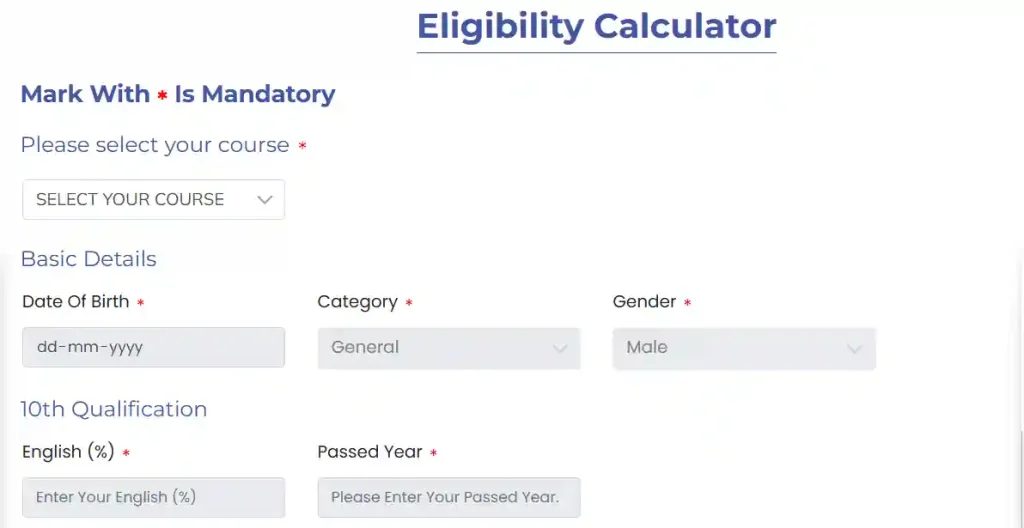
Another useful feature is the eligibility calculator. Instead of manually trying to work out whether your marks meet the requirements of a particular Merchant Navy course, you can use the calculator to check your eligibility based on your academic details.
Choosing the correct course is one of the most important decisions in your Merchant Navy career. Your choice determines the department in which you will train.
B.Sc. Nautical Science is a three-year course meant for those aspiring to join the deck department. Some of the subjects covered in this course include navigation, seamanship, ship handling, maritime safety, and other technical subjects.
Upon completion of this training course, eligible candidates proceed to on-board training as deck cadets and finally satisfy the requisite sea service and certification requirements to become officers.
Who should choose it?
Students who want a three-year academic program focused on navigation and ship operations can consider B.Sc. Nautical Science.
The Diploma in Nautical Science is an annual training program before the seagoing phase for students opting for the deck department.
Completion of the course demands the fulfillment of the necessary onboard training, sea service, post-sea training, and competency examinations. What are the entry requirements for DNS through affiliated institutes? The requirement for DNS admission through affiliated institutes is normally sponsorship.
Who should pursue it?
Students who wish to join the deck department through a sponsor-based training process could consider DNS.
This B.Tech. in Marine Engineering is a four-year course of study in the field of engineering for those who are interested in joining the engine department.
It involves subjects from the field of engineering that have applications in the field of marine engines, thermodynamics, electrical work, machinery, and maintenance. Once the necessary training and certification procedure has been completed successfully, candidates can start moving towards becoming marine engineering officers.
Who should opt for it?
Those candidates who have an interest in physics, engineering, machinery, and solving problems should look at this option. Before opting for any course, one needs to compare the approval of the institute, total fees, training facilities, and eligibility criteria for admission into the course.
The IMU CET, which stands for Indian Maritime University Common Entrance Test, is a crucial test for getting into many maritime courses.
For entry into BSc Nautical Science and DNS, the candidate has to fulfill the examination and admission criteria pertaining to the particular course.
These include:
Getting through IMU CET doesn’t necessarily mean that you will get admitted to all the institutes or a shipping company’s sponsorship.
The Crack IMUCET book is another useful preparation resource for students targeting IMU-CET. It can help you practice important concepts and questions and strengthen your preparation with focused revision.
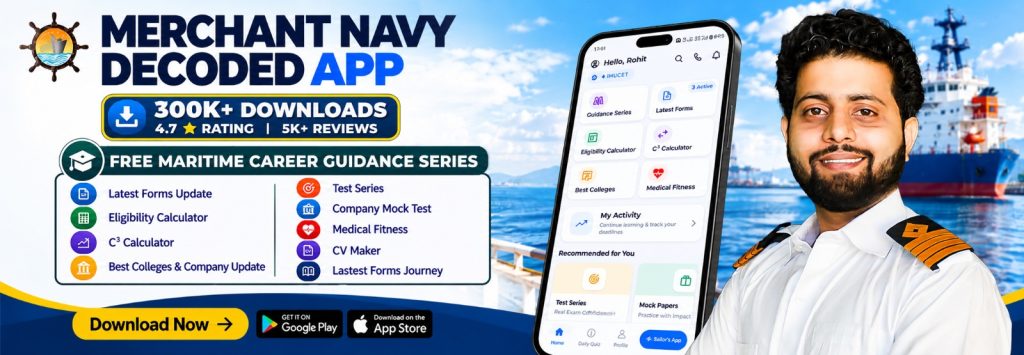
If you are planning to join the Merchant Navy, having the right information and preparation resources can make the process easier. The Merchant Navy Decoded app brings several useful tools for students preparing for IMUCET and exploring Merchant Navy career options.
Sponsorship is the practice where the shipping company chooses the applicants for a specific nautical training path. This choice process involves aptitude tests, interviews, medical fitness tests, and educational credentials validation. Different shipping companies have different approaches to the selection process.
Sponsorship is especially significant for the students who wish to get enrolled in DNS programs in affiliated institutions where it is a must-have condition.
An important point is that in order to enroll in the B.Sc. Nautical Science course on the IMU campus, sponsorship is not mandatory for enrollment. But getting access to a proper on-board training program is very important for future development of your career as an officer. It is important to clarify what you are getting when receiving the offer for sponsorship. Check if the sponsorship agreement concerns training, placement on board, employment conditions, or anything else.
Students preparing for DNS Sponsorship can also explore JMDI Academy’s preparation resources. Students Apply now with JMDI Academy to begin your preparation with the right guidance and study resources.Â
A cadet is someone who is being trained to carry out shipboard activities in an instructional environment. An officer is an individual who has met all the professional qualifications, sea experience, and certification needed for the post. For instance, a deck cadet gets training on navigation, watchkeeping, safety, and cargo handling. Through the acquired experience and qualifications, the cadet advances to the status of a qualified deck officer.
In a similar way, a mechanical trainee gets training in machinery operations and maintenance before qualifying through the engineering certification process. The duration needed to be qualified varies depending on the course and sea service experience, among other factors.
There are prospects in the Merchant Navy of moving up to a more senior shipboard position. Nevertheless, progression in one’s career will be influenced by experience, professional examinations, performance, good health, and job opportunities.
Career Pathway in the Deck Department
Deck Cadet → Third Officer → Second Officer → Chief Officer → Captain
Career Pathway in the Engine Department
Engine Trainee → Junior Engineering Officer → Second Engineer → Chief Engineer
These are general career pathways. Exact names and progression will depend on qualifications and certificates.
Yes. It is possible for students from the recognized state board to apply provided that they fulfill all the criteria for the selected program. The name of the board does not determine eligibility.
Yes. Mathematics is an essential subject for the standard Class 12 entry routes into B.Sc. Nautical Science, DNS, and B.Tech. Marine Engineering. It also supports navigation calculations and engineering studies.
It depends on the course. Sponsorship is generally required for DNS admission through affiliated institutes, while it is not a prerequisite for admission to B.Sc. Nautical Science at an IMU campus. You must still plan for the required onboard training.
No. It is based on the ship they operate, the employer, and the type of contract.
Yes. Women can do the course of deck and engine officers as long as they meet the requirements of the same.
Check the availability of the course and eligibility criteria of companies for that particular batch.
No. One can be trained in India and can work for either an Indian company or an international company, depending upon the recruitment criteria and certification requirement of that particular company. The nationality of the employer does not absolve one from having the right qualifications.
One should refer to the website of the Directorate General of Shipping and also the information available from the Indian Maritime University.
Disclaimer :- The opinions expressed in this article belong solely to the author and may not necessarily reflect those of Merchant Navy Decoded. We cannot guarantee the accuracy of the information provided and disclaim any responsibility for it. Data and visuals used are sourced from publicly available information and may not be authenticated by any regulatory body. Reviews and comments appearing on our blogs represent the opinions of individuals and do not necessarily reflect the views of Merchant Navy Decoded. We are not responsible for any loss or damage resulting from reliance on these reviews or comments.
Reproduction, copying, sharing, or use of the article or images in any form is strictly prohibited without prior permission from both the author and Merchant Navy Decoded.
Decoded Discount Alert! up to 50% OFF
Use Coupon Code Deep50