Hi this is Team Merchant Navy Decoded !!!
Please fill the below form with your query and we will get back to you in next 12 hours.
Rest assured your data is safe with us !!!🙂
Ask Your Query| For Beginner | For Professional |
|---|---|
| GME | Engine Side |
| G.P. Rating | Deck Side |
| ETO | G.P. Rating |
| IMUCET & Sponsorship | Combo Offers |
| Free Course | MEO |
| Free Course |
| For Beginner | For Professional |
|---|---|
| GME | Engine Side |
| G.P. Rating | Deck Side |
| ETO | G.P. Rating |
| IMUCET & Sponsorship | Combo Offers |
| Free Course | MEO |
| Free Course |
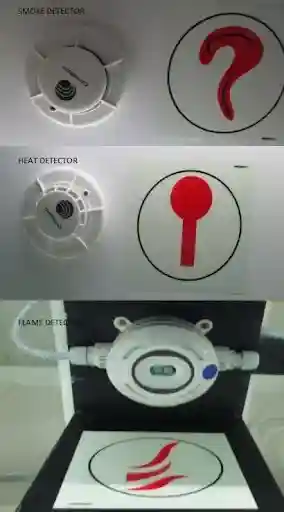
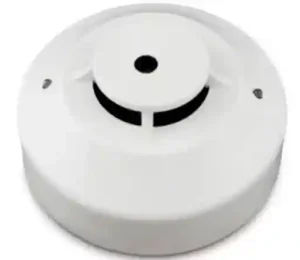
Whilst smoke detectors are commonly used within a fire detection system there are certain areas aboard a ship where they would cause problems. Areas like the galley – cooking steam, laundry, drying room, and boiler room – exhaust fumes and hot air will cause a smoke detector to constantly sound. To overcome this a different type of detector is used which does not detect smoke but heat only.
The heat detector is not as quick to respond as a smoke detector but is much more difficult to trick, making it one of the most reliable parts of the fire alarm system aboard a ship.
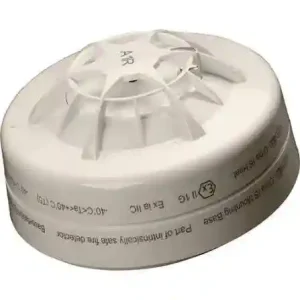
The heat detector detects the air temperature. When the temperature becomes too high or increases too quickly it will send a signal to the fire alarm panel which will cause the alarm to sound and show the zone. It does not attempt to detect smoke or flames. Therefore steam, cooking fumes, dust and exhaust do not affect it.
As heat does not increase as fast as smoke it will take longer for the detector to activate. This means it will generally not activate as quickly as a smoke detector. It is therefore used in areas where false alarms would be an issue.


Types of sensing devices
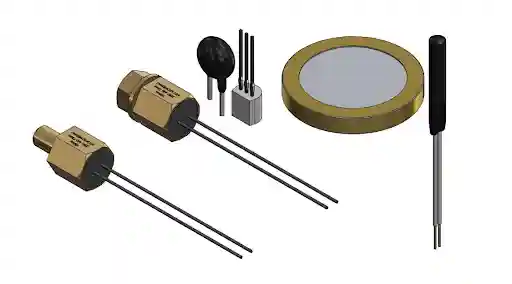
Fusible element: A small piece of special alloy holds a sprung contact apart. When the temperature reaches the melting point of the alloy it will melt, releasing the contact and triggering the detector. This is the simplest and cheapest form but will only ever be able to be used once as the element needs replacing.

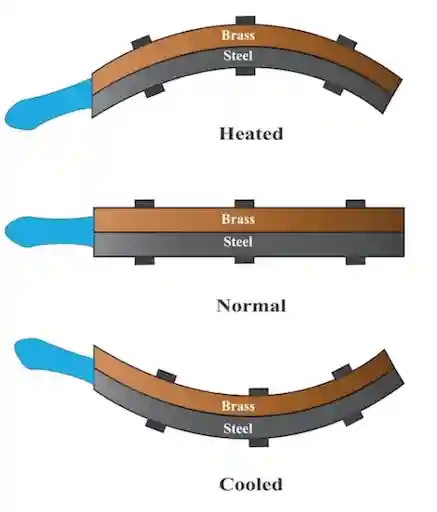
Bimetallic element: This contains two metals which have been bonded together. The two metals have a different expansion rate. As the temperature increases the bimetallic strip will bend. When the temperature reaches a set point the contact will close. This works on the same principle as the bimetallic temperature sensors discussed above. Unlike the fusible type it can be reset as it cools

Thermistor (Electronic): This uses a thermistor or similar to constantly detect the temperature. The detector will then decide based on the electronics if it should trigger. These can be used for both rate of rise and fixed temperature. They work well within addressable systems as they can communicate back to the panel.

Pneumatic: An older system which uses a sealed air chamber with a small hole. As the temperature increases slowly the air will expand and escape through the hole. If the temperature increases quickly the air expands faster than it can escape. Pressure builds up causing the diaphragm to close the contact. This is how some rate of rise detectors work.
Point and Linear: Most heat detectors are point detectors. They will just detect the temperature at one point. Enough detectors will be fitted to cover the area.

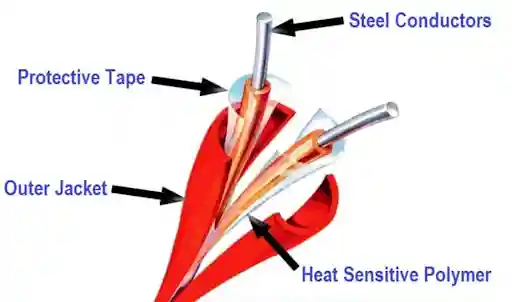
Linear heat detectors use a long cable or tube to detect temperature throughout the whole length. If any part of the cable gets too hot it will trigger an alarm. This can be useful in areas which can be difficult to cover with point detectors such as cable trays, long conveyors and some machinery areas. Some systems will also tell you approximately where along the cable the heat is.
The temperature should be set to the correct temperature for the area. If it is set too low it will cause false alarms. If it is set too high it will not activate quickly enough.
If it is being used in a corridor or accommodation area of a cabin it can be set to a lower rating. If it is being used in a high temperature area such as a boiler room, galley or drying room it should be set to a higher rating so it does not trigger due to normal temperatures. The FSS Code and class rules will state the maximum temperature they can operate at. High temperature areas will have a higher temperature allowed. The exact temperature should be taken from these documents and the manufacturer’s information.
Â
Smoke detectors are usually preferred in accommodation areas as they will trigger sooner. Heat detectors will be used where smoke detectors cannot be used.
False alarms are usually caused by incorrect temperature rating, location near a heat source or a true heat issue. Investigate all alarms.
Heat detectors are a simple device with a clear function. They do not try to be clever and will wait for the temperature to rise. In areas where smoke detectors would go crazy due to steam, smoke and fumes this is exactly what you want. Fixed temperature detectors will provide reliable protection, rate of rise detectors will detect fast developing fires and combination detectors will do both. Selecting the correct type and rating, keeping them clean and not covered and testing as per schedule will ensure they do their job in the galley, laundry and engine room.
A fire detector which detects a set temperature or temperature increase. It will send a signal to the fire alarm panel.
Cooking fumes and steam would cause smoke detectors to constantly trigger. Heat detectors will only trigger if there is an actual temperature increase meaning much less false alarms.
Fixed temperature will trigger if the air reaches a set temperature. Rate of rise will trigger if the temperature increases at a faster rate than a set level.
They will trigger for fast developing fires (rate of rise) and slow developing fires (fixed).
No, they cannot be tested without damaging them. They will be visually inspected and tested in the circuit. They may be replaced on a schedule after they have operated.
Using a specialised heat tester or controlled hot air. Apply heat gradually and never use an open flame. Ensure the panel shows the correct zone.
A cable or tube which detects heat throughout the whole length. Useful for cable trays and areas which are difficult to cover with point detectors.
Paint will cause the sensing device to be insulated meaning it will not react quickly.
Disclaimer :- The opinions expressed in this article belong solely to the author and may not necessarily reflect those of Merchant Navy Decoded. We cannot guarantee the accuracy of the information provided and disclaim any responsibility for it. Data and visuals used are sourced from publicly available information and may not be authenticated by any regulatory body. Reviews and comments appearing on our blogs represent the opinions of individuals and do not necessarily reflect the views of Merchant Navy Decoded. We are not responsible for any loss or damage resulting from reliance on these reviews or comments.
Reproduction, copying, sharing, or use of the article or images in any form is strictly prohibited without prior permission from both the author and Merchant Navy Decoded.
Decoded Discount Alert! up to 50% OFF
Use Coupon Code Deep50