Hi this is Team Merchant Navy Decoded !!!
Please fill the below form with your query and we will get back to you in next 12 hours.
Rest assured your data is safe with us !!!🙂
Ask Your Query| For Beginner | For Professional |
|---|---|
| GME | Engine Side |
| G.P. Rating | Deck Side |
| ETO | G.P. Rating |
| IMUCET & Sponsorship | Combo Offers |
| Free Course | MEO |
| Free Course |
| For Beginner | For Professional |
|---|---|
| GME | Engine Side |
| G.P. Rating | Deck Side |
| ETO | G.P. Rating |
| IMUCET & Sponsorship | Combo Offers |
| Free Course | MEO |
| Free Course |
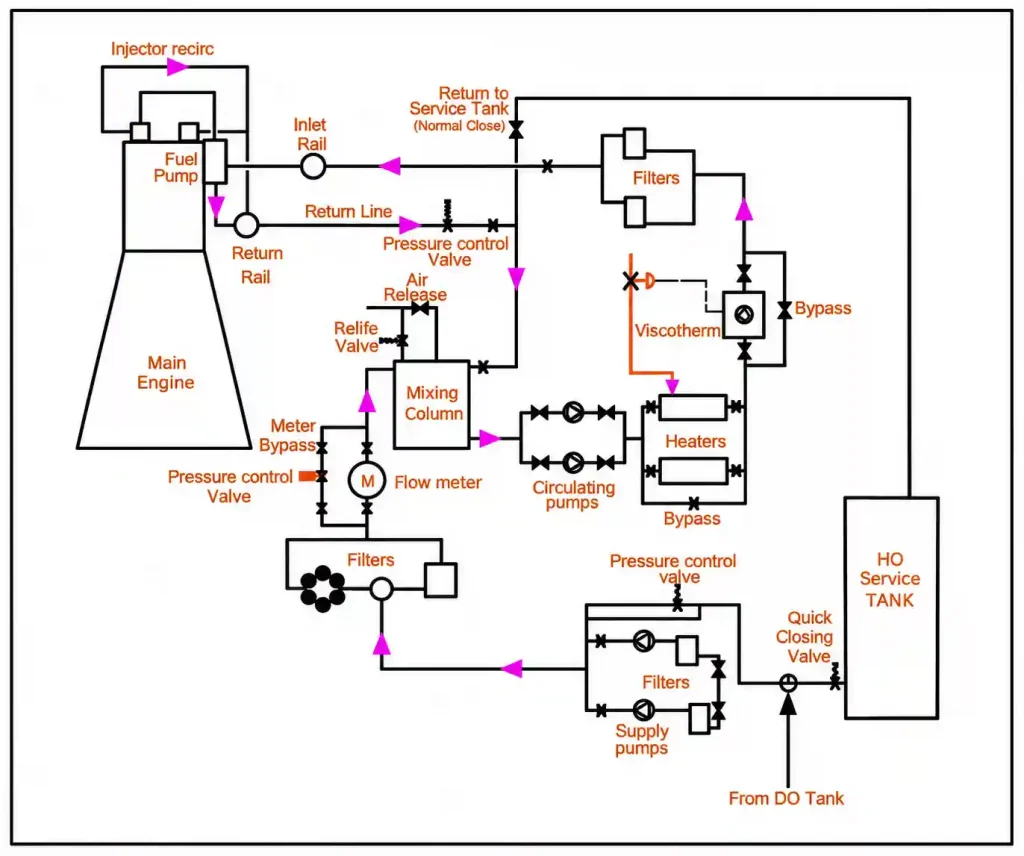
A large marine diesel engine can consume a lot of fuel, this requires storage, filtering, heating, pressurising, and accurate delivery. When something goes wrong with this system you’ll notice quickly with a loss of power, smoke, rough running or complete failure. This is a treatment system for the fuel; taking a dirty viscous fuel and converting it to usable fuel for the injectors. This post will look at the fuel route from the bunker tank to the cylinder.
Marine vessels use a variety of fuels:-
The sulphur content of fuels is regulated by international regulations (MARPOL Annex VI). These are stricter in emission control areas. Many vessels will have multiple grades of fuel and will switch between them. Some vessels may have scrubbers or alternative fuels but the general principle remains the same. Regulations and availability will change over time so ensure you’re aware of the current regulations and fuel policy of your company.
Want to improve your practical marine engineering knowledge? Explore the Merchant Navy Decoded App, where seafarers can access MND FLIX technical learning resources, MMD exam preparation support, DG Shipping updates, and other useful maritime services.
Each part of the system performs a purpose
Â
Â
Â
All fuel tanks will require regular draining of water and sludge. The fuel level, temperature and tank gauges will be monitored. Overflows can cause pollution so care must be taken when filling. Drip trays & save-alls will be present.
The most important part of the fuel cleaning process is the purifier. This is a centrifugal separator and will spin the fuel at high speeds, separating out the heavier water and solid particles.
There are 2 commonly used modes:-
The fuel should be heated to around the manufacturers recommendations prior to going into the separator. This causes the fuel to become thinner which helps with the separation. The throughput should be low enough to ensure the oil is fully cleaned. If the purifier is run too fast or the fuel isn’t at the correct temperature then dirty fuel will pass through.
Modern units will be self cleaning. Sludge will be discharged at intervals to the sludge tank. The unit must be maintained properly. Bowls should be cleaned and checked. Sludge should be dealt with following the ship’s waste procedures.
Purifiers are very important when trying to remove catalytic fines. These are hard aluminium & silicon particles from the catalyst in the refinery. They can cause excessive wear on the pumps, injectors, liners & rings. Limits and testing will be performed to ensure the fuel doesn’t contain these.
Heavy fuel can be quite viscous at ambient temperatures. The fuel needs to be at the viscosity specified by the engine manufacturer. Typically this will be a narrow range. To achieve this the fuel will be heated.
A viscosimeter will be used to measure the viscosity of the fuel going to the engine. It will adjust the heater to keep the fuel at the correct viscosity. If the fuel is too cold and viscous then the injection spray won’t be good and combustion will be bad. If the fuel is too hot and thin then the pumps will suffer from lack of lubrication and efficiency, with a risk of vapour.
The fuel will be heated in stages. The temperature will increase gradually. This can be done using steam, thermal oil or electric heating. The correct temperature will vary depending on the grade of fuel being used. All heated pipework will be traced and insulated to ensure the fuel doesn’t become viscous.
Filters are the last line of defence for the pumps & injectors. A typical setup will contain:-
Pressure Differential will be monitored. This indicates that the filter is becoming blocked. A bypass will be in place to protect the system but it is not good practice to run the fuel through the bypass. This will mean unfiltered fuel will be going to the engine.
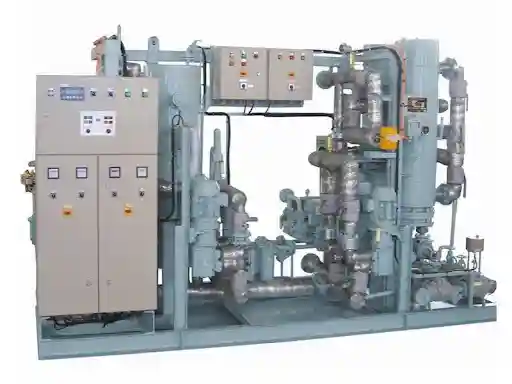
The booster system is a loop to treat the fuel prior to going to the engine. Generally contains:-
Pressure will be kept high to prevent boiling/gas formation. Pressure will be high enough to ensure the injection system receives fuel properly. The circulation ensures the fuel is kept moving and at the correct temperature. Only the correct amount will be sent to the engine.
Changing fuels such as heavy fuel to distillate (e.g. Entering an emission control area) needs to be done carefully.
The biggest issue will be thermal shock. The heavy fuel will be at a high temperature and the distillate will be cold. If the cold fuel is introduced too quickly the temperature of the injection pumps and injectors will drop quickly. This can cause seizing or scuffing of components due to the tight tolerances. The changeover should be done slowly. The temperature should be changed gradually, following the manufacturers guidelines. The changeover should also be timed to ensure the correct fuel is in the system when entering the controlled area. The changeover should be recorded with timings, volumes and amounts of fuel.
Some fuels don’t mix well. This can cause sludge formation. This is why, where possible, bunkers will be separated. This also applies to changing grades in the tanks. Distillate fuels are thin with low viscosity. Many vessels will have a cooling system in place to prevent the distillate becoming too hot and thin. This will ensure the viscosity at the pumps is within limits. The system must also be able to cope with the reduced lubricity.
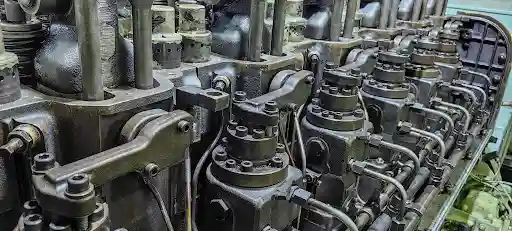
The fuel must be delivered at the correct time, amount, at high pressure, and as a fine spray.
Regardless of the type of engine the injectors will spray the fuel as a fine mist which mixes with the hot compressed air. Worn/dirty injectors will cause poor spraying resulting in poor combustion, smoke and fouling. Some engines will have cooling on the injectors. They will be overhauled and tested at set intervals.
High pressure pipework will be at very high pressures. Usually they will have a sheath or double wall to protect them. There will also be an alarm for any leakage. This will prevent fuel spraying onto hot surfaces in the event of a rupture. This is a fire safety measure. Leak off and drain lines will collect any small amounts of fuel leaking past the plungers/injectors and send it to a leak tank.
Fuel and hot engines can be a fire risk. The following are in place to reduce this risk:-
This is required by SOLAS and class. The exact setup will vary between vessels.
Sometimes the fuel you receive won’t be what is stated on the paperwork. Due to the effect fuel can have on the engine and regulations it is good practice to check:-
Poor quality fuel can cause issues either immediately or gradually. Try not to use a bunker until you know what it is.
The fuel system of a marine diesel takes a heavy dirty fuel and treats it in stages. The tanks & settling will easily remove contaminants. The purifiers & filters will remove the rest. The heating & viscosity controller will put the fuel into the correct condition. The booster loop will send the fuel to the injection system at a constant pressure. The injectors will spray the fuel as a fine mist at the correct time. The safety features will reduce the risk of fire. As long as you take care of each part, monitor the quality of fuel and carefully change grades the engine will run clean and reliable.
Heavy Fuel Oil, Low Sulphur (HFO, LSFO and VLSFO) & Distillate (Marine Diesel Oil & Marine Gas Oil). Many vessels will have more than one grade.
It is very viscous at normal temperatures. Heating will reduce the viscosity allowing it to be pumped, cleaned & injected.
Spins the fuel at high speeds to remove water & solid particles. Removes cat fines.
Measures the viscosity of the fuel going to the engine and adjusts the heater to keep it within the correct range specified by the engine manufacturer.
Where the fresh fuel is mixed with the fuel coming back from the engine. Allows air & vapour to escape. Ensures a constant supply.
To avoid thermal shock. Cold distillate can cause the pumps & injectors to seize/scuff.
Hard aluminium & silicon particles from catalyst in the refinery. Can cause excessive wear on the pumps, injectors, liners & piston rings.
To prevent fuel spraying onto hot areas in the event of a rupture. This would be a major fire risk. There will be a leak alarm.
Sampling & testing whilst bunkering. Store fuels separately. Ensure purifiers & filters are working properly.
Disclaimer :- The opinions expressed in this article belong solely to the author and may not necessarily reflect those of Merchant Navy Decoded. We cannot guarantee the accuracy of the information provided and disclaim any responsibility for it. Data and visuals used are sourced from publicly available information and may not be authenticated by any regulatory body. Reviews and comments appearing on our blogs represent the opinions of individuals and do not necessarily reflect the views of Merchant Navy Decoded. We are not responsible for any loss or damage resulting from reliance on these reviews or comments.
Reproduction, copying, sharing, or use of the article or images in any form is strictly prohibited without prior permission from both the author and Merchant Navy Decoded.
Decoded Discount Alert! up to 50% OFF
Use Coupon Code Deep50