Hi this is Team Merchant Navy Decoded !!!

Please fill the below form with your query and we will get back to you in next 12 hours.

Rest assured your data is safe with us !!!🙂

Ask Your Query

Fire Main System in Ship

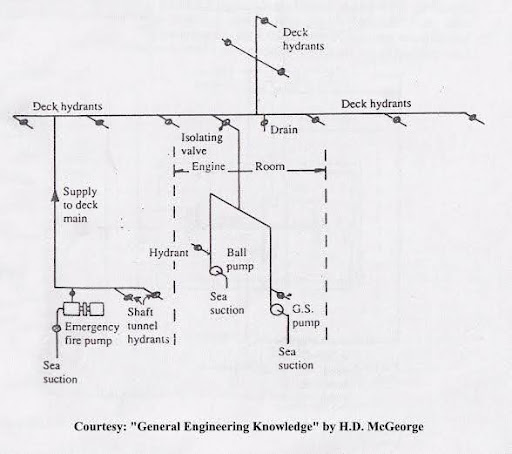
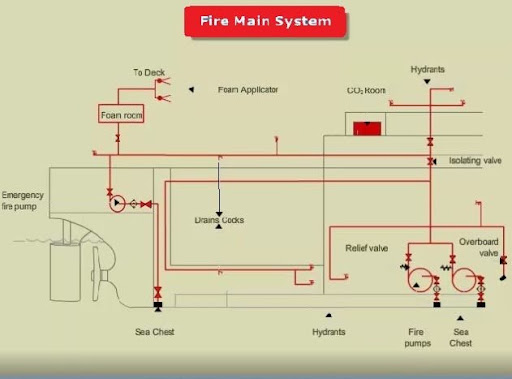
Fire Main System

The Fire Main System in a ship is the primary firefighting water distribution system designed to supply seawater under pressure to fire hydrants located throughout the vessel. It forms the backbone of a ship’s firefighting arrangement and enables the crew to combat fires quickly before they spread.

The system consists of a network of pipelines connected to fire pumps, hydrants, hoses, and nozzles. During a fire emergency, seawater is drawn from the sea chest by the fire pump and delivered through the fire main pipeline to hydrants located around the ship. The system is a mandatory requirement under SOLAS Chapter II-2, which specifies standards for fire protection, fire detection, and fire extinction on board ships.

Purpose of the Fire Main System

The fire main system is designed to:

  • Supply seawater for firefighting operations
  • Deliver adequate pressure to all fire hydrants
  • Provide continuous water supply during fire emergencies
  • Protect accommodation, engine room, cargo spaces, and deck areas
  • Support portable firefighting equipment

Without a properly functioning fire main system, controlling an onboard fire becomes extremely difficult and can threaten the safety of the crew, cargo, and vessel.

Main Components of a Fire Main System

A ship’s fire main system consists of several essential components that work together to ensure a reliable water supply.

Fire Main System

  1. Sea Chest

The sea chest provides seawater to the fire pumps. Most ships have high and low sea suctions to ensure uninterrupted water supply under different loading conditions.

  1. Fire Pumps

Fire pumps are responsible for drawing seawater and supplying it to the fire main pipeline.

Types include:

  • Main Fire Pump
  • Emergency Fire Pump

According to SOLAS, ships are generally fitted with at least two independently driven fire pumps. If both main pumps could be disabled by a fire in the same machinery space, an emergency fire pump located outside that space is required.

  1. Fire Main Pipeline

The fire main is a permanently installed pipeline that distributes pressurized seawater throughout the vessel.

It connects:

  • Fire pumps
  • Fire hydrants
  • Isolation valves
  • International Shore Connection
  1. Fire Hydrants

Fire hydrants are installed at strategic locations throughout the ship.

Each hydrant allows firefighters to connect:

  • Fire hose
  • Nozzle
  • Branch pipe

Hydrant spacing ensures every part of the ship can be reached by at least two jets of water, one of which may be from a single length of hose, in accordance with SOLAS requirements.

  1. Fire Hoses

Fire hoses carry pressurized seawater from the hydrant to the fire location.

Each hose station normally contains:

  • Fire hose
  • Couplings
  • Nozzle
  • Spanner
  1. Fire Nozzle

The nozzle controls water discharge.

Common spray patterns include:

  • Solid jet
  • Fog spray
  • Combination jet and spray

Fog spray is often used to cool surfaces and protect firefighters.

  1. Isolation Valves

Isolation valves divide the fire main into sections.

Advantages include:

  • Easy maintenance
  • Isolation of damaged sections
  • Continuous water supply to unaffected areas
  1. International Shore Connection (ISC)

The International Shore Connection is a standardized flange fitted to the fire main, allowing shore-based fire services to supply water to the ship when alongside in port. It is required by SOLAS for international voyages.

Table of Contents

Working Principle of the Fire Main System

The operation of the fire main system is straightforward:

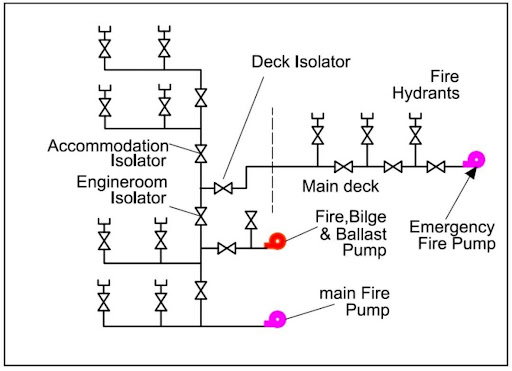
Fire Main System Diagram (Flow)

Step 1: Fire is detected and the fire alarm is raised.

Step 2: The designated fire pump is started.

Step 3: Seawater is drawn through the sea chest.

Step 4: Water is pumped into the fire main pipeline.

Step 5: Crew connect a fire hose to the nearest hydrant.

Step 6: The nozzle is opened and water is directed onto the fire.

If the machinery space is inaccessible due to fire, the emergency fire pump can continue supplying the fire main from its independent location.

SOLAS Requirements for Fire Main Systems

The International Convention for the Safety of Life at Sea (SOLAS) specifies minimum requirements for shipboard fire main systems, including:

  • Adequate number of independently driven fire pumps
  • Emergency fire pump when required
  • Fire hydrants positioned to cover all spaces
  • Sufficient pressure and water flow at the most remote hydrant
  • Readily available fire hoses and nozzles
  • Operational readiness, inspection, and maintenance of the entire system

These provisions are contained in SOLAS Chapter II-2, which governs fire protection, detection, and extinction on ships.

Advantages of the Fire Main System

The fire main system provides several important benefits:

  • Rapid response to onboard fires
  • Continuous seawater supply
  • Coverage throughout the vessel
  • Reliable operation during emergencies
  • Integration with portable firefighting equipment
  • Compliance with international safety regulations

Routine Maintenance of the Fire Main System

Regular maintenance ensures the system remains ready for emergencies.

Routine tasks include:

  • Testing main fire pumps
  • Testing emergency fire pump
  • Checking fire hydrants for leaks
  • Inspecting hoses and couplings
  • Operating isolation valves
  • Verifying nozzle operation
  • Inspecting sea suction strainers
  • Checking pipeline corrosion
  • Confirming International Shore Connection condition
  • Recording all inspections and tests

Common Problems in Fire Main Systems

Some common issues include:

Problem

Possible Cause

Solution

Low Water Pressure

Pump wear or leakage

Inspect pump and pipeline

Hydrant Leakage

Damaged valve seat

Replace valve components

Corroded Pipeline

Saltwater corrosion

Repair or replace pipe

Hose Damage

Age or improper storage

Replace hose

Pump Fails to Start

Electrical or mechanical fault

Inspect motor, coupling, and power supply

Blocked Sea Suction

Marine growth or debris

Clean sea chest and strainer

Safety Precautions During Fire Main Operation

Always follow safe operating practices:

  • Wear appropriate firefighting PPE.
  • Confirm adequate pump pressure before opening hydrants.
  • Open hydrant valves gradually to avoid water hammering.
  • Never stand directly in front of a charged hose.
  • Check communication between the bridge and firefighting team.
  • Test emergency fire pumps regularly.

Frequently Asked Questions (FAQs)

The fire main system is a permanent seawater piping network that supplies water under pressure to fire hydrants for firefighting throughout the vessel.

An emergency fire pump provides an independent source of water to the fire main if the main fire pumps become unavailable due to a fire in the machinery space.

It is a standardized flange that enables shore firefighters to connect an external water supply to the ship’s fire main while in port.

Seawater is readily available around the vessel, making it a reliable firefighting medium for most onboard fires.

The fire main system falls under SOLAS Chapter II-2, which addresses fire protection, fire detection, fire extinction, and operational readiness.


Disclaimer :- The opinions expressed in this article belong solely to the author and may not necessarily reflect those of Merchant Navy Decoded. We cannot guarantee the accuracy of the information provided and disclaim any responsibility for it. Data and visuals used are sourced from publicly available information and may not be authenticated by any regulatory body. Reviews and comments appearing on our blogs represent the opinions of individuals and do not necessarily reflect the views of Merchant Navy Decoded. We are not responsible for any loss or damage resulting from reliance on these reviews or comments.

Reproduction, copying, sharing, or use of the article or images in any form is strictly prohibited without prior permission from both the author and Merchant Navy Decoded.

DIWALI SALE

Decoded Discount Alert! up to 50% OFF

DIWALI SALE

Decoded Discount Alert! up to 50% OFF

Use Coupon Code Deep50

Days
Hours
Seconds
0
Would love your thoughts, please comment.x
()
x