Hi this is Team Merchant Navy Decoded !!!
Please fill the below form with your query and we will get back to you in next 12 hours.
Rest assured your data is safe with us !!!🙂
Ask Your Query| For Beginner | For Professional |
|---|---|
| GME | Engine Side |
| G.P. Rating | Deck Side |
| ETO | G.P. Rating |
| IMUCET & Sponsorship | Combo Offers |
| Free Course | MEO |
| Free Course |
| For Beginner | For Professional |
|---|---|
| GME | Engine Side |
| G.P. Rating | Deck Side |
| ETO | G.P. Rating |
| IMUCET & Sponsorship | Combo Offers |
| Free Course | MEO |
| Free Course |
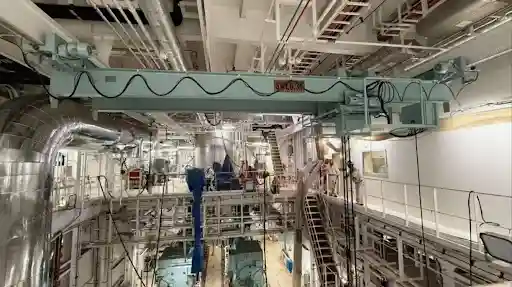
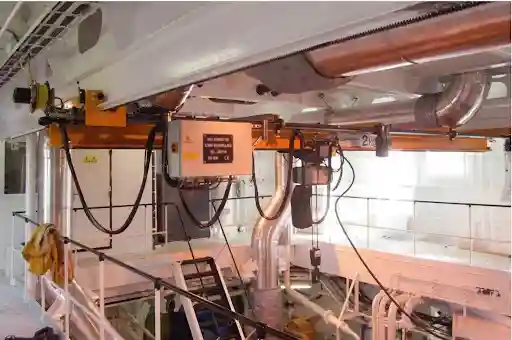
The engine room is a busy place and the main piece of equipment used for heavy lifting is often overlooked unless there is a problem. This one piece of kit will be used for lifting your piston, cylinder head, liner, turbocharger rotor and pump to be overhauled. Due to the heavy loads, confined spaces and moving of the ship, mistakes can happen which can lead to serious injury.
Know your equipment
Most engine rooms will have one of the following:-
All of these work in the same principle but will have different controls, limitations and capacities. Always read the plate on your crane. The Safe Working Load should be indicated on the plate. This means, you should never lift more than this stated amount.
You should carry out a quick check before lifting anything:-
Ensure the crane is up to date with checks. Lifting appliances on board are regularly inspected and tested to class and flag requirements. There should be a register and certificates.
Think about how you are going to lift the load. Ask yourself:-
Many ships require a work permit or risk assessment for heavy lifting.
Ensure your crane is safe.
Be organised:
Engine rooms can be very noisy. Agree on clear signal hands or radios. Ensure the person giving signals can clearly see the load and the operator. Only one person should be giving signals at a time. Anyone can shout ‘stop’ and the operator should stop straight away.
Account for ship movement
Many people are surprised that the ship will move at sea. The ship will roll, pitch and vibrate. Even in port it could move due to other vessels and swelling. Loads that would sit still in a workshop could move quite a bit. It’s best to carry out heavy lifting when it’s calm or in port. If you have to carry it out at sea ensure the load is held in place with lashings/tag lines, lifted as low as possible and extra care taken. Some lifts may involve engine room hatches and openings to the deck above. Coordinate with the deck side.
Put the crane back in a safe condition. Raise the hook so it is clear of the working area (don’t hit the upper limit). Park the crane in it’s allocated area. Turn off the power and store the pendant. Return slings and gear to their correct storage. Report any damage or issues.
Regular maintenance should be carried out.
Whilst none of this is complicated it is important to know what you are lifting, check the crane and gear, plan your lift, communicate, lift slowly, keep everyone clear and account for ship movement. Most crane incidents occur due to lack of checks, hurried lifts and incorrect positioning. Taking a few minutes to complete the checks before lifting will ensure the crane is used as intended.
Safe Working Load – This is the maximum amount the crane/lifting gear can lift. You should never exceed this.
Crane, rope/chain, hook and latch, pendant and controls, emergency stop, limit switches, brake and checks.
They are a safety device to stop the hook/trolley from hitting anything. Using them as a normal stop will wear them out and reduce your safety margin.
The larger the angle between the sling legs the more tension there will be. Slings that are fine for a small angle could be overloaded for a large angle.
It’s best to do heavy lifting in port or when it’s calm. If you have to lift at sea ensure the load is held in place, lift as low as possible, use tag lines and extra care.
Stop immediately. If possible lower the load. Check the item is fully unbolted. If it’s seized pulling it could overload the crane.
Only trained and authorised personnel who know how to use the controls and emergency procedures.
Disclaimer :- The opinions expressed in this article belong solely to the author and may not necessarily reflect those of Merchant Navy Decoded. We cannot guarantee the accuracy of the information provided and disclaim any responsibility for it. Data and visuals used are sourced from publicly available information and may not be authenticated by any regulatory body. Reviews and comments appearing on our blogs represent the opinions of individuals and do not necessarily reflect the views of Merchant Navy Decoded. We are not responsible for any loss or damage resulting from reliance on these reviews or comments.
Reproduction, copying, sharing, or use of the article or images in any form is strictly prohibited without prior permission from both the author and Merchant Navy Decoded.
Decoded Discount Alert! up to 50% OFF
Use Coupon Code Deep50