Hi this is Team Merchant Navy Decoded !!!
Please fill the below form with your query and we will get back to you in next 12 hours.
Rest assured your data is safe with us !!!🙂
Ask Your Query| For Beginner | For Professional |
|---|---|
| GME | Engine Side |
| G.P. Rating | Deck Side |
| ETO | G.P. Rating |
| IMUCET & Sponsorship | Combo Offers |
| Free Course | MEO |
| Free Course |
| For Beginner | For Professional |
|---|---|
| GME | Engine Side |
| G.P. Rating | Deck Side |
| ETO | G.P. Rating |
| IMUCET & Sponsorship | Combo Offers |
| Free Course | MEO |
| Free Course |
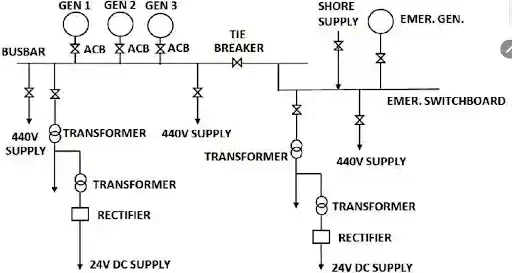
Every ship has an electrical power flow diagram. This is usually known as the single line diagram. This is posted in the engine control room, listed in the electrical manual and used during blackouts, faults and isolation.
Understanding this diagram can give you all the information needed to answer questions like if this generator trips what will still be on? What will be lost if I open this breaker? Where does the emergency board get its supply? This post will explain how to read and understand the power flow diagram.
Want to understand how electrical power is generated, distributed, and supplied across different systems on a ship? Explore the Electrical Circuit Diagram Course by Merchant Navy Decoded to improve your understanding of shipboard electrical circuits, connections, and power distribution systems.
As electrical power on a ship is 3 phase there are 3 conductors. To show all 3 phases on each cable would make the diagram very complicated. Instead we draw this as one line, therefore it is referred to as a single line diagram. This is a simplified version showing how the components are connected.
You don’t need to know all these symbols but some will be used on most ships:-
Usually all components will have a tag or label. This will match the tags on the actual equipment and the breaker list
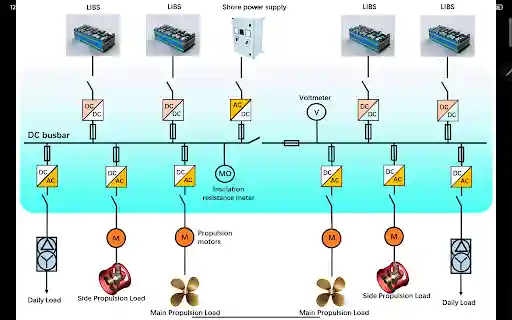
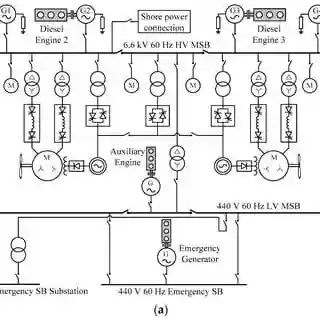
Actual diagrams will be more complex with more feeders and protection. The general layout will be the same with supply coming from the generators to the busbars and then everything else.
When the ship is connected to shore supply the breaker will be closed and generators turned off. This can be seen on the diagram with another supply. There is an interlock between the shore breaker and the generators to ensure you cannot accidentally put both on. The voltage, frequency and phase sequence must all match before connecting to avoid the motors running in reverse.
If the main supply is lost:-
You can follow this on the diagram by seeing which breakers will open and close. It is a good idea to practice this on paper.
The power flow diagram acts as a map. The generators are at the top, busbars in the middle and loads at the bottom. Breakers, transformers and emergency supplies are also shown. This will tell you where the power is coming from, going to, what is protecting it and what will happen if there is a fault. Once you are confident reading the diagram, you will be able to follow the power flow during normal operation, shore supply and blackouts. This will allow you to safely isolate equipment and troubleshoot much quicker.
          A simplified diagram showing a 3 phase electrical system. Each circuit is represented by one line to show how the supply, busbars, feeders and loads are connected.
     Normally from top to bottom. From the supply (generators, shaft generator and shore supply) through the busbars and feeders to the loads.
           This connects the two sections of the main busbar. This allows them to be run together or separated. If there is a fault on one section the other will still work.
To prevent them both being accidentally connected to the busbars. This could cause damage to equipment.
           The interconnector breaker will open. The emergency generator will start and the   breaker will close onto the emergency board. Emergency loads will return.
Disclaimer :- The opinions expressed in this article belong solely to the author and may not necessarily reflect those of Merchant Navy Decoded. We cannot guarantee the accuracy of the information provided and disclaim any responsibility for it. Data and visuals used are sourced from publicly available information and may not be authenticated by any regulatory body. Reviews and comments appearing on our blogs represent the opinions of individuals and do not necessarily reflect the views of Merchant Navy Decoded. We are not responsible for any loss or damage resulting from reliance on these reviews or comments.
Reproduction, copying, sharing, or use of the article or images in any form is strictly prohibited without prior permission from both the author and Merchant Navy Decoded.
Decoded Discount Alert! up to 50% OFF
Use Coupon Code Deep50