Hi this is Team Merchant Navy Decoded !!!
Please fill the below form with your query and we will get back to you in next 12 hours.
Rest assured your data is safe with us !!!🙂
Ask Your Query| For Beginner | For Professional |
|---|---|
| GME | Engine Side |
| G.P. Rating | Deck Side |
| ETO | G.P. Rating |
| IMUCET & Sponsorship | Combo Offers |
| Free Course | MEO |
| Free Course |
| For Beginner | For Professional |
|---|---|
| GME | Engine Side |
| G.P. Rating | Deck Side |
| ETO | G.P. Rating |
| IMUCET & Sponsorship | Combo Offers |
| Free Course | MEO |
| Free Course |
All equipment on board uses electricity, this includes pumps, fans, lights, winches and radars. There is no national grid, so the power is generated, distributed, protected and maintained in a fail-safe way. This is known as the electrical distribution system. Once you can follow the flow of electricity from the generator to the lamp inside the cabin, most of the equipment within the electrical department begins to make sense.
Want to learn more about group starter panels and their role in shipboard electrical distribution? Explore the Group Starter Panel Course by Merchant Navy Decoded to understand its components, working principles, motor control, and electrical protection systems onboard ships.
There are a few stages to electrical distribution:-
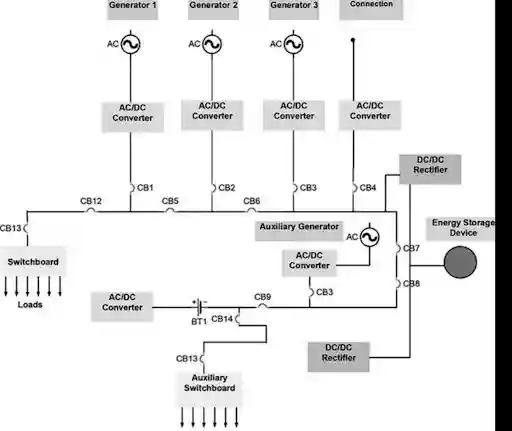
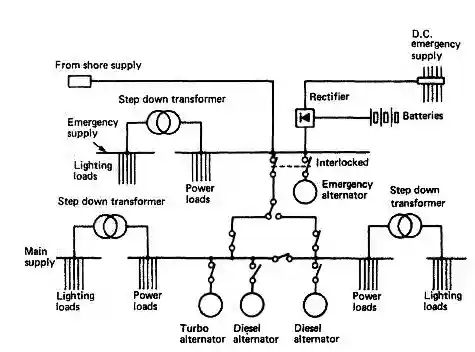
This is shown in a single line diagram.
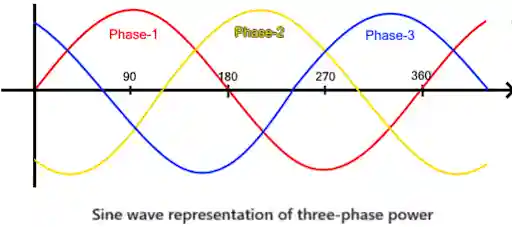
Most ships will have a 3-phase voltage. The most common voltages used are 440V @ 60Hz, but some ships will have 380V or 400V @ 50Hz. The electricity is supplied at a high voltage and is reduced using a transformer to provide a low voltage supply to lights and small equipment. This is usually 220V (or 230V). There is also a 24V DC supply which comes from batteries and chargers. This is used for control circuits, alarms, emergency lighting and communications.
Large ships (tankers, cruise ships and some container ships) will have a high voltage supply. Usually this is 3.3kV, 6.6kV or 11kV. This reduces the current and therefore the size of cable needed. This high voltage will be stepped down using transformers to give 440V to normal equipment. Any high voltage equipment requires specialist training, procedures and safety equipment.
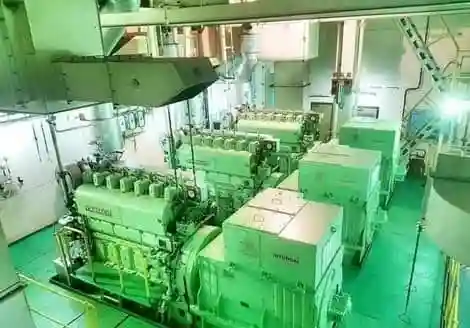
Ships usually have several generators. This is so that if one needs to be maintained there will not be a blackout. It also means that there can be enough generators running to match the load. Depending on where the ship is, there may only be 1 or 2 generators running. When in port or using thrusters to manoeuvre there may be 3 or more generators running.
The generators will be synchronised and run in parallel. Before connecting the generators to the live bus, they must match the voltage, frequency and phase. This means that the generators share the load. This is achieved using governors and power management. No one generator will receive too much load.
Some ships will have a shaft generator. This is driven by the main engine and provides a low cost supply when at sea. Shore connection allows the ship to take power from the port. This means that the generators can be switched off.
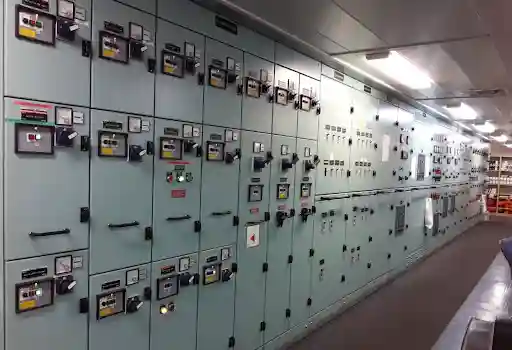
The main switchboard is the core of the system. It contains:-
Protection is an important feature of the system. If there was a fault on the electrical system on the ship it could cause a fire or even a blackout when it is most needed. The main devices to protect the system are:-
From the main switchboard, feeders (large cables) will send power to:-
The system is generally radial. Feeders will leave the main switchboard. They will then branch off. Each item of equipment will generally only have one source. Important equipment such as the steering gear will have a dual supply from different sections of the board.
The e main 440V and 220V systems are usually insulated. No points are deliberately connected to the hull. If there was one earth fault it will not trip the supply. The equipment will still run whilst the fault is located. If there was a second fault on another phase this would cause a short circuit through the hull. Therefore insulation levels are constantly monitored.
This is an independent supply. This ensures that essential services are maintained in the event of a loss of power. This could be due to a fire or flooding in the engine room.
The emergency generator and system will be regularly tested. This includes testing the automatic start. The emergency switchboard must always be ready.
If there is a loss of main supply (blackout) the emergency generator will start. Most ships will have an automatic system which will start a standby generator. The breaker will close onto the dead busbar. Essential equipment will be restarted in sequence (sequential restart). This is to ensure that not everything tries to start at once. Once the main supply is stable the essential equipment will be restarted. This will include lube oil pumps, cooling water pumps and fuel pumps. The steering gear and other auxiliaries will then be restarted. Finally the main engine can be restarted.
Cables on ships are flame retardant. They will be in cable trays and ducts. They will be correctly supported, away from heat and fluids. Essential equipment will be routed so that if there was a fire it will not lose both the main and standby supplies. All metal casings will be earthed to the ship’s hull. This is separate to the insulated system. This means that any exposed metal will be at the potential of the hull and is safe to touch.
The electrical distribution system seems quite complex but the principles are simple. Generate, distribute, protect all the branches and have an independent emergency supply ready in case of a loss of supply. The generators feed into the main switchboard. Feeders will send the electricity to the starters and transformers. Protection will prevent faults from affecting the rest of the system. The emergency system will ensure that essential services are maintained. Once you can follow the flow of electricity on the single line diagram it becomes much easier to trace a fault or plan a job.
Usually 440V 3-phase @ 60Hz. Some ships will run at 380V/400V @ 50Hz. 220V/230V for lights and small equipment. 24V DC for control and emergency systems. Large ships may run at high voltage such as 3.3kV, 6.6kV, 11kV.
So that one can be maintained or failed whilst maintaining the supply. It allows enough generators to run to match the load.
When the generators are close to overload non-essential equipment will be tripped automatically to maintain the essential services.
If a generator starts to motor (being driven by the bus) it will trip.
To provide emergency services in the event of a loss of supply. It will automatically start and must provide the emergency loads within 45 seconds.
Batteries provide certain equipment such as emergency lighting and alarms whilst the emergency generator starts.
This connects two sections of the switchboard. This will allow faults to be isolated on one section.
Emergency generator starts. The standby generator starts and closes onto the dead bus. Essential services are restarted in sequence.
Disclaimer :- The opinions expressed in this article belong solely to the author and may not necessarily reflect those of Merchant Navy Decoded. We cannot guarantee the accuracy of the information provided and disclaim any responsibility for it. Data and visuals used are sourced from publicly available information and may not be authenticated by any regulatory body. Reviews and comments appearing on our blogs represent the opinions of individuals and do not necessarily reflect the views of Merchant Navy Decoded. We are not responsible for any loss or damage resulting from reliance on these reviews or comments.
Reproduction, copying, sharing, or use of the article or images in any form is strictly prohibited without prior permission from both the author and Merchant Navy Decoded.
Decoded Discount Alert! up to 50% OFF
Use Coupon Code Deep50