Hi this is Team Merchant Navy Decoded !!!

Please fill the below form with your query and we will get back to you in next 12 hours.

Rest assured your data is safe with us !!!🙂

Ask Your Query

Electric Current Flow Direction

Introduction

Electric current is one of the fundamental concepts in electrical and electronic engineering disciplines. Any device or machinery that requires electricity for its operation is a result of the flow of current in a closed circuit. 

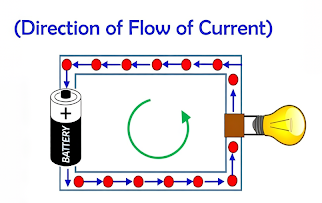
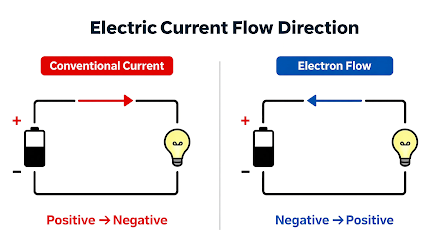
The direction of current flow is a common misconception among electronics students with the movement of electrons taking place from the negative to the positive terminal whereas the conventional current direction is from the positive to negative terminal. Both current directions are correct because they describe electricity in different aspects.

What Is Electric Current?

Electric Current Flow Direction

Electric current is the flow of electric charge in a closed circuit resulting from the movement of electrons. In metallic conductors such as copper wire electricity flows in the form of electrons.

The formula for calculating electric current is:

I= Q/t

Where: I is the current in Amperes,

Q is the quantity of charge measured in Coulombs,

t is the time taken for charge to flow in seconds.

How Does Electric Current Flow?

For current to flow, three basic conditions must be met:

  • A source of electrical energy like a battery or generator.
  • A conducting path, usually made of copper or aluminum.
  • A closed circuit with no breaks.

When the circuit is complete the voltage from the source creates a field inside the conductor. This electric field pushes the electrons making them move and create electric current.

Electron Flow Direction

In metallic conductors, electrons are charge carriers and therefore electricity flows from the negative terminal to the positive terminal.

Conventional Current Direction

Before the discovery of electrons by scientists electricity was assumed to flow from the positive terminal to the negative terminal in primary cells. This direction of conventional current is used to describe how electrons ideally should flow within circuits.

Table of Contents

Why Are There Two Current Directions?

  • Electron flow: 

Negative terminal → Positive terminal

  • Conventional current: 

Positive terminal → Negative terminal

The flow of electrons takes place from the negative terminal to the positive terminal of the battery whereas conventional current is opposite to the direction of electron flow.

Electric Current Flow Direction

Factors That Affect Current Flow

1.Voltage

A higher voltage provides a stronger electrical force allowing more current to flow through the circuit.

2. Resistance

Resistance opposes the movement of current. Materials with high resistance allow less current to pass.

3. Conductor Material

Copper, silver and aluminum are excellent conductors because they have many free electrons available for conduction.

4. Temperature

As temperature increases, the resistance of most metallic conductors also increases, reducing the amount of current flowing through them.

Current Flow in Different Materials

Electricity flows differently in different materials. Metals carry electricity through free electrons but electrolytes conduct electricity through ions. On the other hand, semiconductors allow the flow of current through the movement of free electrons and holes to fill empty spaces.

Applications of Current Flow Direction

  • Designing electrical and electronic circuits.
  • Troubleshooting faults in wiring systems.
  • Installing batteries with correct polarity.
  • Operating electric motors and generators.
  • Maintaining industrial control systems.
  • Marine electrical systems and shipboard power distribution.

Common Misconceptions

  • Current and electrons always move in the same direction. In reality, conventional current is opposite to electron flow.
  • Electric current is the same as voltage. Voltage causes current to flow but they are different quantities.
  • Electrons travel at the speed of light. Individual electrons move relatively slowly, while the electrical signal travels through the conductor almost at the speed of light.

Conclusion

The direction of current is a vital concept in electrical and electronics engineering which describes the nature of electricity. In reality electrons flow from one terminal to another but still make use of conventional current.

Whether one is working on simple domestic electrical devices or operating industrial electronics, the concept of current flow direction is critical to how engineers interpret circuit diagrams and perform electrical operations. Having a clear understanding of the topic is crucial in developing a clear understanding of electrical and electronics engineering principles. The knowledge of electricity flow direction is essential in running and interpreting electrical circuits correctly.

Frequently Asked Questions (FAQs)

Electron flow is the movement of electrons from the negative terminal to the positive terminal whereas conventional current is the direction that describes how electrons ideally should flow.

Electrical engineering adopts conventional current to describe how current is supposed to flow during calculations and designs. The direction is also useful in determining how electricity flows within circuit diagrams internationally.

A closed circuit means there is a continuous path for electricity to flow from the supply source to the load. The current flows through the conducting wires as opposed to an open circuit where electricity cannot flow due to discontinuity of the wire.

Disclaimer :- The opinions expressed in this article belong solely to the author and may not necessarily reflect those of Merchant Navy Decoded. We cannot guarantee the accuracy of the information provided and disclaim any responsibility for it. Data and visuals used are sourced from publicly available information and may not be authenticated by any regulatory body. Reviews and comments appearing on our blogs represent the opinions of individuals and do not necessarily reflect the views of Merchant Navy Decoded. We are not responsible for any loss or damage resulting from reliance on these reviews or comments.

Reproduction, copying, sharing, or use of the article or images in any form is strictly prohibited without prior permission from both the author and Merchant Navy Decoded.

DIWALI SALE

Decoded Discount Alert! up to 50% OFF

DIWALI SALE

Decoded Discount Alert! up to 50% OFF

Use Coupon Code Deep50

Days
Hours
Seconds
0
Would love your thoughts, please comment.x
()
x