Hi this is Team Merchant Navy Decoded !!!

Please fill the below form with your query and we will get back to you in next 12 hours.

Rest assured your data is safe with us !!!🙂

Ask Your Query

Distress Signals on Ship

Distress Signals on ship

When a ship is in distress (fire, flooding, collision, abandoning ship), it is important to alert people to the situation so they can provide assistance. Distress signals allow this to occur.

There are many standard distress signals. Some are traditional and others are electronic. All distress signals have the same purpose of quickly alerting rescuers to a situation that requires immediate assistance, regardless of language, weather or distance. The main signals are described below, along with information on sending a distress call via radio, using electronic signals, using pyrotechnics and next steps after sending a distress signal.

Understanding distress signals on ships is essential for every marine engineer, especially during emergencies at sea. Along with safety knowledge, strong technical fundamentals are important for MEO Class 4 preparation.

To strengthen your knowledge, explore the MEO Class 4 Free Guidance Series by Merchant Navy Decoded.

Types Of Distress Signal

  1. Distress (Mayday)
  2. Urgency (Pan-Pan)
  3. Safety (Securite)
  • Distress (Mayday) indicates a ship/aircraft/person is in grave immediate danger, assistance is required immediately.
  • Urgency (Pan-Pan) indicates very urgent information about the safety of a ship/person. It does not however indicate immediate danger to the life of people/ship. Examples include needing medical advice or machinery assistance.
  • Safety (Securite) indicates safety of navigation or important weather information.

Only send a Mayday distress signal when in real distress. Only the master can decide to send a distress signal. Never send a distress signal for any other reason.

Recognised Distress Signals

Various distress signals are included within international regulation (COLREGS, Radio regulations):-

  • Voice Distress Signal using the phrase ‘MAYDAY’
  • Digital Selective Calling (DSC) Alert
  • Message using any other form of communication with the group SOS in Morse code.
  • Fire rockets/shells containing red stars (one at a time, in quick succession).
  • Red parachute flares, red handheld flares.
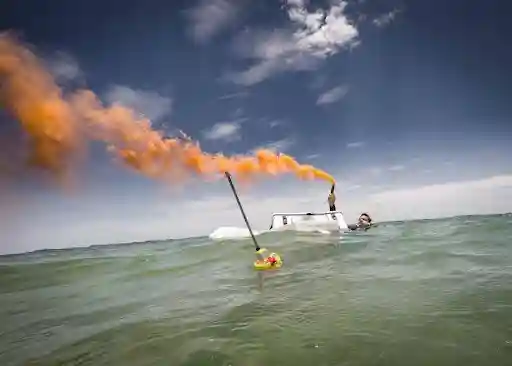
  • Orange smoke signals.
  • Continuous sound from fog signaling device.
  • Slowly repeatedly waving arms out to sides.
  • Visible flames on the vessel (burning tar/oil barrels).
  • Firing a gun/explosive signal approximately every minute.
  • Flag signal NC (International Code of Signals)
  • Square flag with a ball (or object resembling a ball) above/below.
  • Canvas of orange colour, with a black square and circle for visibility from aircraft.
  • Marking the water with dye to colour the sea.
  • EPIRB, SART and AIS-SART 

Some of these distress signals are very old, but are still included as they are effective. All of these signals indicate distress. However, they must not be used for any purpose other than distress.

GMDSS - Distress Signals via Radio and Electronics

Most vessels are equipped with a Global Maritime Distress and Safety System (GMDSS). Using radios and satellite systems, a signal can be sent and aid coordinated. Key components of distress signals include:

Digital Selective Calling (DSC): By pressing a button (protected under a cover) on the DSC unit in the VHF/MF/HF radio, a distress signal is sent digitally. It includes information on the identity of the vessel. If the radio is connected to a positioning system, location and time will also be included. As this signal is automatic and digital, it can be sent quickly to coast stations and other vessels, even if no crew is able to speak. To send this signal, open the protection cover, and hold the red distress button for the time indicated in the manual. Follow up with a voice message on the distress frequency.

Voice Mayday: If a DSC signal has not been sent or is unavailable, a Mayday signal can be sent on the distress frequency (VHF Channel 16). The standard message is:

  1. MAYDAY MAYDAY MAYDAY
  2. THIS IS [Name of vessel] [Name of vessel] [Name of vessel] [Call Sign/Identification]
  3. MAYDAY [Name of vessel] [Call Sign]
  4. Position (latitude/longitude or bearing and distance from a known position).
  5. Nature of distress (eg. fire/flooding)
  6. Type of assistance required.
  7. Number of people onboard.
  8. Any additional relevant information (master’s intentions, weather conditions, type of survival craft).
  9. OVER

Speak the message clearly and slowly. Continue to send the message until it is acknowledged. All vessels must remain silent on this frequency except for aiding vessels.

Satellite: Using satellite systems, such as Inmarsat, distress signals and messages can be sent directly to a rescue coordination centre.

Note: The ship security alert system is for pirate/threat situations, and is not a distress signal in the same way.

Table of Contents

EPIRB

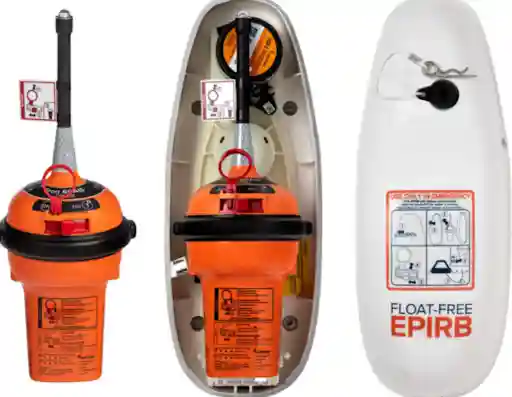
An Emergency Position Indicating Radio Beacon (EPIRB) automatically sends a distress signal. If the vessel has to be abandoned it will automatically activate. A typical 406MHz satellite EPIRB will:-

  • Send a signal to a rescue coordination centre via satellite. The ship can be identified from the unique code on the EPIRB, and its location from either the GPS inbuilt to the EPIRB, or calculated from the satellite.
  • Includes a homing signal to allow rescue by planes/boats.
  • Housed in a bracket with a hydrostatic release mechanism. If the vessel sinks, the EPIRB will automatically float to the surface and activate.
  • Can be manually activated.
  • Includes a flashing light. It can be operated on battery for a long period of time (typically a minimum of 48 hours).

Maintenance

  • Ensure that the EPIRB is registered to the appropriate vessel. If it is unregistered or incorrectly registered, it may delay assistance.
  • Test the EPIRB using the self testing function. As per ship procedures, typically monthly. Do not activate during testing.
  • Check that the batteries and hydrostatic release are not due to expire, and replace as necessary.
  • Ensure the bracket is clear. Ensure the EPIRB is not painted, tied down or blocked.
  • Annual tests must be conducted at an approved servicing centre.
  • Only activate EPIRBs in real emergencies. If it is accidentally activated, immediately inform the rescue authority and state that it was a false alarm.

SART and AIS-SART

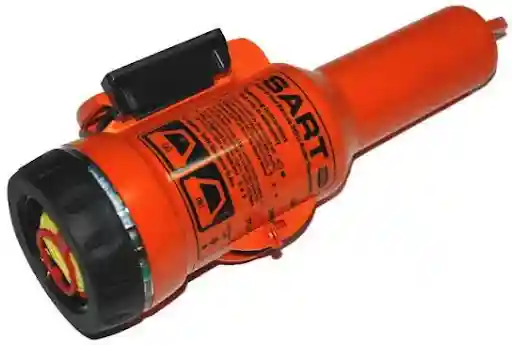
The Search and Rescue Transponder (SART) makes survival crafts easier to locate. It is a small radar transponder, and is typically placed in life rafts and life boats. When the SART receives a radar signal from a rescue vessel (9GHz frequency), it produces a series of blips on the radar screen. This appears as a straight line of blips pointing towards the SART, making it visible on the radar. Without an SART, the survival craft may be difficult to find due to the waves. The range of detection of the SART depends on the height of the SART and radar. However, to maximise detection, it is best to place it as high as possible (on the canopy of the raft or pole)

The AIS-SART performs a similar function using AIS. It sends a special signal that appears on AIS displays of nearby vessels, indicating location. Many vessels now have AIS-SARTs. Some have replaced radar SARTs with AIS-SARTs.

Both devices must be regularly maintained (batteries checked and in good working order). They should be considered as part of the survival craft equipment.

Pyrotechnic Distress Signals

Pyrotechnic Distress Signals

Traditional visual distress signals. These are located on the bridge and on survival craft and are used when a vessel or aircraft can be seen or heard (rescuers are in close proximity). Typical types include:-

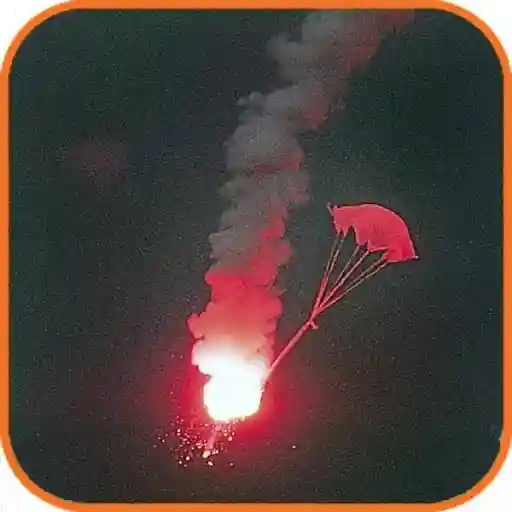
  1. Rocket parachute flares: These produce a bright red flare at height, and descend slowly on a small parachute. These are very visible, and therefore should be used to be noticed from a distance. They can be used in daylight/night. Minimum height and duration is specified in the LSA Code. Check the standard.
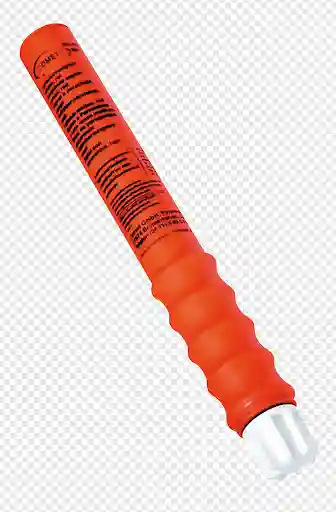
  2. Handheld red flares: Produce a very bright red light for approximately 1 minute. They are used to show the position of survival craft to nearby rescuers (ships/helicopters).
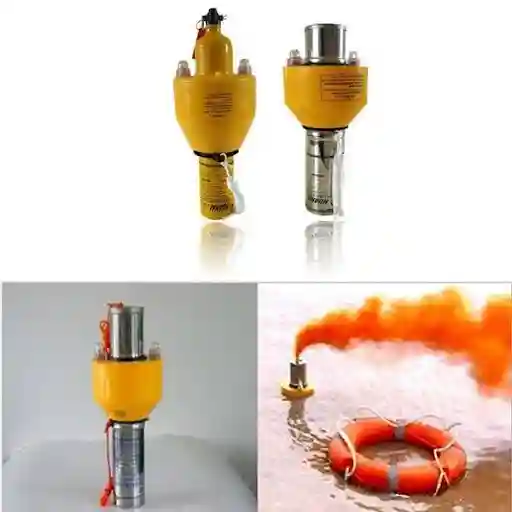
  3. Buoyant orange smoke: Produces thick orange smoke. Typically used in daylight, but particularly helpful for aircraft as it shows wind direction and position. The device floats, and can be thrown onto the water.

Using pyrotechnic distress signals safely. It is very important that these are used safely. General guidance includes:- 

  • Follow the instructions given with the device.
  • Hold the flare away from your body, upwind, and pointing away from survival craft, people and inflatable.
  • Do not point rockets at people or aircraft. Ensure it is pointed at the correct angle.
  • Wear gloves if available. The casing gets very hot and burning particles may drip.
  • Ensure that hand flares are not close to fabric in the life raft. Falling embers may cause damage.
  • Do not waste. Use if there is a chance they will be seen.
  • Store in dry, cool, easily accessible place. Store in original packaging. Keep away from ignition sources.
  • Expiry Dates. These signals have a limited lifetime, typically a few years from the manufacturing date. Check expiration date. If out of date they must be replaced and disposed of correctly, typically at an approved centre or as per regulation.


Pyrotechnic Distress Signal

Training

In order to be used correctly, people should be trained on distress signals. The following should be included in training:-

  1. Location and operation of radio distress systems, and EPIRB.
  2. How to send a Mayday signal, and standard wording. This should be displayed near the radio.
  3. Operation of pyrotechnic signals. Should be demonstrated (with training device) or demonstrated, and should NOT be live.
  4. Understanding of SART and EPIRB functions, and when to turn on.
  5. How to cancel false alarms correctly.
  6. Understanding of other recognised distress signals.
  7. The instructions for sending Mayday and method of determining location should be easy to find at the radio in case someone inexperienced must send a distress signal.

Common Issues

  • Unregistered EPIRB, expiring batteries/release mechanisms, or incorrect details in registration.
  • Accidental activation of DSC distress button or EPIRB. Delay in canceling.
  • Expire pyrotechnic signals. Poor storage in damp/warm areas.
  • No position provided to DSC radio. Therefore the position of the vessel is not included in the distress signal.
  • Crew may not know how to send Mayday signals, or may not have the format available.
  • Flat batteries in SART/AIS-SART. Not tested.
  • EPIRB brackets blocked or painted over.
  • Improper use of pyrotechnic signals. For example, accidentally firing in a drill.
  • Delay in sending an alarm as the situation may improve.

Conclusion

Distress signals mean that a vessel in distress can be located. The voice Mayday and DSC signal mean that the world knows there is trouble and where. If no one is left on board, the EPIRB will continue to send distress signals. The SART allows life rafts to be located using radar. Flares, smoke and mirrors all allow rescuers to know exactly where to look. By ensuring equipment is current, registered, and people know how to use them, and by sending alerts as early as possible, people will know to come to assist.

Frequently Asked Questions (FAQs)

Mayday indicates grave immediate danger and requires immediate assistance. Pan-Pan indicates very urgent safety information, but there is no immediate danger. Security indicates safety information for navigation/weather.

Mayday repeated 3 times, name of vessel (3 times) and call sign, location, nature of distress, assistance required, number of people on board and any other useful information.

Sends a distress signal to rescue coordination centres using satellite. Gives ship ID and location. Includes a homing signal. If vessel sinks, it can automatically be released.

So that the rescue centre can identify the vessel, and get in contact with the owner or vessel to confirm if it is a genuine situation. If unregistered, it can delay a response.

It acts as a radar responder. When rescuers send a radar signal, a line of blips appear on the screen allowing the survival craft to be located.

They are used when rescue vessels can be seen (for example other ships/aircraft). Rocket parachute flares can be used to be seen from a distance. Hand flares and smoke can be used to show location from close by.

Hold away from your body, and upwind. Point away from people and material in life raft. Wear gloves if available. Follow instructions on the device.

Cancel immediately. Send a message to the rescue coordination centre or coast station informing them that it was a false alarm. Include ship identity and location.

Yes. They have a limited life span, typically a few years from production. If out of date they must be replaced and disposed of correctly.

Rescue may take time. Sending distress signals late may mean that rescuers arrive too late. If it is found that it was not necessary, it can be cancelled.

Disclaimer :- The opinions expressed in this article belong solely to the author and may not necessarily reflect those of Merchant Navy Decoded. We cannot guarantee the accuracy of the information provided and disclaim any responsibility for it. Data and visuals used are sourced from publicly available information and may not be authenticated by any regulatory body. Reviews and comments appearing on our blogs represent the opinions of individuals and do not necessarily reflect the views of Merchant Navy Decoded. We are not responsible for any loss or damage resulting from reliance on these reviews or comments.

Reproduction, copying, sharing, or use of the article or images in any form is strictly prohibited without prior permission from both the author and Merchant Navy Decoded.

DIWALI SALE

Decoded Discount Alert! up to 50% OFF

DIWALI SALE

Decoded Discount Alert! up to 50% OFF

Use Coupon Code Deep50

Days
Hours
Seconds
0
Would love your thoughts, please comment.x
()
x