Hi this is Team Merchant Navy Decoded !!!
Please fill the below form with your query and we will get back to you in next 12 hours.
Rest assured your data is safe with us !!!🙂
Ask Your Query| For Beginner | For Professional |
|---|---|
| GME | Engine Side |
| G.P. Rating | Deck Side |
| ETO | G.P. Rating |
| IMUCET & Sponsorship | Combo Offers |
| Free Course | MEO |
| Free Course |
| For Beginner | For Professional |
|---|---|
| GME | Engine Side |
| G.P. Rating | Deck Side |
| ETO | G.P. Rating |
| IMUCET & Sponsorship | Combo Offers |
| Free Course | MEO |
| Free Course |
Water level is one of the most important things that an engineer will be concerned about with a boiler. Pressure can be released via the safety valve. And temperature can be managed with margins. However, if the water level gets too low, the heating surfaces will be exposed to the flames and there will be no way for the heat to be removed and the metal could get too hot, warp or fail. If there is too much water, then wet steam will be produced and this will cause the water to go into the superheater, turbines and pipework.
Water level is monitored, controlled and protected with a number of different independent systems. This post will explain all three.
Want to understand more about ship automation systems? Explore the Automation Package by Merchant Navy Decoded to learn about level controllers, sensors, transmitters, and other essential automation systems used onboard ships.
The aim is to keep water level within a small range and ensure it remains steady as steam load changes.
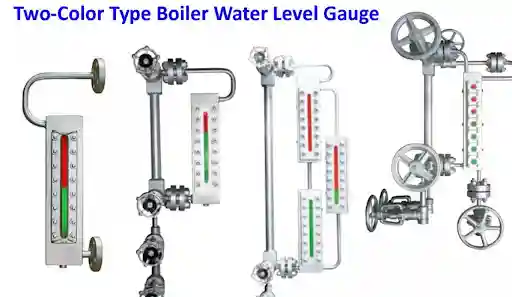
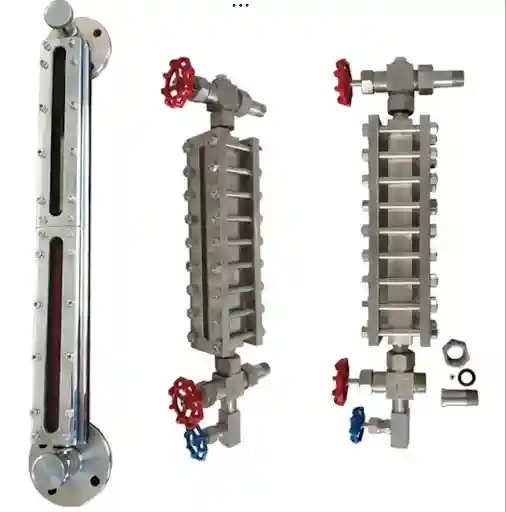
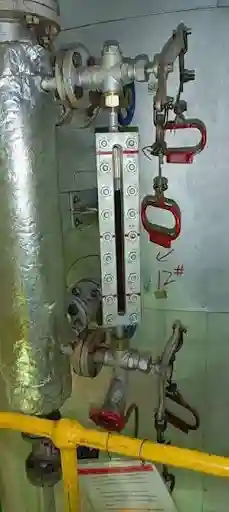
Before any automatic controls, the first thing to do would be to visually monitor water level. All boilers must have a reliable gauge.


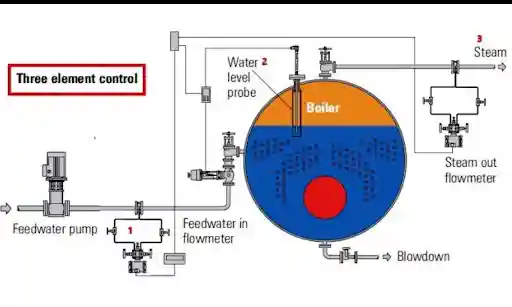
To keep the level within range, the controller will control the amount of feed water entering the boiler. The controller will compare the actual level to the desired level and either start/stop the feed pump or open/close the feed regulating valve.
On/off – The simplest option. When the level falls below a certain point, the controller will start the feed pump. When it reaches a high point, it will stop. This will cause the level to fluctuate. This is a common option on smaller boilers like auxiliary boilers.
Modulating – The feed regulating valve (or variable speed pump) will open/close constantly to match the demand and keep the level more steady.
There are a few methods of modulating:-
This is a quirk of boiler water level control. When there is a sudden increase in steam demand, the pressure in the boiler will drop slightly. This will cause the water in the boiler to boil more vigorously. The steam bubbles in the water will take up more volume causing the level in the drum to rise. This is known as swell. A simple controller will notice the rise and close the feed valve. This is the opposite of what should happen as the boiler is using more water.
If steam demand drops suddenly, the pressure will rise. This will cause the bubbles to collapse which will cause the level to drop. This is known as shrink. A simple controller will open the feed valve.
This is why steam flow is included. This helps the controller to see the actual change in load.
There are a number of ways to measure water level, often multiple on a boiler:-
The controller will try to keep the water level at the correct level, however there are safety devices in place. Typically these will be set at:-
Many boilers will have a high-high trip. This can shut off the feed. The rules will usually require the low water trip to be independent. It is often duplicated to ensure the boiler is protected even if one sensor fails. Requirements will vary depending on boiler type, class and regulations.
These should be regularly tested, often by reducing the level in a controlled manner or using the internal test function. They must never be bypassed to keep the boiler running. All tests and defects should be logged.
The boiler will be kept safe with the water level. The gauge glass provides the visual indication. The controller will keep the level steady whilst load changes. Alarms and trips will be in place as a last resort. The clever bit is the controller taking into account the shrink and swell effects. This is why larger boilers will use steam flow and feed flow. Ensure you look after your gauge glasses and test the protection. Investigate any discrepancies.
If the level drops too low, heating surfaces can overheat and fail. Possibly leading to explosions. If too high, wet steam will cause water to enter pipework and turbines.
To ensure the glass and fittings are clear. After blowing down, the level should return quickly. If it does not then there may be a blockage.
When there is a sudden increase in steam demand, bubbles will form and the level will temporarily rise (swell). However there will be less water in the boiler. When demand drops, the level will temporarily drop (shrink). A simple controller can react incorrectly.
Single element is only water level. Double element includes steam flow. Triple element includes feed water flow. This will give the most stable control especially on larger boilers.
Float, electrode probes, DP transmitter, capacitance and displacer. Often more than one is used.
A safety device to automatically shut off the burner if the water level drops to a dangerously low level. This must be independent of the level controller.
They are the last resort if the controller or gauge fails. Running without them can cause overheating and damage.
Investigate why. If you cannot confirm the water level, do not run the boiler.
Disclaimer :- The opinions expressed in this article belong solely to the author and may not necessarily reflect those of Merchant Navy Decoded. We cannot guarantee the accuracy of the information provided and disclaim any responsibility for it. Data and visuals used are sourced from publicly available information and may not be authenticated by any regulatory body. Reviews and comments appearing on our blogs represent the opinions of individuals and do not necessarily reflect the views of Merchant Navy Decoded. We are not responsible for any loss or damage resulting from reliance on these reviews or comments.
Reproduction, copying, sharing, or use of the article or images in any form is strictly prohibited without prior permission from both the author and Merchant Navy Decoded.
Decoded Discount Alert! up to 50% OFF
Use Coupon Code Deep50