Hi this is Team Merchant Navy Decoded !!!
Please fill the below form with your query and we will get back to you in next 12 hours.
Rest assured your data is safe with us !!!🙂
Ask Your Query| For Beginner | For Professional |
|---|---|
| GME | Engine Side |
| G.P. Rating | Deck Side |
| ETO | G.P. Rating |
| IMUCET & Sponsorship | Combo Offers |
| Free Course | MEO |
| Free Course |
| For Beginner | For Professional |
|---|---|
| GME | Engine Side |
| G.P. Rating | Deck Side |
| ETO | G.P. Rating |
| IMUCET & Sponsorship | Combo Offers |
| Free Course | MEO |
| Free Course |
The piston, the liner, the valves depend on one system quietly running underneath all of it: lubricating oil. It’s not just reducing friction. The same oil is cooling the piston from the inside, carrying away contaminants, and in some designs even helping adjust engine timing hydraulically.
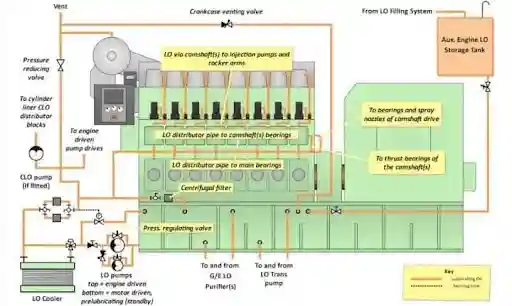
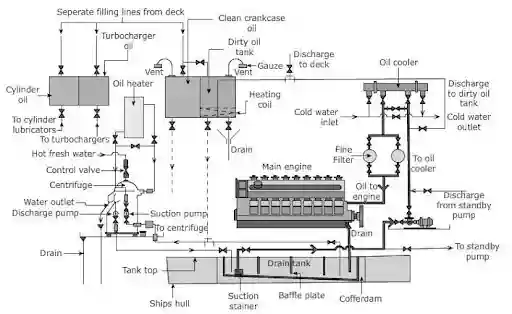
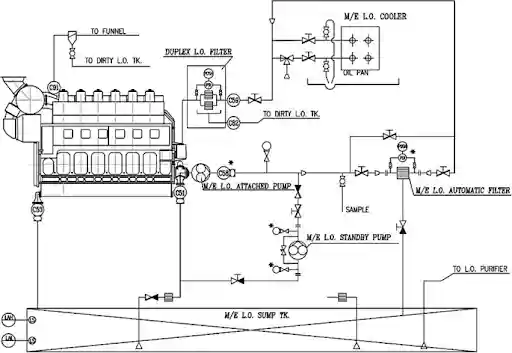
This post lays out the full system: what’s in it, how oil actually flows through it, and what each component is doing with a diagram tying it all together.
Want to understand auxiliary machinery beyond just the basics? Explore the complete Auxiliary package on MND Flix, where you can learn important concepts.
It’s easy to think of lube oil as just reducing friction between moving parts, but on an auxiliary engine it’s doing at least three distinct jobs at once:
A system doing three different jobs at once needs more than a single pump and a pipe which is why the full layout has many components
Component | Function |
Sump (wet) | Oil reservoir, typically built into the bedplate itself,with a dipstick or sight glass to check level |
Suction Strainer | Coarse first stage filter protecting the pump from large debris |
Lube oil pump | Engine – driven drawing oil from the sump and pushing it through the system |
Standby/pre-lubricating pump | Electrically driven,used before starting and as backup if main pressure drops |
Lube oil cooler | Removes heat picked up from the engine typically a plate or tubular heat exchanger |
Thermostatic( 3-way) valve | Controls how much oil bypasses the cooler, keeping oil temperature within range regardless of load |
Full-flow filter | Removes all contaminants from oil before it reaches engine |
Pressure regulating valve | Maintains system pressure by spilling excess oil back to the sump |
Oil mist detector (ODM) | Monitors the crankcase atmosphere for oil mist concentration |
Once oil reaches the distribution line, it’s routed to every point on the engine that needs it and the routing itself is worth understanding, since it isn’t just parallel pipes to everywhere at once.
Â
Destination | How it reaches there |
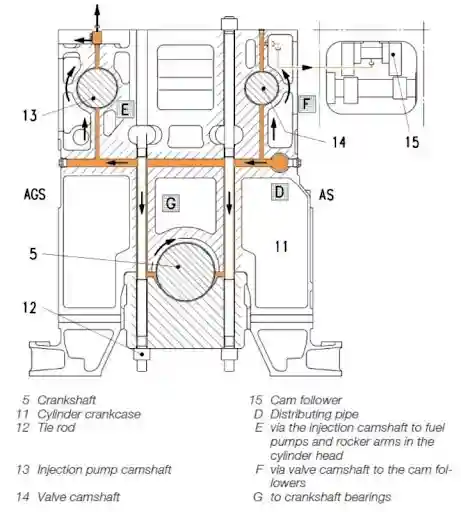
Main bearings | Through bores in the engine frame, connected to the external main lube oil pipe |
Big end (connecting rod) bearings | Supplied from the adjacent main bearing through drilled passages inside the crankshaft itself |
Piston cooling | Oil routed up through a channel into dedicated cooling space near piston crown and ring zone |
Camshaft and Valve gear | A separate bunch lubricates cam followers,rocker arms and the valve train |
Turbocharger | Either fed from the main system or on many trunk piston designs running it’s own separate self contained lube system entirely |
Governor and accessory drives | Gear trains and drive components taking lubrication from the same distribution network |
Starting an engine with zero oil pressure, even briefly, means running bearings dry for the first few seconds exactly the condition that causes avoidable wear. That’s what the electrically driven standby pump exists to prevent.
Filtration isn’t a single step it’s layered, catching different contaminant sizes at different points, from the coarse suction strainer through to the full-flow filter nearer the engine itself.
The oil mist detector deserves its own mention, since it’s doing something different from filtration. It continuously samples the crankcase atmosphere, watching for oil mist concentration rising above a safe threshold a classic early sign of a bearing running hot enough to vaporise oil before it actually fails outright. This is specifically what’s standing between a developing bearing problem and a crankcase explosion, which is why OMD alarms are treated as a genuine shutdown-level event, not a nuisance alarm to silence and investigate later.
Sump oil doesn’t stay clean just because it’s being filtered continuously on its way through the engine water contamination and fine particulates still accumulate in the sump itself over time. A separate takeoff line feeds sump oil to a centrifugal purifier (the same type of machine covered in earlier posts in this series), continuously or periodically cleaning a portion of the sump’s total oil volume and returning it purified, running in parallel with the main lubrication loop rather than interrupting it.
Â
The lube oil system is the one piece of machinery that affects every other component covered in this series: Piston, liner, valve gear depends on working correctly, continuously, without anyone thinking about it. Understanding the full path oil actually takes, from sump through pump, cooler, and filter, out to every bearing and back again, is what turns a pressure gauge reading into something genuinely diagnostic rather than just a number to glance at. Keep the standby pump tested, the filters watched, and the oil mist detector respected, and the system will keep doing its three jobs lubricating, cooling, and cleaning all at once, exactly as designed.
Lubrication (separating moving metal surfaces), cooling (including cooling the piston from underneath on oil-cooled piston designs), and cleaning (carrying contaminants away from running surfaces to the filter).
Oil is supplied from the adjacent main bearing through drilled passages inside the crankshaft itself, rather than through a separate external pipe which is why a main bearing oil supply problem can show up downstream at the big-end bearing it feeds.
The engine-driven main pump can’t build pressure until the engine is actually turning, so an electric standby pump pre-lubricates the engine before starting and automatically cuts in as backup if main pump pressure drops while running, preventing bearings from running dry even briefly.
It continuously monitors the crankcase atmosphere for oil mist concentration, an early warning sign of a bearing running hot enough to vaporise oil before outright failure. It’s a key safeguard against crankcase explosions, which is why its alarms are treated as a genuine shutdown-level event.
Continuous filtration during normal circulation doesn’t remove water contamination or very fine particulates from the sump’s total oil volume. A separate purifier takeoff line continuously or periodically cleans a portion of the sump oil through centrifugal separation, running alongside the main lubrication loop rather than replacing it.
Disclaimer :- The opinions expressed in this article belong solely to the author and may not necessarily reflect those of Merchant Navy Decoded. We cannot guarantee the accuracy of the information provided and disclaim any responsibility for it. Data and visuals used are sourced from publicly available information and may not be authenticated by any regulatory body. Reviews and comments appearing on our blogs represent the opinions of individuals and do not necessarily reflect the views of Merchant Navy Decoded. We are not responsible for any loss or damage resulting from reliance on these reviews or comments.
Reproduction, copying, sharing, or use of the article or images in any form is strictly prohibited without prior permission from both the author and Merchant Navy Decoded.
Decoded Discount Alert! up to 50% OFF
Use Coupon Code Deep50