Hi this is Team Merchant Navy Decoded !!!
Please fill the below form with your query and we will get back to you in next 12 hours.
Rest assured your data is safe with us !!!🙂
Ask Your Query| For Beginner | For Professional |
|---|---|
| GME | Engine Side |
| G.P. Rating | Deck Side |
| ETO | G.P. Rating |
| IMUCET & Sponsorship | Combo Offers |
| Free Course | MEO |
| Free Course |
| For Beginner | For Professional |
|---|---|
| GME | Engine Side |
| G.P. Rating | Deck Side |
| ETO | G.P. Rating |
| IMUCET & Sponsorship | Combo Offers |
| Free Course | MEO |
| Free Course |
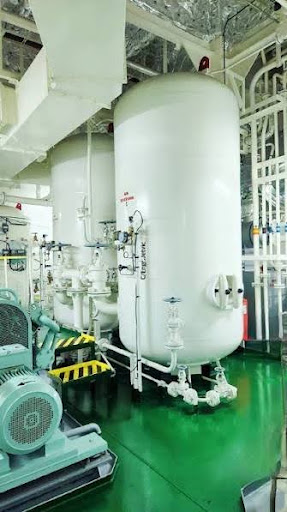
An air receiver is a pressure vessel that stores compressed air for use across various systems on a ship. Compressed air plays a big role onboard, powering things like main engine starting, auxiliary engine starting, control systems, automation, and general service needs.
When it comes to the main engine starting system specifically, the air receiver works as a reservoir of high-pressure air. This means that whenever the engine needs to be started or manoeuvred, there’s enough air ready and waiting to do the job right away.
Since the air inside is stored at high pressure, an air receiver is treated as critical machinery. That’s why it needs proper safety devices fitted, and why it has to be maintained carefully at all times.
air receiver is a pressure vessel designed to receive, store, and supply compressed air produced by an air compressor.
The compressed air enters the receiver from the compressor and remains stored under pressure until it is required by the system. The receiver also helps to maintain a stable air supply and provides a reserve capacity when the demand for compressed air suddenly increases.
On ships, air receivers may be used for:
The design pressure and capacity of an air receiver depend on its intended application and the requirements of the machinery installation.
The air receiver performs several important functions within the compressed-air system.
The primary function of an air receiver is to store compressed air at the required operating pressure.
For a main engine starting system, the stored air provides the energy required to rotate the engine during the starting sequence.
The receiver provides a reserve quantity of compressed air that can be used when the compressor is not running or when there is a sudden increase in air demand.
This is particularly important for the starting and manoeuvring of the main engine.
The air receiver acts as a buffer between the compressor and the air-consuming equipment.
It helps reduce rapid pressure fluctuations and provides a more stable supply of compressed air.
Compressed air leaving the compressor may contain moisture and traces of lubricating oil.
As the air enters the receiver, its velocity decreases, allowing heavier water droplets and oil particles to settle at the bottom of the vessel.
For this reason, regular draining of the air receiver is essential.
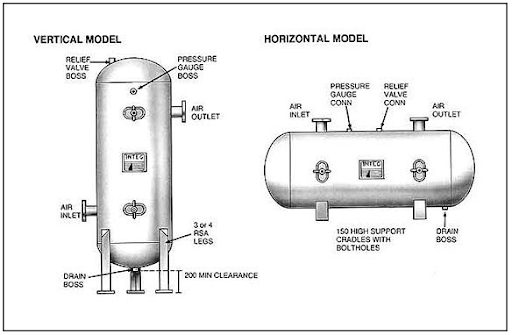
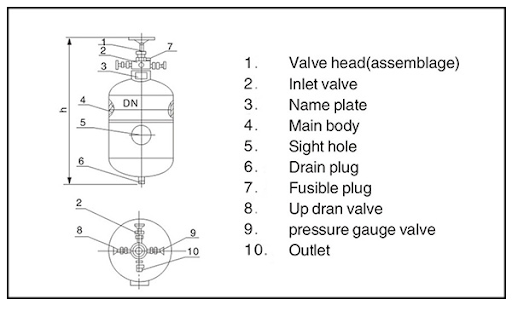
An air receiver is generally constructed as a welded steel pressure vessel designed to withstand the maximum working pressure of the compressed-air system.
A typical air receiver consists of:
The receiver is usually installed in a vertical or horizontal position, depending on the machinery arrangement and available space.
The lower section is provided with a drain connection to remove accumulated water, oil, and other contaminants.
The working principle of an air receiver is relatively simple.
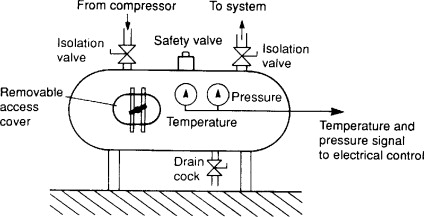
The air compressor draws atmospheric air, compresses it, and delivers it to the receiver through the inlet connection. The compressed air is stored inside the pressure vessel.
When compressed air is required, it flows from the receiver through the outlet connection to the relevant system.
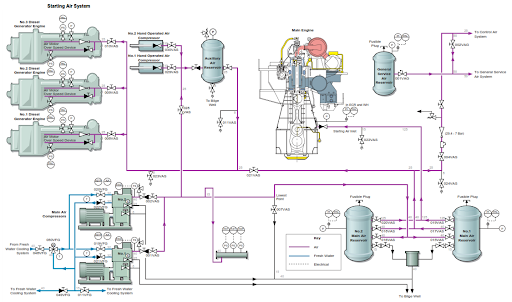
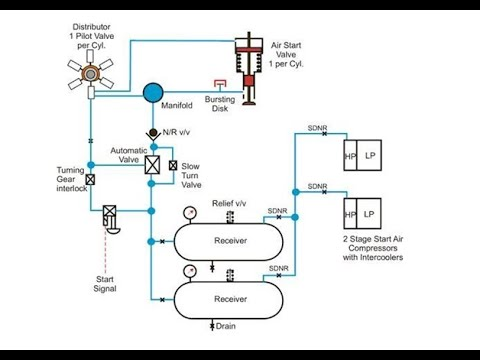
For example, during main engine starting, compressed air is supplied from the starting-air receiver to the main starting-air line. The air is then distributed to the engine cylinders according to the engine starting sequence.
As compressed air is consumed, the pressure inside the receiver decreases. When the pressure reaches the predetermined cut-in pressure, the compressor starts automatically, depending on the control arrangement, and recharges the receiver.
Because an air receiver operates at high pressure, several safety devices and fittings are provided to prevent overpressure and ensure safe operation.
The safety valve is the most important protective device fitted on an air receiver.
If the pressure inside the receiver rises above the safe working limit, the safety valve opens automatically and releases compressed air.
This prevents excessive pressure from damaging or rupturing the receiver.
The safety valve should be properly maintained and tested in accordance with the manufacturer’s instructions and applicable statutory or classification requirements.
A pressure gauge is fitted to indicate the internal pressure of the air receiver.
The gauge allows the operator to monitor:
The gauge should be clearly visible and maintained in good working condition.
A drain valve is fitted at the lowest point of the air receiver.
During compression, moisture from atmospheric air can condense inside the receiver. Oil and other contaminants may also accumulate.
Regular draining is necessary to prevent:
Automatic drain arrangements may also be fitted depending on the system design.
Large air receivers may be fitted with an inspection opening, manhole, or handhole.
This allows internal examination, cleaning, and maintenance of the pressure vessel.
The internal condition of the receiver is important because corrosion can reduce the wall thickness and affect the structural integrity of the pressure vessel.
One of the most important routine maintenance tasks is the regular draining of condensate.
Atmospheric air always contains a certain amount of moisture. When the air is compressed and subsequently cooled, this moisture condenses into water.
If water remains inside the air receiver, it can cause:
The drain valve should therefore be operated according to the vessel’s established operating procedures.
The starting-air receiver plays a critical role in the operation of a marine main engine.
The starting-air compressor charges the receiver with high-pressure compressed air. This air remains stored until the main engine receives a start command.
During starting, air flows through the starting-air system and is admitted to the engine cylinders in the correct firing sequence. The compressed air acts on the piston and rotates the crankshaft until the engine reaches sufficient speed for fuel injection and normal combustion.
A sufficient quantity of starting air must be available to permit safe engine operation and manoeuvring.
For this reason, the starting-air system must be maintained in a ready condition at all times.
Several faults can affect the performance and safety of an air receiver.
Leakage from valves, flanges, pipelines, or fittings can cause a gradual loss of receiver pressure.
Excessive air leakage may reduce the available starting-air capacity.
Failure to drain the receiver can result in excessive water accumulation.
This increases the risk of internal corrosion and can contaminate downstream equipment.
A safety valve that fails to open can allow the receiver pressure to rise above its safe limit.
A valve that leaks continuously can result in unnecessary pressure loss.
An inaccurate or defective pressure gauge can provide incorrect information about the condition of the air receiver.
This may result in unsafe operation or failure to identify a pressure-related problem.
Internal corrosion is a serious concern because it can reduce the thickness and strength of the receiver shell.
Regular inspection and maintenance are necessary to ensure the pressure vessel remains safe for operation.
Proper maintenance is essential for the safe and reliable operation of an air receiver.
Important maintenance activities include:
An air receiver is a high-pressure vessel and must never be opened or dismantled while under pressure.
Before maintenance work is carried out:
Personnel should never attempt to loosen fittings, open inspection covers, or remove valves while the receiver is pressurised.
 A pressure vessel that stores compressed air for systems like main engine starting, auxiliary engine starting, control air, and service air.
It stores compressed air and supplies it when needed. It also smooths out pressure changes and lets moisture and dirt separate from the air.
 To protect the vessel from too much pressure. If the pressure exceeds the safe limit, the valve opens and releases air automatically.
 Compressed air holds moisture, which builds up inside the receiver over time. Draining removes water and oil, and helps prevent corrosion and loss of capacity.
The receiver must be isolated, fully depressurised, vented, and drained before opening any cover, valve, or fitting. Check that the pressure gauge reads zero, and follow proper isolation and permit-to-work procedures.
Disclaimer :- The opinions expressed in this article belong solely to the author and may not necessarily reflect those of Merchant Navy Decoded. We cannot guarantee the accuracy of the information provided and disclaim any responsibility for it. Data and visuals used are sourced from publicly available information and may not be authenticated by any regulatory body. Reviews and comments appearing on our blogs represent the opinions of individuals and do not necessarily reflect the views of Merchant Navy Decoded. We are not responsible for any loss or damage resulting from reliance on these reviews or comments.
Reproduction, copying, sharing, or use of the article or images in any form is strictly prohibited without prior permission from both the author and Merchant Navy Decoded.
Decoded Discount Alert! up to 50% OFF
Use Coupon Code Deep50