Hi this is Team Merchant Navy Decoded !!!
Please fill the below form with your query and we will get back to you in next 12 hours.
Rest assured your data is safe with us !!!🙂
Ask Your Query| For Beginner | For Professional |
|---|---|
| GME | Engine Side |
| G.P. Rating | Deck Side |
| ETO | G.P. Rating |
| IMUCET & Sponsorship | Combo Offers |
| Free Course | MEO |
| Free Course |
| For Beginner | For Professional |
|---|---|
| GME | Engine Side |
| G.P. Rating | Deck Side |
| ETO | G.P. Rating |
| IMUCET & Sponsorship | Combo Offers |
| Free Course | MEO |
| Free Course |
Immersion suits allow individuals in cold water to be kept warm for significantly longer than they would be in just cold air. In cold water, individuals may suffer complete loss of dexterity in their arms and hands, and become extremely cold within a short amount of time. Immersion suits prevent water entry to the skin and retain body heat, increasing the chances of survival until rescue.
Understanding how immersion suits work, their safety features, and the correct way to wear them is important for every marine engineer. If you are preparing for your MEO Class 4 examinations, you can also explore the MEO Class 4 Free Guidance Series by Merchant Navy Decoded to get additional guidance for your exam preparation.
There are 3 phases to entering cold water:-
These timings can vary greatly depending on water temperature, the fitness/physique of the individual and what they are wearing. However, it is clear that in cold water, time is very limited for an individual, even with no protection. Wearing immersion suits means that heat is lost more slowly, delaying the effects of cold water. The effects of cold water in individuals wearing immersion suits can be delayed by hours compared to minutes.
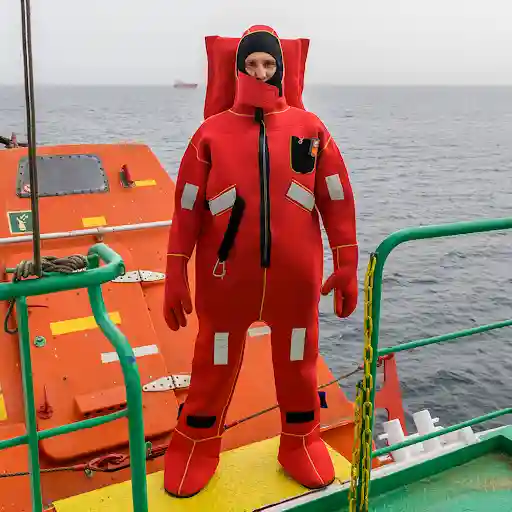
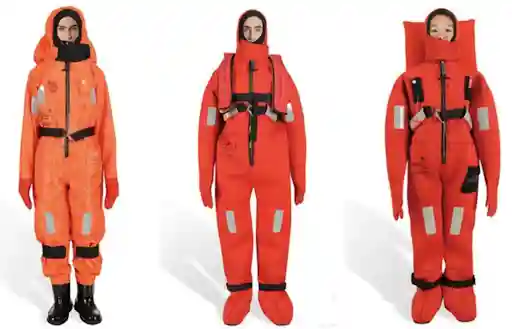
Immersion suits (SOLAS) are full body suits (with the exception of part of the face). They generally contain a hood, built in footwear and gloves/mitts. They are manufactured from waterproof thermal insulation materials (such as neoprene or foam). Seams are watertight, and watertight zips allow the suit to be closed. Seals are included on the face, wrists and sometimes ankles.
General features include:-
Easy to put on quickly by the individual without assistance. Individuals can climb ladders, jump from a height into water and swim a short distance whilst wearing the immersion suit.
Exact requirements and standards (including duration of thermal protection, time to put on suit and jump height) can be found within the LSA Code. Refer to the latest versions of these.
SOLAS regulations mean different individuals must be given immersion suits depending on the type of ship, trade and region. In general:
Specific requirements for different vessels vary depending on vessel type and version of the regulations. Refer to latest versions of SOLAS and LSA Code, requirements in relation to flag state, and ship safety plan.
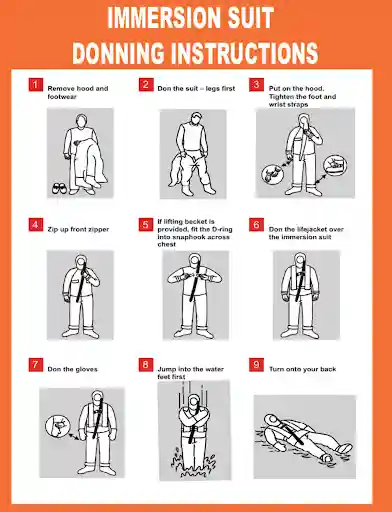
It is important to put on the suit quickly, however it must be done correctly to ensure it is properly sealed. If the suit is not properly sealed, water will enter and defeat the purpose of wearing it. Everyone should be trained to wear immersion suits. Instructions to wear the suit are usually located on the bag and in cabins.
Steps to wear:-
As a result of urgency, many people may struggle wearing immersion suits. Therefore regular drills are important. Common errors include not zipping up the suit fully, allowing water entry.
Immersion suits should be a last resort for entering the sea. Where possible, enter via ladder, slide or survival craft. If it is necessary to jump in:
Immersion suits should be periodically tested for water tightness. Testing is usually carried out by an approved servicing facility by either inflating or pressurising the suit. Testing frequency should follow manufacturer recommendations and regulation. Testing may be required following repairs. This ensures that suits are watertight. If there is a small leak in the suit, thermal protection can be greatly reduced.
Cleaning and Storing: If the suit has been used/wet, rinse with fresh water. Dry thoroughly. Do not use solvents, harsh detergents or heat. Immersion suits must NEVER be stored wet.
Repairs: Only repair as per manufacturer guidance, using approved methods and materials. If a suit is too damaged to be repaired, it should be replaced.
Record Keeping: Record checks, tests and replacements.
Training: Although putting on an immersion suit may seem straightforward in ideal conditions, during an emergency, in poor lighting, on a leaning vessel and quickly, it can be very difficult. Training should be provided on board, including:-
Immersion suits allow people to be kept alive long enough to be rescued in cold water. Cold water can be very dangerous to people. There are 3 stages to this danger, beginning with cold shock in the first minute, to hypothermia. Immersion suits delay this process. In order for immersion suits to work properly, they must fit the individual, be in good condition, have tightly zipped zips and seals and be quickly wearable. By checking, testing and practicing with immersion suits, if the worst happens, they will perform well.
Immersion suits are waterproof and thermally insulated. They prevent water getting to skin, and retain body heat, delaying hypothermia. This increases the chance of survival until rescue.
Lifejackets keep people afloat and upright. Immersion suits protect individuals in cold water. Some immersion suits contain buoyancy, however some must be worn with lifejackets.
According to LSA code, immersion suits should be worn (by oneself) within approximately 2 minutes. Refer to current regulations for exact information. Practicing regularly will allow individuals to wear them quicker.
No. Removing the suit puts the individual at risk of becoming cold.
Heat escapes lessening posture. When in water alone, bring knees up and wrap arms around the torso. When in a group, huddle together.
If the zip is not fully closed, or is difficult to open, water can get in and render the suit useless. Zips should therefore be checked, well lubricated and fully closed.
Should be regularly checked (usually monthly). Leak tests should be carried out at intervals given by manufacturer and regulations, by an approved service. Check current requirements
A lightweight suit worn by individuals working in boats or exposed areas (such as rescue boat crews). They provide protection from cold/wet but allow movement.
This depends on ship type, trade and region. Many cargo ships must carry suits for every individual onboard. Extra suits must be available at watch stations. Refer to current SOLAS requirements and requirements in relation to flag state.
Disclaimer :- The opinions expressed in this article belong solely to the author and may not necessarily reflect those of Merchant Navy Decoded. We cannot guarantee the accuracy of the information provided and disclaim any responsibility for it. Data and visuals used are sourced from publicly available information and may not be authenticated by any regulatory body. Reviews and comments appearing on our blogs represent the opinions of individuals and do not necessarily reflect the views of Merchant Navy Decoded. We are not responsible for any loss or damage resulting from reliance on these reviews or comments.
Reproduction, copying, sharing, or use of the article or images in any form is strictly prohibited without prior permission from both the author and Merchant Navy Decoded.
Decoded Discount Alert! up to 50% OFF
Use Coupon Code Deep50