Hi this is Team Merchant Navy Decoded !!!
Please fill the below form with your query and we will get back to you in next 12 hours.
Rest assured your data is safe with us !!!🙂
Ask Your Query| For Beginner | For Professional |
|---|---|
| GME | Engine Side |
| G.P. Rating | Deck Side |
| ETO | G.P. Rating |
| IMUCET & Sponsorship | Combo Offers |
| Free Course | MEO |
| Free Course |
| For Beginner | For Professional |
|---|---|
| GME | Engine Side |
| G.P. Rating | Deck Side |
| ETO | G.P. Rating |
| IMUCET & Sponsorship | Combo Offers |
| Free Course | MEO |
| Free Course |
All hydraulic systems start with a pump. It takes oil from a tank and pumps it into the system. This oil is then used in various places including hatch covers, winches, lifting cargo, moving the rudder and working the watertight doors. The pump is what provides the oil for the valves, cylinders and motors to work.
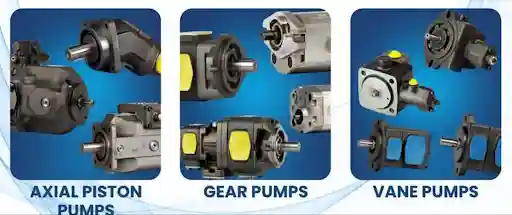
There are three main types of hydraulic pump onboard ships. They are all similar in that they provide oil, but differ in how they operate, the pressure they can cope with and what they are used for. We’ll look at each one.
Want to understand how hydraulic pumps and systems work onboard ships?
Explore our Ship Hydraulic System Course by Merchant Navy Decoded. Learn about hydraulic components, working principles, and their applications in shipboard machinery through practical explanations.
A hydraulic pump is a device that converts mechanical energy in the form of an electric motor or engine, into hydraulic energy. The pump does not create pressure. It creates flow. Pressure will develop when there is resistance in the line, for example if there is a load on the cylinder or a valve closed. If the oil cannot easily flow it will build up pressure until something moves or a relief valve is opened.
Nearly all hydraulic pumps are Positive Displacement. This means that for every revolution of the pump it will push a set amount of oil out, regardless of the outlet pressure. This is very different to a centrifugal pump as it will just create a flow that decreases with pressure. Because it is a positive displacement pump a relief valve must be fitted to every hydraulic circuit.
Key Terms:-
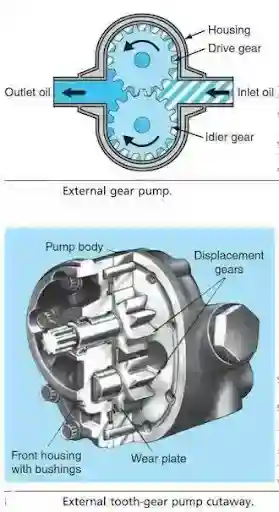
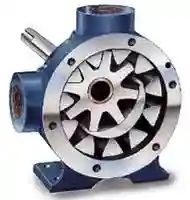
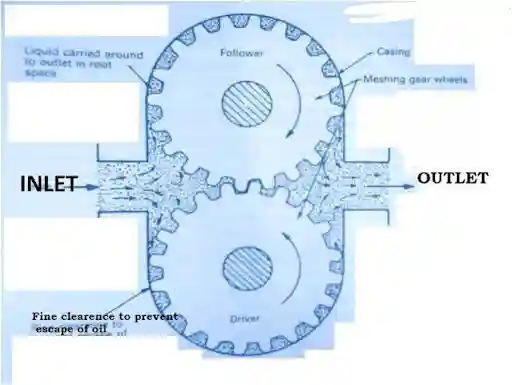
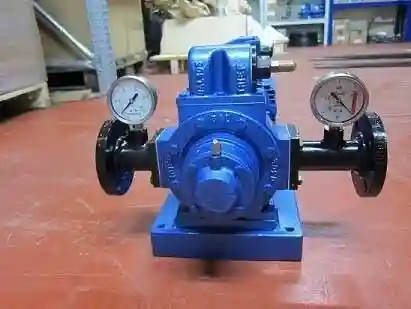
These are the simplest most common pumps. They are durable and can cope with dirty oil.

2. Internal Gear Pumps – A small gear is placed inside a large ring gear. There is a crescent divider. The principle is the same but they are generally quieter and smoother.


Advantages:-
Disadvantages:-
Used for auxiliary functions like lubrication and transfer pumps, pilot/charge pumps to feed larger systems, and small power packs. They are also used as the oil supply for many gearboxes and engine lube systems.
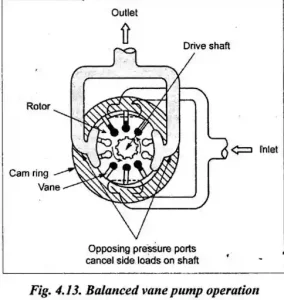
These are in the middle. They are quieter and smoother than gear pumps. They are cheaper and simpler than most piston pumps.

4. Variable Displacement – A round ring can be moved relative to the rotor. The further it is offset the higher the displacement. Moving it closer to the centre will reduce the displacement. There will be a pressure compensator to automatically adjust the displacement to only supply the required amount of flow.
Advantages:-
Disadvantages:-
These are the high performance options. They can cope with the highest pressures, they are the most efficient and are the standard for high performance systems. However they are the most complex and expensive and require the cleanest oil.
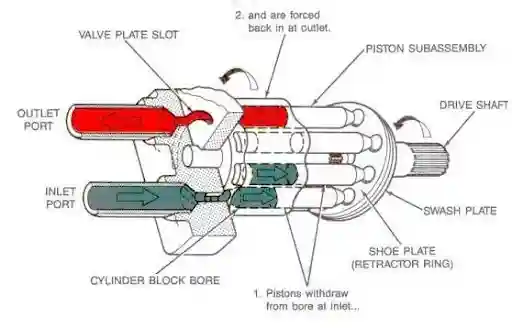
All piston pumps work by having pistons that move in and out of the bores in the cylinder block. As the piston extends it draws in oil. When it retracts it pushes the oil out. There are two main types.
1. Axial Piston Pumps – The pistons are arranged in a circle parallel to the drive shaft. As the cylinder block rotates the pistons are forced in and out of the bores by an angled surface. There are two common ways of achieving this:-
2. Radial Piston Pumps – The pistons are arranged radially around a central rotor. The pistons are moved in and out by an eccentric cam/ring. These can deliver very high pressures with less flow. They are used in specialised high pressure situations.
Advantages:-
Disadvantages:-
This is a balance between pressure, flow, efficiency, noise, cost and oil quality.
Gear pumps are great for simple, cheap and durable pumping with moderate pressures and possibly not the cleanest oil. Vane pumps are good for medium pressure systems that need to be quiet. Piston pumps are chosen when high pressure, high efficiency and variable flow are required along with very clean oil.
Generally you will find gear pumps for low pressures, vane pumps for medium pressures and piston pumps for high pressures. This depends on the design and what the manufacturer states.
Most hydraulic pumps on board will be driven by an electric motor. Often directly connected. Some may be driven from the engine using a gearbox or power take off. For example the HPS pumps are engine driven. In a power pack there will be a pump, motor, reservoir, filter, relief valve and cooler.
All three pumps trap oil and force it out but they all do it differently. Gear pumps are simple, durable and can cope with harsh conditions. Vane pumps are quiet and smooth. They are in the middle for pressure. Piston pumps (swash plate or bent axis) can cope with the highest pressures and offer the best control. As long as they are supplied with clean oil. Choose the correct pump for the application, ensure the suction side is in good condition and the oil is clean and your pump will last for years with little maintenance.
Its main function is to supply clean, properly conditioned fuel to the auxiliary diesel engine to ensure reliable combustion and electrical power generation.
A purifier removes water and solid impurities from fuel using a centrifuge.
A heater reduces viscosity of heavy fuel oil so that it can circulate and be injected under suitable conditions. The fuel and engine specifications will dictate whether it is needed and the degree of heating.
It provides the right quantity of fuel at injection pressure levels to the injector at the right time.
A blocked filter causes fuel flow restriction which results in low supply pressure and engine power loss, instability or shutdown.
Excess fuel is returned to maintain stable supply conditions and to allow the system to circulate more fuel than the engine consumes.
Disclaimer :- The opinions expressed in this article belong solely to the author and may not necessarily reflect those of Merchant Navy Decoded. We cannot guarantee the accuracy of the information provided and disclaim any responsibility for it. Data and visuals used are sourced from publicly available information and may not be authenticated by any regulatory body. Reviews and comments appearing on our blogs represent the opinions of individuals and do not necessarily reflect the views of Merchant Navy Decoded. We are not responsible for any loss or damage resulting from reliance on these reviews or comments.
Reproduction, copying, sharing, or use of the article or images in any form is strictly prohibited without prior permission from both the author and Merchant Navy Decoded.
Decoded Discount Alert! up to 50% OFF
Use Coupon Code Deep50