Hi this is Team Merchant Navy Decoded !!!

Please fill the below form with your query and we will get back to you in next 12 hours.

Rest assured your data is safe with us !!!🙂

Ask Your Query

scrubber tower in ship

Scrubber Towers

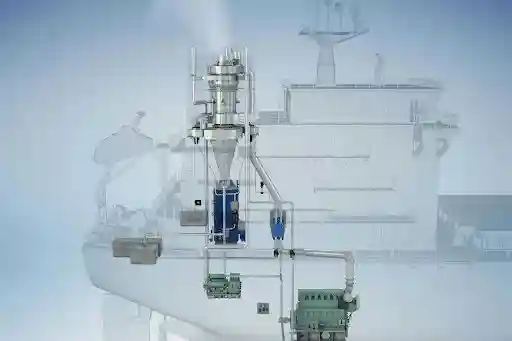
Scrubber towers are the central component of marine Exhaust Gas Cleaning Systems (EGCS) installed to reduce sulphur oxide (SOₓ) emissions from ship engines and boilers. Since the IMO 2020 global sulphur cap of 0.50% mass/mass entered into force, scrubbers have become a mainstream compliance option alongside low‑sulphur fuels and alternative fuels. This blog provides a technically detailed yet accessible overview of scrubber tower working principles, system types, key components, operational parameters, and maintenance practices.

What Is a Scrubber Tower?

A scrubber tower is a vertical gas–liquid contactor installed in the exhaust line between the engine or boiler and the funnel. Its primary function is to remove SOₓ, particularly sulphur dioxide (SO₂), from hot exhaust gases before atmospheric release.

In a typical arrangement, exhaust gas enters the tower, contacts alkaline washing water sprayed through nozzles, and leaves with substantially reduced SOₓ content. The absorbed SOₓ reacts in the liquid phase and is neutralised by the water’s alkalinity, which comes from natural seawater bicarbonates in open systems or from added chemicals such as sodium hydroxide (NaOH) in closed systems.

Why Are Scrubber Towers Required?

Why Are Scrubber Towers Required

Conventional marine fuels, especially Heavy Fuel Oil (HFO), can contain sulphur levels well above current regulatory limits. Combustion of sulphur-bearing fuel produces SOâ‚“, which contributes to air pollution, acid deposition, respiratory health impacts, and ecosystem damage.

MARPOL Annex VI sets a global fuel sulphur limit of 0.50% m/m, with stricter 0.10% limits in designated Emission Control Areas (ECAs). As of March 2026, additional ECAs, including parts of the Canadian Arctic and the Norwegian Sea, have implemented tighter SOₓ, NOₓ and particulate requirements. Approved EGCS, commonly called scrubbers, are recognised by IMO as an equivalent means of compliance, allowing ships to use certain higher‑sulphur fuels while meeting emission limits through exhaust cleaning.

Table of Contents

Working Principle of a Scrubber Tower

The working principle is relatively simple:

Hot exhaust gas + alkaline washing water → SOx absorption/neutralisation → cleaned exhaust gas

The fundamental principle is mass transfer of SOâ‚“ from the gas phase into an alkaline liquid phase, followed by neutralisation.

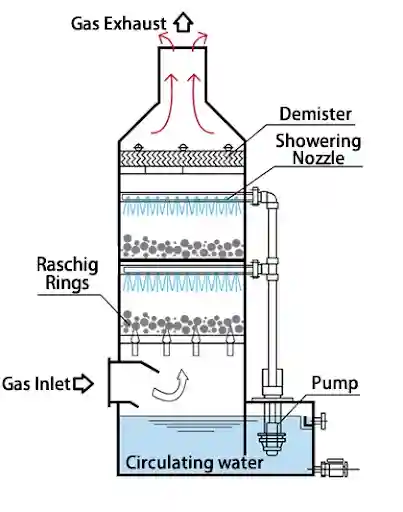
  • Hot exhaust gas enters the scrubber tower.
  • Alkaline washing water is atomised into the gas stream via spray nozzles.
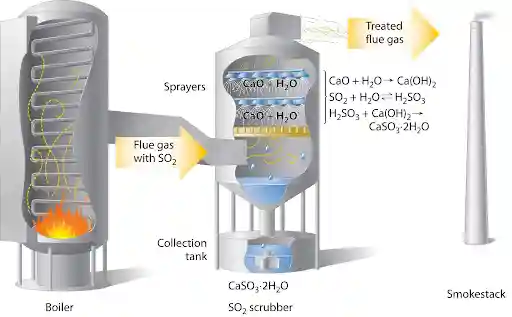
  • SOâ‚“ dissolves in the water and reacts to form sulphurous and sulphuric acid species.
  • These acids are neutralised by alkalinity from seawater (bicarbonates) or from dosed NaOH in closed systems.
  • Cleaned gas passes through a demister to remove entrained droplets and then exits via the funnel.

A simplified chemical representation is:

S in fuel + O₂ → SO₂ (and some SO₃)
SOₓ + H₂O → acidic species
Acidic species + alkalinity → neutralised sulphates and related compounds

Construction of a Scrubber Tower

Construction of a Scrubber Tower

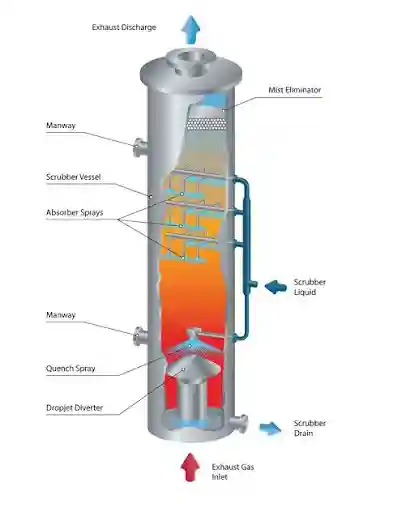
A typical marine scrubber tower comprises several functional zones.

Exhaust gas inlet
Designed to withstand high temperature, corrosive constituents, pressure fluctuations and high gas flow rates. One tower may serve a single engine or multiple exhaust sources, depending on system layout.

Spray section (Showering Nozzle or absorber sprays)
Multiple spray nozzles distribute washwater across the gas path to maximise interfacial area. Uniform spray coverage is critical for consistent SOâ‚“ removal efficiency.

Scrubbing section
Gas flows through the tower while washwater passes through the gas stream. Some designs use multi‑stage spray arrangements or packed sections to enhance contact time and mass transfer.

Demister (mist eliminator)
Located downstream of the scrubbing zone, the demister removes fine water droplets from the cleaned gas. This limits water carryover to the funnel and reduces visible plume formation.

Washwater collection section
Contaminated washwater collects at the tower base. Depending on system type, it is discharged after treatment, recirculated, partially purged, or stored for shore disposal.

Types of Marine Scrubber Systems

Marine EGCS are classified into three main configurations.

Type

Scrubbing medium

Washwater handling

Typical application

Open‑loop

Seawater (natural alkalinity)

Treated and discharged to sea under IMO parameters

Vessels operating mainly at sea where discharge is permitted

Closed‑loop

Freshwater + NaOH dosing

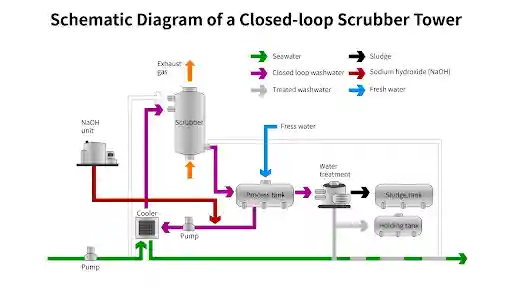
Recirculated with sludge storage and controlled bleed‑off

Ports and ECAs with discharge restrictions, coastal and inland operations

Hybrid

Seawater or freshwater + chemicals

Switchable between open and closed modes

Ships trading across regions with varying regulatory regimes

Open‑loop systems are mechanically simpler but depend on seawater alkalinity and local discharge rules. Closed‑loop systems provide greater control over water chemistry but require chemical storage, dosing systems, and sludge management. Hybrid systems combine both modes to optimise compliance and operational flexibility.

Major Components of a Scrubber System

The scrubber tower operates as part of a larger EGCS that typically includes:

  • Washwater circulation pumps and seawater supply pumps.
  • Spray nozzles, distribution headers and associated piping.
  • Recirculation tanks, heat exchangers and mixing tanks (closed and hybrid systems).
  • Caustic soda dosing units with metering pumps and storage tanks.
  • Washwater treatment units, separators and sludge tanks.
  • Continuous monitoring instruments for pH, PAH, turbidity, temperature, flow, and exhaust SOâ‚‚/COâ‚‚.

What Happens Inside the Scrubber?

What Happens Inside the Scrubber

Sulphur in the fuel is oxidised during combustion, producing sulphur oxides.

The principal reaction is:

S + O₂ → SO₂

Some SOâ‚‚ can further oxidise:

2SO₂ + O₂ → 2SO₃

When these gases contact water, they form acidic species. The overall process can therefore be simplified as:

SOx + H₂O → acidic compounds

The alkaline nature of seawater or the addition of caustic soda helps neutralise these compounds.

The exact chemistry is more complex than this simplified representation, but the engineering objective remains the same:

Transfer SOx from the exhaust gas into the washwater and neutralise it.

Monitoring, Control and Compliance Parameters

Continuous monitoring is essential to verify performance and demonstrate compliance with IMO and flag‑state requirements.

Exhaust gas parameters

  • SOâ‚‚ and COâ‚‚ concentrations
  • Exhaust gas temperature and pressure
  • Gas flow rate

Washwater parameters

  • pH
  • Polycyclic aromatic hydrocarbons (PAH)
  • Turbidity
  • Temperature and flow rate

Under IMO guidelines, scrubber washwater discharge should generally have a pH not less than 6.5, measured under specified conditions. Accurate sensor calibration and data logging are therefore critical to avoid false alarms and compliance issues.

Why is pH Monitoring Important?

When SOx is absorbed into water, acidic compounds are produced. Therefore, the washwater can become acidic. The pH monitoring system verifies that the washwater is within the required operating/discharge parameters.

For example, Wärtsilä notes that under IMO guidelines, scrubber washwater discharge should have a pH of not less than 6.5, subject to the applicable requirements and measurement conditions.

Operation and Maintenance of Scrubber System

Scrubber systems operate in a harsh environment characterised by high temperature, saline water and acidic species. Reliable performance depends on disciplined operation and maintenance.

Nozzle inspection
Spray nozzles should be checked for blockage, erosion, corrosion and uneven spray distribution. Degraded spray patterns reduce gas–liquid contact and SOₓ removal efficiency.

Demister cleaning
Demisters accumulate deposits over time and must be inspected and cleaned according to manufacturer instructions. Fouled demisters increase pressure drop and can cause water carryover.

Pump maintenance
Washwater and seawater pumps require regular checks of mechanical seals, bearings, vibration levels, impeller condition and hydraulic performance. Many systems use variable frequency drives to match pump speed to engine load.

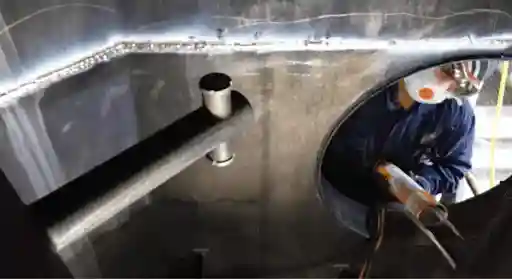
Corrosion inspection
Tower internals, piping, valves and discharge lines are exposed to corrosive conditions. Periodic inspections, coating surveys and material assessments are necessary to manage corrosion risk.

Sensor calibration
pH, PAH, turbidity, SOâ‚‚, COâ‚‚ and flow meters must be calibrated and verified at defined intervals. Poor sensor accuracy can lead to incorrect compliance readings and operational restrictions.

Common operational issues include high washwater temperature, low water flow, nozzle fouling, elevated pressure drop across the tower, corrosion of internals, and sensor drift or failure.

Advantages and Limitations

Advantages

  • High SOâ‚“ removal efficiency, typically around 98% in well‑designed systems.
  • Fuel flexibility to use certain higher‑sulphur fuels while remaining compliant.
  • Potential fuel‑cost savings where high‑sulphur fuel discounts are significant.
  • Feasibility of retrofit on existing vessels, subject to space, structural and power availability.
  • Operational flexibility with hybrid systems across different regulatory zones.

Limitations

  • High capital expenditure for tower, pumps, piping, treatment and monitoring systems.
  • Additional space and weight, although newer designs aim to reduce footprint.
  • Ongoing maintenance, chemical logistics and sludge handling for closed and hybrid systems.
  • Discharge restrictions for open‑loop systems in some ports and ECAs.
  • Corrosive environment requiring careful material selection and inspection regimes.

Is a Scrubber the Same as an Inert Gas Scrubber?

Is a Scrubber the Same as an Inert Gas Scrubber

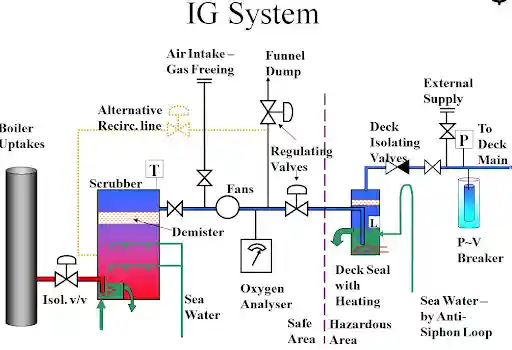
No, this is an important distinction for marine engineering students. A scrubber associated with an Exhaust Gas Cleaning System (EGCS) is primarily designed to reduce SOx emissions from engine or boiler exhaust. An inert gas scrubber, on the other hand, is associated with an inert gas system and is primarily used to cool and clean flue gas before it is supplied as inert gas, particularly on tankers.

Although both systems use the basic concept of gas-water contact, their purpose, design and operating requirements are different.

Is a Scrubber the Same as an Inert Gas Scrubber?

No, this is an important distinction for marine engineering students. A scrubber associated with an Exhaust Gas Cleaning System (EGCS) is primarily designed to reduce SOx emissions from engine or boiler exhaust. An inert gas scrubber, on the other hand, is associated with an inert gas system and is primarily used to cool and clean flue gas before it is supplied as inert gas, particularly on tankers.

Although both systems use the basic concept of gas-water contact, their purpose, design and operating requirements are different.

Purpose of Scrubber Tower in IG System and Scrubber System (EGCS)

Scrubber Tower in IG System

Scrubber System (EGCS)

Cools hot flue gas before it enters the inert gas system.

Reduces SOâ‚“ emissions from engine or boiler exhaust.

Removes soot and particulate matter.

Absorbs SOâ‚“ using alkaline washwater.

Reduces acidic and soluble impurities.

Neutralises the absorbed sulphur compounds.

Produces cleaner and cooler gas for inert gas production.

Helps comply with MARPOL Annex VI sulphur-emission limits.

Protects downstream IG equipment from heat, soot and corrosion.

Reduces the release of sulphur oxides into the atmosphere.

Used as part of the Inert Gas System on tankers.

Used as part of an Exhaust Gas Cleaning System (EGCS).


Frequently Asked Questions (FAQs)

This depends on local regulations and system type. Open‑loop discharge is restricted or prohibited in some ports and ECAs. Ships may switch to closed‑loop mode or use low‑sulphur fuel while in those areas. Hybrid systems are designed to support such mode changes.

Intervals vary by manufacturer and operating profile. Nozzles are typically inspected during planned maintenance windows and cleaned if spray patterns degrade. pH, PAH and turbidity sensors require routine calibration and verification to maintain accurate compliance data.

In open‑loop systems, treated washwater is discharged under IMO parameters for pH, PAH, turbidity and related limits. In closed‑loop systems, most water is recirculated. Contaminants accumulate as sludge, which is stored and discharged to shore facilities, with limited bleed‑off treated onboard under applicable rules.

No. Scrubbers primarily target SOâ‚“ and some particulate matter. NOâ‚“ control typically requires other technologies such as exhaust gas recirculation or selective catalytic reduction. COâ‚‚ mitigation is addressed through efficiency measures, operational optimisation and alternative fuels.

No. An EGCS scrubber cleans engine or boiler exhaust to reduce SOâ‚“ emissions. An inert gas scrubber on tankers cools and cleans flue gas before it is used as inert gas in cargo tanks. The purposes, design criteria and operating conditions are different.

Disclaimer :- The opinions expressed in this article belong solely to the author and may not necessarily reflect those of Merchant Navy Decoded. We cannot guarantee the accuracy of the information provided and disclaim any responsibility for it. Data and visuals used are sourced from publicly available information and may not be authenticated by any regulatory body. Reviews and comments appearing on our blogs represent the opinions of individuals and do not necessarily reflect the views of Merchant Navy Decoded. We are not responsible for any loss or damage resulting from reliance on these reviews or comments.

Reproduction, copying, sharing, or use of the article or images in any form is strictly prohibited without prior permission from both the author and Merchant Navy Decoded.

DIWALI SALE

Decoded Discount Alert! up to 50% OFF

DIWALI SALE

Decoded Discount Alert! up to 50% OFF

Use Coupon Code Deep50

Days
Hours
Seconds
0
Would love your thoughts, please comment.x
()
x