Hi this is Team Merchant Navy Decoded !!!
Please fill the below form with your query and we will get back to you in next 12 hours.
Rest assured your data is safe with us !!!🙂
Ask Your Query| For Beginner | For Professional |
|---|---|
| GME | Engine Side |
| G.P. Rating | Deck Side |
| ETO | G.P. Rating |
| IMUCET & Sponsorship | Combo Offers |
| Free Course | MEO |
| Free Course |
| For Beginner | For Professional |
|---|---|
| GME | Engine Side |
| G.P. Rating | Deck Side |
| ETO | G.P. Rating |
| IMUCET & Sponsorship | Combo Offers |
| Free Course | MEO |
| Free Course |
To become a captain in the Merchant Navy is an achievement that all students aspire to have. The captain of a ship, also known as a master, is the highest-ranking officer on board a ship. The captain is answerable for the ship, the crew, the cargo, the passengers, and sailing. But becoming a captain does not take place overnight, following completion of the maritime course. There are years of education, practical experience, professional exams, and other qualifications required to become a captain.
If you are thinking of joining the Merchant Navy post Class 12, this guide will help you with everything, starting from how to become a deck cadet till how to become a captain.
The captain of the merchant navy has the responsibility of ensuring the successful operation of commercial ships. Unlike traditional occupations, the choice made by the captain has a tremendous impact on the safety of the ship and all individuals aboard the ship.
Main responsibilities of a captain include
In addition to that, the captain is responsible for proper documentation of the ship according to maritime laws. A captain is not just a person steering the vessel. This position involves much more than that.
To become a merchant navy captain, one has to start by being in the deck department.
The following course options will be selected by students aspiring to become a captain after passing the PCM course after Class 12.
A B.Sc. in Nautical Science is a three-year undergraduate program.
Some of the topics covered in the program are
After completion of the course, candidates undergo mandatory sea training to become deck officers.
A diploma in nautical science is a year-long training course that is followed by a B.Sc. degree according to the prescribed academic path. DNS is a common entry course for those aspirants who wish to work in the Merchant Navy as deck cadets. Usually, students require sponsorship for admission into sponsored DNS courses. Sponsorship offers an opportunity to gain onboard training experience, but it doesn’t ensure that one will be a captain in the future.
Both the B.Sc. Nautical Science and DNS courses provide opportunities to work in the deck department. Selection of the course entirely depends upon the eligibility, admissions, and career choices of the candidate.
Students generally need to meet the following requirements to join a nautical science program in India.
Requirement | General criteria |
Educational qualification | Class 12 with PCM |
PCM marks | Usually 60% average |
English marks | Generally 50% in Class 10 or 12 |
Medical fitness | Must meet applicable maritime medical standards |
Eyesight | Must meet prescribed nautical eyesight standards |
Admission | IMU-CET or the applicable institute admission process |
There may be slight differences in the requirements according to the different courses, institutes, years of admission, and categories. For instance, in the IMU prospectus for 2026-27, the minimum PCM percentage of 60% and English percentage of 50% in Class 10th or Class 12th have been laid down for admission into the course of B.Sc. Nautical Science. Before applying, check your marks, age, and medical eligibility carefully.
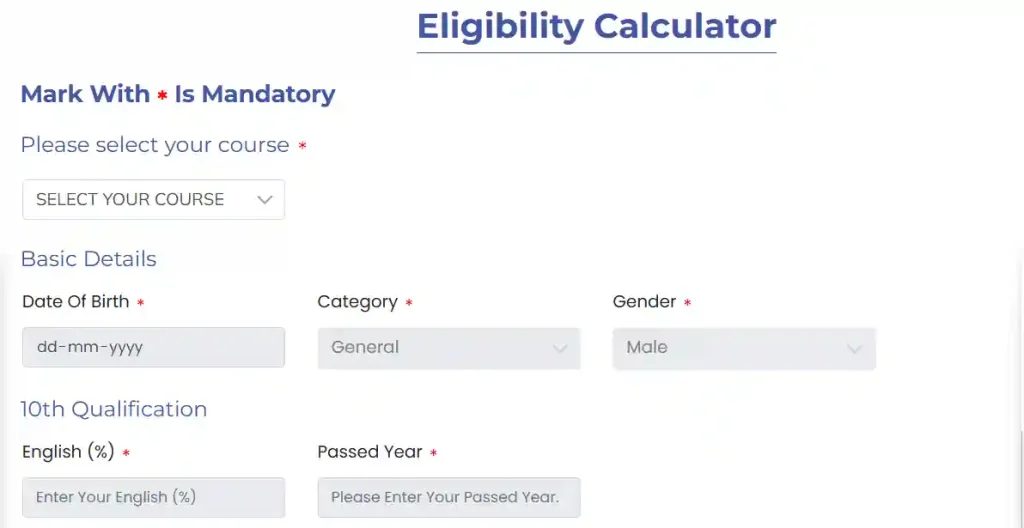
A useful feature is the eligibility calculator. Instead of manually trying to work out whether your marks meet the requirements of a particular Merchant Navy course, you can use the calculator to check your eligibility based on your academic details.
When students get admitted, then they need to undergo the training process before going to sea in any reputable maritime training institute. In this way, students can learn about how things work on board the ship. This process will include classroom training, practical sessions, and also safety training.
Some of the essential topics taught in pre-sea training are:
The students are also made aware of working in a team and following instructions. It is necessary to verify that the institute and the course are recognized by the Directorate General of Shipping before joining a college. The official DGS website provides information about approved maritime training institutes and courses.
Preparing for the Merchant Navy entrance exam involves more than studying physics, chemistry, and mathematics. You also need to stay updated about admissions, understand eligibility requirements, and practice questions regularly.
The Merchant Navy Decoded app can help you organize these parts of your preparation. It also helps with tracking the latest forms, which can be useful because admission and application deadlines can be easy to miss when several colleges and programs open applications at different times.
Upon completion of pre-sea training, the next thing will be joining a merchant vessel as a deck cadet. A deck cadet refers to an aspiring officer who receives hands-on experience on how ships operate through the guidance of experienced officers.
This is arguably the most critical phase of the process since what was learned theoretically in class should now be applied practically.
Tasks performed by a deck cadet can include:
Deck cadets gain knowledge about the ship’s procedures, watchkeeping duties, and work environment at sea. It is essential that the sea service is completed and documented properly. The time period and requirements will depend on the training and certification program being followed. This period gives students an insight into how vessels function in reality.
After gaining the necessary sea service experience and professional training, a deck cadet can take steps towards qualifying for officer status. The individual has to pass the necessary competence test and fulfill the certification criteria. For the foreign going-deck officer career path, the Second Mate Certificate of Competency is a crucial step.
The duties of a second officer include navigation and watchkeeping duties at the bridge.
They may consist of:
The second officer is still not a captain. This is, however, the start of a professional officer’s career, which may end up in becoming a master. The candidate needs to keep gaining sea experience and developing professionally.
After getting the necessary experience as an officer of the deck, the next career progression to aim for is that of a chief officer, which is also known as a chief mate. A chief officer is the second highest ranking officer aboard a vessel after the captain.
This is a more responsible position than that of a second officer.
Some of his duties include:
The position of chief officer requires the candidate to fulfill the prescribed sea service qualification and competency qualifications. The position of chief officer is a significant level since it trains an officer to command a ship.
The last professional license that an officer requires in order to become a ship captain in a foreign-going merchant ship is known as the Master Certificate of Competency (Master FG CoC). A master FG certificate enables an officer to be qualified to command a foreign-going ship in the limits of the certificate.
In order to acquire this license, the officer should fulfill all the requirements, which include the following:
The master’s test will measure an officer’s knowledge of navigation, ship management, laws relating to ships and shipping business, etc. The Directorate General of Shipping governs the licensing procedure for Indian seafarers.
It is essential to note that simply attending a course does not qualify one as a captain. The person should have the required sea service and competency qualifications.
Earning a Master FG Certificate of Competency is indeed a remarkable feat; however, it does not necessarily mean that the officer will be promoted to captain right away. There are a number of factors that the shipping company has to look into, such as the officer’s experience, performance, and suitability as a commander.
Sometimes, the company also needs to do some more evaluations before appointing the officer as a captain.
Following the promotion of the officer to the rank of captain, he/she becomes formally referred to as the master of the ship. Duties of the captain are not limited to management of the ship; decision-making regarding navigation, safety, cargo handling, crew, and emergencies fall under his/her mandate. Besides the technical know-how, leadership and decision-making skills are mandatory for a captain.
However, there is no specific timeframe to become a captain in the Merchant Navy. The time is dependent on the choice of course, sea experience, exam progress, company policy, and other factors.
A general career progression looks like this:
Career stage | Typical duration |
B.Sc. Nautical Science | 3 years |
DNS pre-sea course | 1 year |
Deck cadet training | Depends on prescribed sea service. |
Second Officer | After required training and certification |
Chief Officer | After further sea service and competency certification |
Captain | After master certification and company appointment |
For many officers, getting to the position of captain usually requires 10-15 or more years from when they start their education at sea. This is just a rough estimate regarding the officer’s career. Some officers can advance quicker, whereas others may take more time to advance.
The officer must have the technical competence and be able to manage people and situations.
Important capabilities include the following:
An officer must be capable of leading the crew, delegating tasks, and enforcing discipline.
Shipping is subject to varying circumstances. The officer must make decisions based on information available.
Efficient communication is extremely important when working with the crew, port authorities, and other ships.
The officer should have knowledge about navigation, stability, cargo operations, and other aspects of maritime legislation.
Working in shipping requires the ability to spend much time in hard conditions on the water. Emotional maturity will ensure that officers perform their tasks properly.
Not at all. To become a captain, students have to undergo training in nautical science, gain sufficients ea experience, obtain professional certificates and climb the ranks of officers.
It is not necessary. Students may join by the DNS route, as well, provided all necessary academic and professional criteria are met.
Yes. DNS is a valid pathway to a deck officer’s profession. A DNS student can work on the way to master rank.
No. A master FG certificate ensures the professional competency of an officer for working in a captain capacity. It is up to a shipping company to appoint him/her to a captain’s post.
Yes. Captains can operate in container ships, bulk carriers, oil tankers, gas carriers, and other types of commercial vessels. But there might be specific types of ships that would need additional certifications.
Yes. Experienced captains can switch to various career opportunities such as marine operations, ship management, maritime training, consultancy, and other related areas.
IMU-CET is an entrance test for the relevant IMU undergraduate nautical science courses. The test itself does not make a person into a captain. Professional certification and relevant sea experience are needed for advancement towards master rank.
Disclaimer :- The opinions expressed in this article belong solely to the author and may not necessarily reflect those of Merchant Navy Decoded. We cannot guarantee the accuracy of the information provided and disclaim any responsibility for it. Data and visuals used are sourced from publicly available information and may not be authenticated by any regulatory body. Reviews and comments appearing on our blogs represent the opinions of individuals and do not necessarily reflect the views of Merchant Navy Decoded. We are not responsible for any loss or damage resulting from reliance on these reviews or comments.
Reproduction, copying, sharing, or use of the article or images in any form is strictly prohibited without prior permission from both the author and Merchant Navy Decoded.
Decoded Discount Alert! up to 50% OFF
Use Coupon Code Deep50