Hi this is Team Merchant Navy Decoded !!!
Please fill the below form with your query and we will get back to you in next 12 hours.
Rest assured your data is safe with us !!!🙂
Ask Your Query| For Beginner | For Professional |
|---|---|
| GME | Engine Side |
| G.P. Rating | Deck Side |
| ETO | G.P. Rating |
| IMUCET & Sponsorship | Combo Offers |
| Free Course | MEO |
| Free Course |
| For Beginner | For Professional |
|---|---|
| GME | Engine Side |
| G.P. Rating | Deck Side |
| ETO | G.P. Rating |
| IMUCET & Sponsorship | Combo Offers |
| Free Course | MEO |
| Free Course |
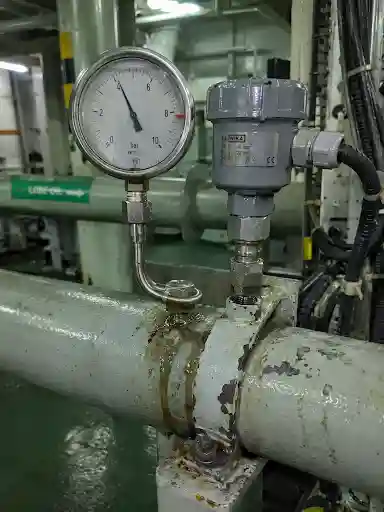
There are many pressure sources in an engine room. There is lube oil pressure to the main bearings, fuel pressure at the injectors, jacket water pressure, starting air pressure, boiler steam pressure, hydraulic oil pressure to the steering gear and sea water pressure to the coolers. Pressure is usually one of the first indications an engineer will look at, and if not correct there is likely something going wrong. If the lube oil pump loses pressure then you won’t have much warning before something happens to the bearings.
It is essential to understand how pressure is measured, and how to interpret the signals and alarms. It is also important to understand how to ensure they are correct with calibration.
Pressure is a force applied to an area. In ships you will see pressure measured in bar, psi, kPa and MPa. Sometimes you will see more than one type of unit used on the same plant. Bar is roughly the pressure of the atmosphere at sea level.
There are a few different types of pressure:-
If the instrument is not measuring the correct type of pressure it will cause confusion, so always check what it is measuring.
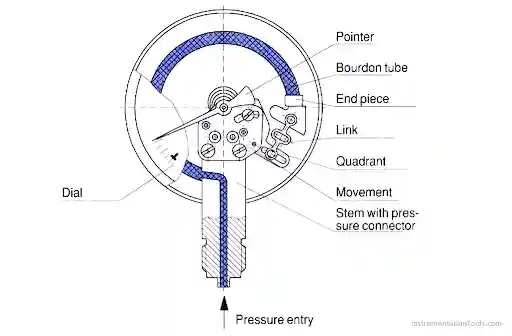
There are 3 main types of instruments:-


All 3 have a purpose, and generally all 3 will be found on a plant.
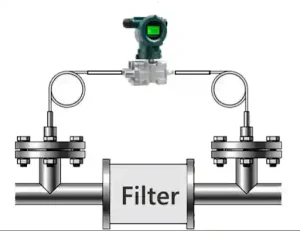
There are 3 key parts to a transmitter:-
The 4-20mA signal is popular due to it being able to run long distances, not affected by much electrical noise. Also having a 4mA signal rather than 0mA means if there was a break in the wire (0mA) it is easily identified. Most transmitters are 2 wire, meaning the same 2 wires are used to power and send the signal. Typically there will be a 24V DC supply in the loop.
There are two key values to remember:-
 So if the transmitter was calibrated for 0-10 bar then at 0bar there will be 4mA, at 10bar there will be 20mA. At 5bar there will be 12mA. If zero or span drift then the reading will be incorrect although the transmitter appears to be working. This is where calibration comes in.
The pressure switch is a simple device. The pressure is applied to a sensor (could be diaphragm, piston or bourdon tube). This pushes against a spring. Once the pressure force overcomes the spring force the sensor will move causing a microswitch to activate inside. The contacts will change.
The spring can be adjusted to change the set point. The tighter the spring the higher the pressure it will trip at.
They also have a differential (deadband). This means that the switch will not reset at the same pressure it tripped at. It will reset at a little lower (or higher depending on the type). For example if you have a low pressure alarm it will trip at 2.0bar falling but will only reset at 2.3bar rising. This means the contacts won’t chatter when the pressure is hovering around the set point. Some have an adjustable differential and some have a fixed differential.
The contacts can be normally open (NO) or normally closed (NC). Safety circuits often use NC contacts so if there was a break in the wire it would cause an alarm. This is the same principle as limit switches.
There are also electronic pressure switches. These use a sensor and electronics to switch an output at a pre-set value. They will generally have a display and it is easy to change the set point. However mechanical switches are still very common due to their simplicity and low cost.
Instruments will drift over time. Vibrations, temperature, ageing, shocks and overpressure will all cause the readings to change. Even if the transmitter/gauge appears to be working they could be a few % out. This can cause problems with safety/alarm systems.
Calibration is the process of comparing the instrument to a more accurate source to identify how much it is out. On ships this is part of a planned maintenance schedule. It is often a requirement from class on safety critical devices such as boiler/engine protection.
The source should be much more accurate than the instrument. It should also be traceable to a recognised source. The calibration equipment will also be calibrated on a regular basis. Results will be recorded. Often a certificate will be issued.
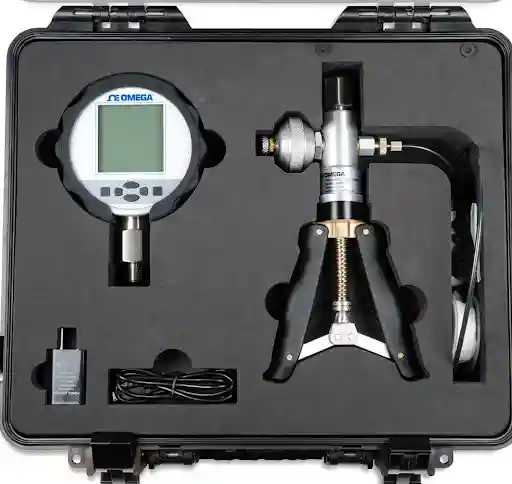
A portable device used to generate and measure pressure.
It will generally have:-
The instrument is connected to the pressure port on the calibrator. Apply pressure using the pump. Compare the true value (from the calibrator) to the value shown.
General steps:-
This is to determine what pressure the switch will trip and reset at:-
Pressure can cause injury if stored. Always isolate and fully depressurise before disconnecting anything. Bleed any trapped pressure through the vent. Ensure the hoses and connections are rated for higher than the pressure being tested. Don’t exceed the maximum pressure of the instrument. Use the correct testing medium. For low pressure air is fine. However for hydraulic testing you need to use a liquid. No-one should use oils or greases near oxygen systems. Don’t stand in line with any fittings being tested. Follow the ship’s permit and isolation procedures. Inform the control room before inhibiting any alarm/trip. Ensure you put it back once finished as forgetting to take it out of bypass can be a real hazard.
A gauge will show pressure, a transmitter will report pressure and a switch will act. Calibration will tell you if they are trustworthy. Understanding how they work, knowing what zero, span, set point and differential mean, testing against a good reference and recording will make pressure readings something you can trust.
A transmitter will constantly measure pressure and send a signal (normally 4-20mA) across the range. A switch will only change the contacts when pressure reaches a set point.
Having a 4mA minimum means it is easy to identify if there is a break in the wire (0mA). It also means 2 wire devices will have power.
Zero is the output at the minimum end of the range. Span is the difference between the minimum and maximum. If either drift then the reading will be incorrect.
The difference between the trip and reset pressure. This will stop the contacts from chattering when the pressure is close to the set point.
It will produce a controlled pressure. It will also accurately measure the pressure. Usually it will have a built-in reference sensor. Often it can measure mA and switch contacts so you can compare to a known value.
As-found values are the values the instrument shows without any adjustment. This will show how much it has drifted. As-left values are after adjustment and show it is within tolerance.
Slowly. If you go too quickly you will overshoot and incorrect trip point. Once you have noted the trip point, go the other way slowly.
It depends on the instrument. It will be part of the planned maintenance schedule on the ship. Safety critical devices will be checked more regularly.
Disclaimer :- The opinions expressed in this article belong solely to the author and may not necessarily reflect those of Merchant Navy Decoded. We cannot guarantee the accuracy of the information provided and disclaim any responsibility for it. Data and visuals used are sourced from publicly available information and may not be authenticated by any regulatory body. Reviews and comments appearing on our blogs represent the opinions of individuals and do not necessarily reflect the views of Merchant Navy Decoded. We are not responsible for any loss or damage resulting from reliance on these reviews or comments.
Reproduction, copying, sharing, or use of the article or images in any form is strictly prohibited without prior permission from both the author and Merchant Navy Decoded.
Decoded Discount Alert! up to 50% OFF
Use Coupon Code Deep50