Hi this is Team Merchant Navy Decoded !!!
Please fill the below form with your query and we will get back to you in next 12 hours.
Rest assured your data is safe with us !!!🙂
Ask Your Query| For Beginner | For Professional |
|---|---|
| GME | Engine Side |
| G.P. Rating | Deck Side |
| ETO | G.P. Rating |
| IMUCET & Sponsorship | Combo Offers |
| Free Course | MEO |
| Free Course |
| For Beginner | For Professional |
|---|---|
| GME | Engine Side |
| G.P. Rating | Deck Side |
| ETO | G.P. Rating |
| IMUCET & Sponsorship | Combo Offers |
| Free Course | MEO |
| Free Course |
If you have completed Class 12 in Commerce and are thinking about joining the Merchant Navy, your stream does not mean that a maritime career is completely closed to you. However, your options depend on the type of career you want to pursue.
After studying commerce, there are two broad routes to consider. The first is to enter the Merchant Navy through a rating-level course such as GP Rating. The second is to pursue the required Physics, Chemistry, and Mathematics (PCM) qualification through a recognized route such as NIOS and then look at officer-entry programs. The important thing is to understand the difference between these two routes before choosing a course.
Yes, a student who has completed Class 12 in Commerce can enter the maritime sector, but Commerce does not by itself satisfy the PCM requirement for officer-entry courses such as B.Sc. Nautical Science, DNS, or B.Tech Marine Engineering.
For example, the current IMU eligibility requirements for B.Sc. Nautical Science and B.Tech. Marine Engineering require 10+2/equivalent with Physics, Chemistry, and Mathematics, along with the prescribed English requirement. Therefore, a commerce student cannot directly enter these PCM-based officer programs simply on the basis of a commerce class 12 qualification.
This leaves two broad possibilities:
Let us understand both options separately.
If you have completed Class 12 Commerce and do not want to go back and pursue a PCM qualification, GP Rating is one route available to you.
The General Purpose Rating (GP Rating) is a pre-sea training course for rating-level careers on merchant ships. The training covers work related to both the deck and engine departments. This is different from becoming a deck officer or marine engineer. A GP-rated candidate enters the rating category and does not directly enter the ship as an officer.
GP Rating is a six-month pre-sea training course recognized under the Directorate General of Shipping framework. The course provides basic training for personnel working in the deck and engine departments of merchant ships. After completing the required training and subsequent sea-service requirements, ratings can progress through the applicable certification pathway.
For a commerce student, this route can therefore provide an entry into the Merchant Navy without requiring physics, chemistry, and mathematics at the class 12 level, provided the candidate meets the applicable GP rating eligibility requirements.
The important point is that GP Rating eligibility is based primarily on the prescribed educational qualification and other requirements set by the Directorate General of Shipping.
The currently published DGS GP Rating requirements include:
Therefore, completing Class 12 Commerce does not automatically disqualify you from GP rating. The important requirement is whether you satisfy the DGS eligibility conditions.
This distinction is extremely important.
A GP Rating candidate is joining through the rating category, whereas programs such as:
are officer-entry programs with their own educational and medical requirements.
So, if your aim is specifically to become a deck officer or marine engineer, a GP rating should not be presented as the direct officer-entry route.
Choosing a GP Rating college and understanding the admission process can sometimes be confusing because students have to compare eligibility, medical requirements, colleges, admission information, and preparation options.
Merchant Navy Decoded App provides digital maritime guidance and resources for students and seafarers. Its GP Rating section includes information about the course, eligibility, and colleges, while its platform also provides tools such as an eligibility calculator and college-related information.
For a student planning to enter through GP Rating after Class 10, Merchant Navy Decoded can be useful for exploring:
The platform also provides a dedicated GP Rating contact channel and other maritime resources through its website and app.
In simple terms, SMVD Marine Academy is focused on offline preparation, while Merchant Navy Decoded provides digital information, tools, and guidance that can help students understand and navigate the GP Rating journey.
Medical fitness is an essential part of joining a seafaring course. The current DGS medical standards prescribe different eyesight requirements depending on the department. For the nautical/deck department, which includes GP Crew, the pre-sea distance-vision standard is unaided 6/6 in the better eye and 6/9 in the other eye, with normal color vision tested using the Ishihara test. The engine department has different eyesight standards.
Because medical requirements can affect your ability to join a maritime course, it is sensible to complete the medical examination before paying substantial admission fees.
Before applying anywhere, check:
Do not rely only on the statement “10th pass is enough.” The DGS requirements contain several conditions beyond the basic qualification.
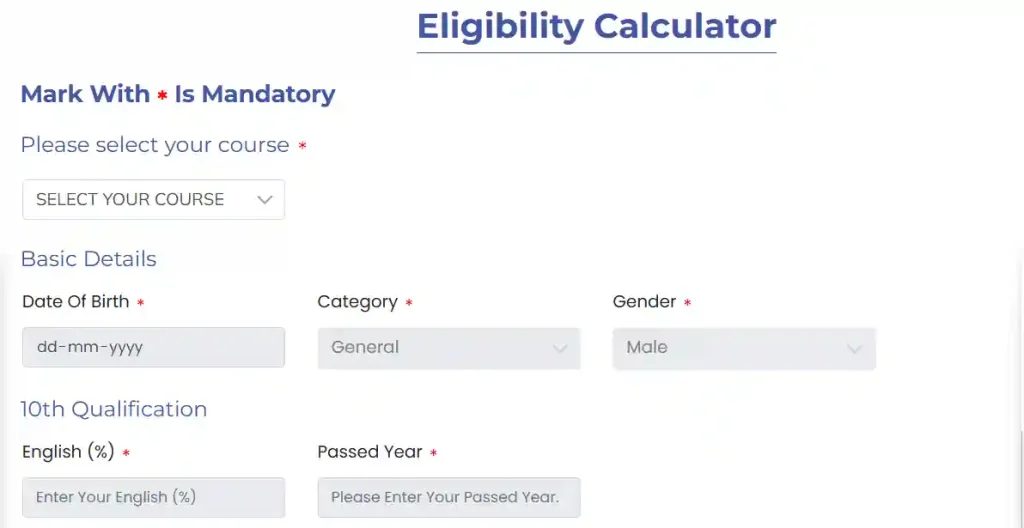
You can check your eligibility with the Merchant Navy Decoded eligibility calculator.Â
Once you decide to pursue GP rating, proper preparation can help you become familiar with the type of entrance tests, interviews, and maritime subjects involved in the selection process.
SMVD Marine Academy offers offline GP Rating coaching and currently lists classroom training, tests, mentorship, and interview preparation among its offerings. Its official website also lists a GP Rating preparation book containing MCQs, concise theory, detailed solutions, and full-length practice papers.
For students who have completed Class 10 and plan to pursue GP Rating, SMVD Marine Academy can therefore be explored as an offline preparation option before entering the actual pre-sea training course.
However, coaching preparation and the actual DGS-approved GP Rating course are two different things. Students should separately verify the DGS approval of the institute where they intend to undertake the 6-month GP Rating pre-sea training.
The second route is relevant if your goal is not just to enter the Merchant Navy as a rating but to pursue an officer career.
For officer-entry programs, physics, chemistry, and mathematics are important because current IMU eligibility for programs such as B.Sc. Nautical Science and B.Tech. Marine Engineering requires 10+2/equivalent with PCM and the prescribed marks. NIOS offers senior secondary subjects, including mathematics, physics, and chemistry. NIOS also allows learners to choose additional subjects within its prescribed rules.
However, there is an important point that commerce students must understand before choosing this route.
NIOS itself states that a learner who has already completed senior secondary through a formal board can seek admission in NIOS for the same course in up to four subjects.
However, this does not automatically mean that every university or maritime program will accept a combination of one board’s commerce subjects plus NIOS PCM subjects for officer admission.
This matters particularly for IMU admissions. IMU’s current 2026-27 prospectus recognizes NIOS among the qualifying examination boards for UG admissions. At the same time, IMU’s admission FAQ states that NIOS candidates should have passed all subjects through NIOS and not across multiple boards. physics,
Therefore, a commerce student should not assume that simply taking physics, chemistry, and mathematics separately through NIOS will automatically make them eligible for IMU-CET or an IMU officer-entry program.
Before taking this route, the candidate should confirm the exact qualification combination accepted for the admission year with the concerned university/institute.
The current IMU 2026-27 prospectus specifies the following broad academic requirement for B.Sc. Nautical Science:
For B.Tech Marine Engineering, the current IMU prospectus similarly requires 10+2/equivalent with 60% PCM and 50% English, along with the applicable age and medical requirements.
This means that obtaining the required PCM qualification is only one part of the process. Candidates must still satisfy the complete eligibility criteria for the specific course and admission year.
Once a candidate has a recognized 10+2/equivalent qualification containing the required PCM subjects and meets the other conditions, different officer-entry pathways may become available.
B.Sc. Nautical Science is a three-year residential undergraduate program designed for students pursuing the deck department. The current IMU program information describes the course as preparing students for careers as deck officers and covers subjects such as navigation, seaman programability, cargo handling, and map program.
handling, 026-27 admission cycle, IMU specifies 60% aggregate in PCM and 50% English, along with the applicable age, medical, marital-status, and IMU-CET requirements. The broad career progression is toward the deck officer side of the Merchant Navy, subject to completing the required training, sea service, examinations, and certification.
DNS is another route into the deck officer career. IMU describes DNS as a one-year residential program that provides training in navigation, seamanship, ship stability, cargo handling, and other maritime subjects. Successful completion forms part of the pathway toward the required Deck Officer Certificate of Competency.
The current IMU eligibility information requires 10+2 with physics and mathematics, along with the prescribed PCM and English marks and other applicable conditions.
An important point for students considering DNS is that sponsors chemistry requirements, mathematics requirements, and whether they are applying to an IMU campus or an affiliated institute. IMU’s current information states that sponsorship is required for DNS programs in affiliated institutes, while sponsorship is not required for courses at IMU campuses.
If your interest is in the engine department rather than navigation and deck operations, B.Tech Marine Engineering is the relevant officer-entry pathway. The current IMU 2026-27 prospectus requires 10+2/equivalent with at least 60% in PCM and 50% in English, along with the applicable age and medical requirements. This pathway is fundamentally different from GP Rating because it is designed for an engineering officer career.
The answer depends mainly on the career level you want to enter. If your priority is to enter the maritime industry without pursuing the PCM requirement for officer-entry courses, GP Rating is the relevant route to investigate, subject to DGS eligibility and medical fitness.
If your goal is specifically to become a deck officer or marine engineer, you need to look at the PCM-based officer-entry requirements. A commerce background by itself does not satisfy those requirements. Marine engineer,
The NIOS route can be relevant for students looking to obtain the required academic subjects, but students should verify the exact board and subject combination accepted by the target university or institute before enrolling. This is especially important because IMU’s current information distinguishes between recognized NIOS qualifications and candidates who have studied across multiple boards. ion rules of the university, institute, and admission year before spending money on the course.
Yes. A commerce student can explore rating-level routes such as GP Rating, subject to the applicable DGS eligibility and medical requirements. Commerce alone, however, does not meet the PCM requirement for the main officer-entry programs.
Not through the standard PCM-based officer-entry programs with a Commerce-only Class 12 qualification. Courses such as B.Sc. Nautical Science and DNS require the prescribed PCM qualification.
Yes, provided you satisfy the applicable DGS GP Rating requirements. GP Rating eligibility is based on the prescribed educational, age, and medical requirements rather than requiring PCM in Class 12.
No. GP Rating is a rating-level entry route. Deck Officer programs such as DNS and B.Sc. Nautical Science are officer-entry pathways with separate academic and medical requirements.
Yes. IMU’s current 2026-27 prospectus lists NIOS among recognized qualifying examinations for UG admissions. However, candidates must also satisfy the course-specific eligibility requirements.
Do not assume that this combination will automatically be accepted. IMU’s current FAQ states that NIOS candidates should have passed all subjects through NIOS and not through multiple boards. Candidates should confirm their exact qualification combination with IMU for the relevant admission year before relying on this route.
For the current 2026-27 IMU admission reference, the requirement is a minimum 60% average in PCM and 50% in English in Class 10 or 12, along with the other applicable requirements. The requirements for a future admission year should be checked when that year’s prospectus is released.
Disclaimer :- The opinions expressed in this article belong solely to the author and may not necessarily reflect those of Merchant Navy Decoded. We cannot guarantee the accuracy of the information provided and disclaim any responsibility for it. Data and visuals used are sourced from publicly available information and may not be authenticated by any regulatory body. Reviews and comments appearing on our blogs represent the opinions of individuals and do not necessarily reflect the views of Merchant Navy Decoded. We are not responsible for any loss or damage resulting from reliance on these reviews or comments.
Reproduction, copying, sharing, or use of the article or images in any form is strictly prohibited without prior permission from both the author and Merchant Navy Decoded.
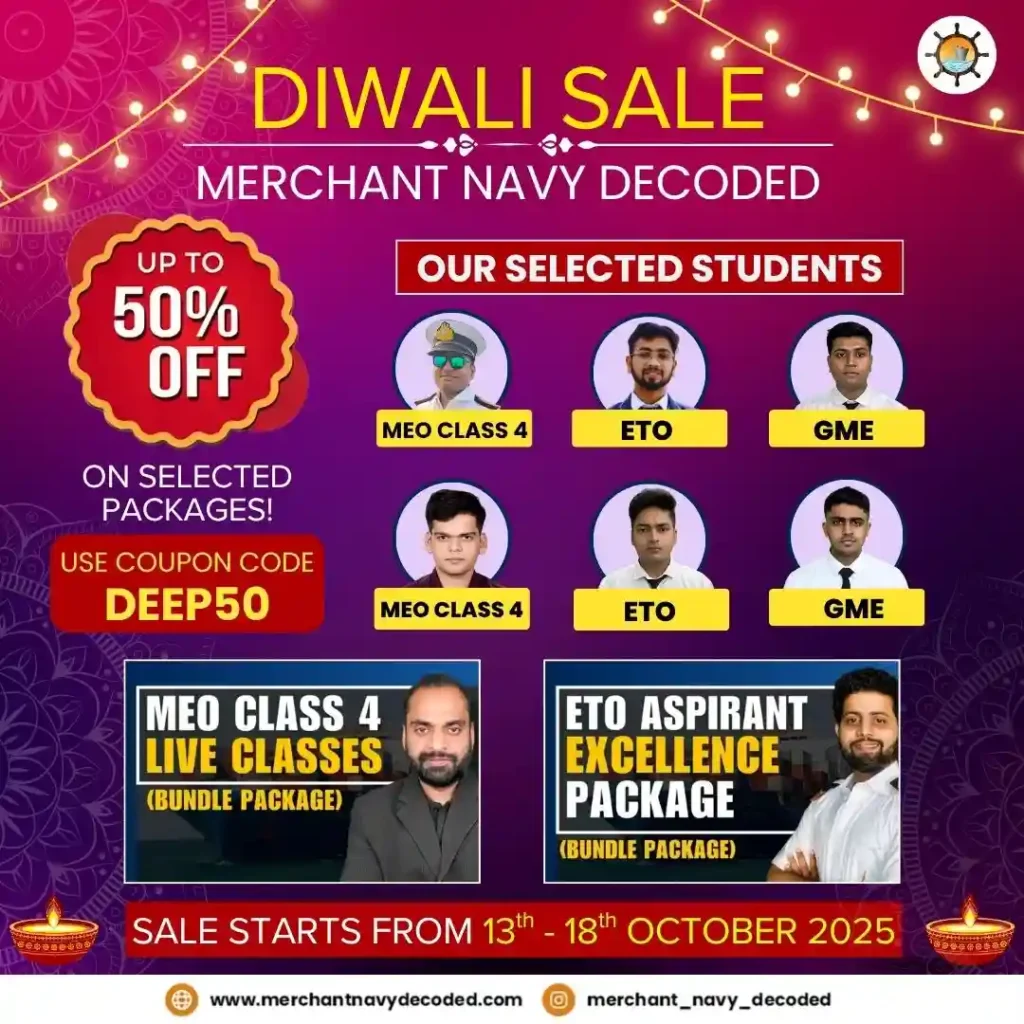
Decoded Discount Alert! up to 50% OFF
Use Coupon Code Deep50