Hi this is Team Merchant Navy Decoded !!!

Please fill the below form with your query and we will get back to you in next 12 hours.

Rest assured your data is safe with us !!!🙂

Ask Your Query

Engine Room Crane

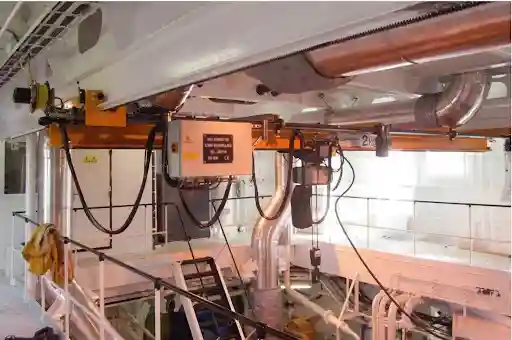
The engine room is a busy place and the main piece of equipment used for heavy lifting is often overlooked unless there is a problem. This one piece of kit will be used for lifting your piston, cylinder head, liner, turbocharger rotor and pump to be overhauled. Due to the heavy loads, confined spaces and moving of the ship, mistakes can happen which can lead to serious injury.

Tips for safe use of an engine room crane:

safe use of an engine room crane

Know your equipment

Most engine rooms will have one of the following:-

  • Overhead Travelling Crane – Travels along rails in the engine room with a trolley and hoist.
  • Monorail – Travels along a single beam above the machine with a chain block/ electric hoist.
  • Fixed points – Some areas will have fixed lifting points or padeyes for a portable chain block.

All of these work in the same principle but will have different controls, limitations and capacities. Always read the plate on your crane. The Safe Working Load should be indicated on the plate. This means, you should never lift more than this stated amount.

Pre-Use Checks

You should carry out a quick check before lifting anything:-

  • Check the crane has no obvious damage, loose bolts, oil leaks from gearbox and nothing caught in rails/trolley.
  • Check the wire rope/chain:No broken strands, kinks, flattened areas, corrosion, stretched or twisted links and worn/damaged areas. If unsure, don’t use.
  • Check the hook:No cracks, bend or open jaws. The safety latch is in place and works.
  • Checking controls:Try moving the pendant in all directions (hoist, lower, traverse and travel) without any load attached. They should move in the right direction and stop when you release.
  • Check emergency stop and limit switches. These are there to stop the hook/trolley from hitting anything. They are a backup and should never be used as a normal stop. Upper and lower limit switches (on hoist) and travel limits are there to stop the hook/trolley from hitting anything. Never use limit switches as a normal stop.
  • Check pendant:No damage to the insulation, housing or cable.
  • Check brake:Should stop the load straight away when releasing from the controls. If the load is creeping or moving stop and report.

Ensure the crane is up to date with checks. Lifting appliances on board are regularly inspected and tested to class and flag requirements. There should be a register and certificates.

Table of Contents

Planning

Think about how you are going to lift the load. Ask yourself:-

  1. How heavy is the load?Look up the weight in the manual or planned maintenance system. Don’t guess! Many engine parts are heavier than they look.
  2. Within the Safe Working Load (SWL) of the crane? As well as the slings, shackles and lifting gear? The lowest rating of the chain is the limit.
  3. Where is the centre of gravity? Uneven loads can cause tilting. Ensure you know the right points to lift from. Use the lifting eyes/tools provided by the manufacturer.
  4. Where is it going? Check for any obstructions, pipework, ladders, cables or people.
  5. Where is it going to be placed? Ensure there is a safe place to place the load. It should be solid and stable. Supports should be in place.
  6. Who is doing what? Decide who is going to be operating the crane, giving signals and supervising. Even if it’s a simple task a short toolbox talk should be carried out.

Many ships require a work permit or risk assessment for heavy lifting.

Slings, Shackles & Lifting Gear

Ensure your crane is safe.

  1. Use the correct slings: Check the tag to ensure it’s rated for the correct amount. It should be up to date with checks. No cuts, fraying, broken wires or chemical damage.
  2. Angle of sling: The wider the angle between the sling legs, the more tension there will be. A sling which is fine for lifting straight up could be overloaded when using a high angle. Use the smallest angle possible.
  3. Avoid sharp edges. Use padding or corner protectors.
  4. Shackles should be fully screwed in or properly secured. Rated for the correct amount.
  5. Never use any temporary equipment. Such as bent bars, bolts instead of pins or knotted slings.
  6. Avoid shock loading. Always winch in slowly.

During the lift

Be organised:

  1. Lift and stop. Lift the load and stop. Ensure it is balanced, slings are in place and nothing is catching. If you notice anything out of place lower the load and fix.
  2. Everyone should be kept clear. No one should be underneath or under the load. No one should be in a position where they could be struck by a falling or swinging load. Mark out the area if needed.
  3. Use tag lines to control swinging of awkward loads.
  4. Move smoothly. Avoid jerking, sudden stops and fast speeds. The more you move the harder it will be to control a swinging load.
  5. Lift low. Only lift as high as needed to avoid obstructions.
  6. Never pull from the side or drag. Cranes are designed to lift vertically. Pulling from the side could overload the crane and cause damage to the rope/structure.
  7. Never leave a load hanging. If you have to stop, lower the load.
  8. Don’t walk away with the pendant. Don’t give the controls to someone who isn’t trained.

Communication

Engine rooms can be very noisy. Agree on clear signal hands or radios. Ensure the person giving signals can clearly see the load and the operator. Only one person should be giving signals at a time. Anyone can shout ‘stop’ and the operator should stop straight away.

Account for ship movement

Many people are surprised that the ship will move at sea. The ship will roll, pitch and vibrate. Even in port it could move due to other vessels and swelling. Loads that would sit still in a workshop could move quite a bit. It’s best to carry out heavy lifting when it’s calm or in port. If you have to carry it out at sea ensure the load is held in place with lashings/tag lines, lifted as low as possible and extra care taken. Some lifts may involve engine room hatches and openings to the deck above. Coordinate with the deck side.

Operation

  • Only trained and authorised personnel should operate the crane. Be familiar with the controls and emergency stop.
  • Always remain in view of the load or work with a signaller.
  • Use slow speed if available for precision.
  • Do not override safety devices such as limit switches, overload protection and interlocks. If a device is faulty, tag the crane out and report.
  • Never exceed the SWL. Never use the crane to pull something free. This can cause the crane to be overloaded.
  • Be aware of any unexpected issues. If something is still bolted or seized. If the crane starts to labour stop immediately. Check the item is free. Lifting seized items can overload the crane.
After the lift

Put the crane back in a safe condition. Raise the hook so it is clear of the working area (don’t hit the upper limit). Park the crane in it’s allocated area. Turn off the power and store the pendant. Return slings and gear to their correct storage. Report any damage or issues.

Maintenance & Checks

Regular maintenance should be carried out.

  • Lubricate wire rope, chain, gearbox and moving parts as per the maintenance schedule.
  • Regularly check the wire rope/chain, hook, brake, limit switches, rails and structure.
  • Test safety devices, keep records of checks, repairs, certificates and keep the register up to date.
  • Report any faults and do not use them until repaired and checked.

Common Mistakes

  1. Using limit switches as a normal stop.
  2. Guessing the weight of the part.
  3. Standing under the load.
  4. Using damaged slings as they’ll be fine for one last lift.
  5. Hurried lifts due to tight schedule.
  6. Lifting an item that isn’t fully unbolted.
  7. Not paying attention to strange noises, jerking or slipping brake.
  8. Giving the crane to someone who isn’t trained.

Conclusion

Whilst none of this is complicated it is important to know what you are lifting, check the crane and gear, plan your lift, communicate, lift slowly, keep everyone clear and account for ship movement. Most crane incidents occur due to lack of checks, hurried lifts and incorrect positioning. Taking a few minutes to complete the checks before lifting will ensure the crane is used as intended.

Frequently Asked Questions (FAQs)

Safe Working Load – This is the maximum amount the crane/lifting gear can lift. You should never exceed this.

Crane, rope/chain, hook and latch, pendant and controls, emergency stop, limit switches, brake and checks.

They are a safety device to stop the hook/trolley from hitting anything. Using them as a normal stop will wear them out and reduce your safety margin.

The larger the angle between the sling legs the more tension there will be. Slings that are fine for a small angle could be overloaded for a large angle.

It’s best to do heavy lifting in port or when it’s calm. If you have to lift at sea ensure the load is held in place, lift as low as possible, use tag lines and extra care.

Stop immediately. If possible lower the load. Check the item is fully unbolted. If it’s seized pulling it could overload the crane.

Only trained and authorised personnel who know how to use the controls and emergency procedures.

Disclaimer :- The opinions expressed in this article belong solely to the author and may not necessarily reflect those of Merchant Navy Decoded. We cannot guarantee the accuracy of the information provided and disclaim any responsibility for it. Data and visuals used are sourced from publicly available information and may not be authenticated by any regulatory body. Reviews and comments appearing on our blogs represent the opinions of individuals and do not necessarily reflect the views of Merchant Navy Decoded. We are not responsible for any loss or damage resulting from reliance on these reviews or comments.

Reproduction, copying, sharing, or use of the article or images in any form is strictly prohibited without prior permission from both the author and Merchant Navy Decoded.

DIWALI SALE

Decoded Discount Alert! up to 50% OFF

DIWALI SALE

Decoded Discount Alert! up to 50% OFF

Use Coupon Code Deep50

Days
Hours
Seconds
0
Would love your thoughts, please comment.x
()
x