Hi this is Team Merchant Navy Decoded !!!
Please fill the below form with your query and we will get back to you in next 12 hours.
Rest assured your data is safe with us !!!🙂
Ask Your Query| For Beginner | For Professional |
|---|---|
| GME | Engine Side |
| G.P. Rating | Deck Side |
| ETO | G.P. Rating |
| IMUCET & Sponsorship | Combo Offers |
| Free Course | MEO |
| Free Course |
| For Beginner | For Professional |
|---|---|
| GME | Engine Side |
| G.P. Rating | Deck Side |
| ETO | G.P. Rating |
| IMUCET & Sponsorship | Combo Offers |
| Free Course | MEO |
| Free Course |
If you have spent a couple of shifts in the engine room you will know exactly what this alarm sounds like. The alarm panel lights up and someone says “We have a low insulation fault on the 440 board”. Everyone looks slightly more alert. There is no blackout, nothing has tripped and everything is running as normal. This can make us take it lightly but it is an early indicator.
In this post we will see what a low insulation alarm actually means, why the ships are set up this way and how to find the fault.
Most electrical systems on land are earthed. This means one part of the system, usually neutral, is earthed to the ground. If the live conductor was to touch the metal casing of the appliance it would cause a large current to flow to the ground. This would result in a breaker or fuse tripping to protect the appliance.
Ships are different. The main 440V 3-phase system and 220V system (usually supplied from the 440V system using a step down transformer) are normally insulated to earth. This is known as an insulated neutral or IT system. Nothing is intentionally earthed to the hull.
The reason for this is to ensure continuity of supply. On land the supply would be lost if there was a first earth fault. This could leave us with no steerage, fuel pumps/lube oil pumps due to one damp junction box. By having an insulated system, there is no circuit completed therefore no large current flows. Nothing will trip and the machinery will continue to run. This gives the crew time to find the problem.
A low insulation alarm does NOT mean there is a short. It simply means there is less than a certain amount of insulation between the live conductors and the hull. There is a small amount of current flowing to earth somewhere on the system. This is typically caused by damp, dirt, salt or damaged cables.
As long as there is only one earth fault this is fine. However, if there is a second fault on another phase this will cause the hull to act as a conductor between the two phases. This creates a short through the hull. This will create a large amount of current, causing breakers to trip. There is a real danger of fire, equipment damage and shock hazards. This is why we need to locate and clear the fault.
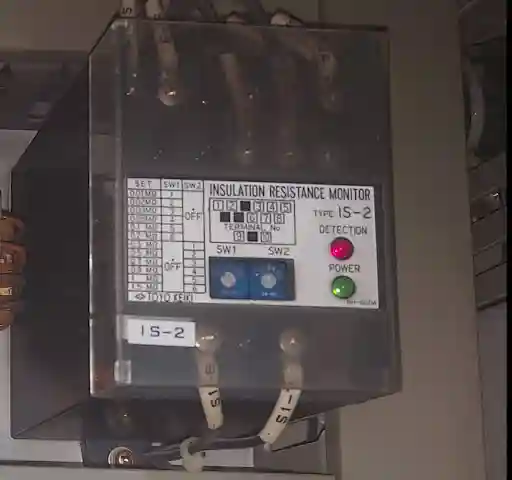
SOLAS states that insulation monitoring devices must be fitted to insulated distribution systems. This will give an audible and visual alarm when the insulation is abnormally low.
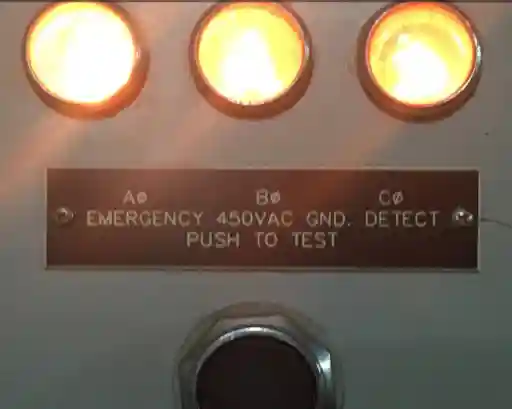
There are 2 common ways of detecting low insulation on a ship.
Both the 440V and 220V systems will have their own monitoring. If the alarm is showing on the 220V panel then the fault will be on the 220V system. This will limit your search.
Low insulation is almost always caused by damp, dirt, heat or damage. Common causes include:-
You want to eliminate the fault. Please follow the correct safety procedures for working on live systems. Ensure you are authorised to open any live equipment and have the correct precautions.
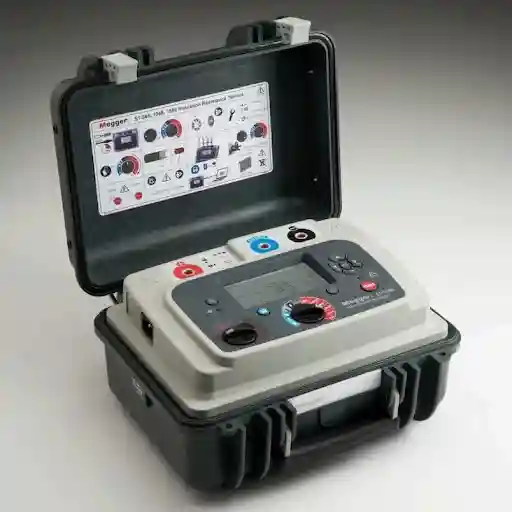
An insulation tester (commonly known as a megger) will apply a DC test voltage. Depending on the circuit, a suitable test voltage will be applied. A 500V test is typical on 440V equipment. Lower voltages may be used on lower voltage circuits. Always refer to the manufacturers guidelines and ship’s procedures. Never test any electronics as the test voltage can cause damage.
A common rule of thumb is to have a minimum of around 1meg ohm on low voltage equipment. However the minimum acceptable values will depend on the ship’s planned maintenance system, class rules and manufacturer. It is also important to know the trends. If a motor was reading 50meg ohms one month and 5 the next something is changing.
Make sure the circuit is isolated, locked off and proved dead. Once the test has been carried out ensure any long cables or windings have been discharged. The test voltage is a hazard. Don’t Ignore it!
It can be tempting to ignore the alarm if it isn’t getting worse. However there is still an earth fault in the system meaning there is one more fault that could cause a short through the hull. Often intermittent alarms are caused by damp issues. These can be affected by temperature/weather and tend to get worse. It is best to treat it as a task. Log it and get to the bottom of it whilst it is just an early indicator.
Insulation failure can cause live metal. Equipment with faulty insulation levels can cause dangerous voltages on the casing.
Most low insulation issues can be prevented by taking basic precautions such as :-
The electrical systems on ships are intentionally kept insulated from the hull so that if there was an earth fault there would not be a blackout. The low insulation alarm lets us know the insulation is becoming low. It is a quiet alarm and nothing will trip. It can be easy to ignore but it is an indication that the system is working how it should. It gives us time to find a fault before it finds a partner. Knowing how the system works, common causes, and systematically isolating and testing will show that most low insulation alarms are caused by damp, dirt or a tired cable.
To prevent the supply tripping if there is a single earth fault. This ensures essential machinery continues to run whilst the crew locate and fix the fault.
No. It means that the insulation resistance between the live conductors and hull has reduced. A second fault on another phase will cause a short through the hull.
3 lamps are connected between each phase and earth. If there is good insulation all 3 will light equally. If there is a fault on one phase the lamp will dim or go out. The other 2 will be brighter.
Earth lamps are an inaccurate visual indicator. An insulation monitor will accurately measure the resistance constantly and will alarm at a set level.
Isolate individual feeders and consumers. Watch the insulation resistance. If it recovers once something has been isolated this is where the fault will be. Confirm by doing an insulation test.
Typically 500V. Always refer to manufacturers guidelines and ships procedures.
It usually indicates there is a damp or damaged issue. It can get worse. There is a second fault on another phase that could cause a short, fire or shock hazard.
Disclaimer :- The opinions expressed in this article belong solely to the author and may not necessarily reflect those of Merchant Navy Decoded. We cannot guarantee the accuracy of the information provided and disclaim any responsibility for it. Data and visuals used are sourced from publicly available information and may not be authenticated by any regulatory body. Reviews and comments appearing on our blogs represent the opinions of individuals and do not necessarily reflect the views of Merchant Navy Decoded. We are not responsible for any loss or damage resulting from reliance on these reviews or comments.
Reproduction, copying, sharing, or use of the article or images in any form is strictly prohibited without prior permission from both the author and Merchant Navy Decoded.
Decoded Discount Alert! up to 50% OFF
Use Coupon Code Deep50