Hi this is Team Merchant Navy Decoded !!!

Please fill the below form with your query and we will get back to you in next 12 hours.

Rest assured your data is safe with us !!!🙂

Ask Your Query

Ship Autopilot

Ship Autopilot

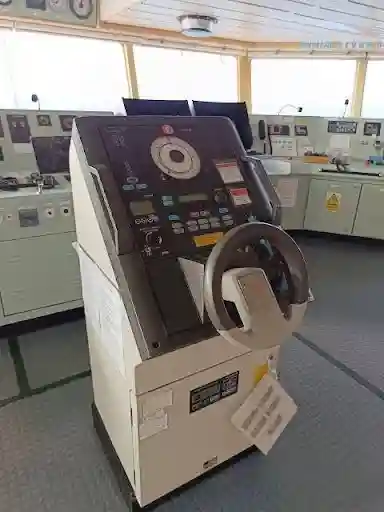
An autopilot is a crucial piece of navigation equipment used onboard ships to allow automatic control of the vessel’s heading. It allows the officer of the watch to be focussed on other navigation tasks by reducing the requirement for them to constantly steer the ship.

Autopilots are commonly used when sailing out at sea and maintaining a steady course. However it does not fully replace the officer of the watch who must constantly be aware of their position, local traffic, weather and the status of the steering system.

What is a Ship Autopilot?

An autopilot is a type of automatic steering system used onboard ships to control the rudder to maintain a set heading. The heading is set by the operator and compared to the actual heading of the ship.

If the ship drifts off course the autopilot will send a signal to the steering system to adjust the rudder to bring the ship back on correct heading.

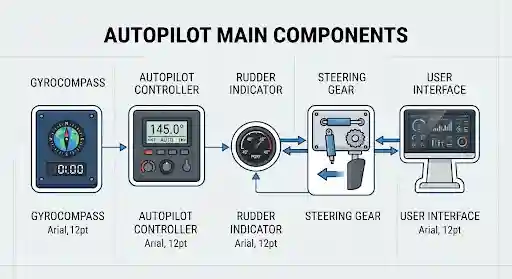
Main Components

  1. Gyrocompass – This provides the actual heading of the ship. Depending on what the ship is fitted with there may be different heading devices
  2. Autopilot controller – Compares the set heading with the actual heading and calculates the correction needed
  3. Rudder indicator – Shows the rudder angle
  4. Steering system – Receives signals from the autopilot and adjusts the steering gear
  5. Rudder and Steering gear – Adjusts the rudder so that the water flows in a new direction causing the ship to turn
  6. User interface – Allows the officer of the watch to set heading and adjust autopilot settings. Allows switching between manual and automatic
Autopilot Main Components

How do they work?

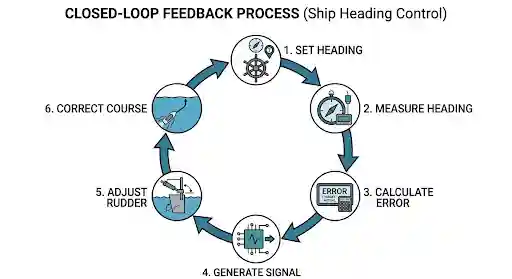
Autopilots use a closed loop feedback system. Constantly comparing the set heading and making adjustments as needed.

Process

  1. Set Heading – The officer sets the desired heading on the autopilot controller
  2. Measure Heading – The gyrocompass continually provides actual heading
  3. Calculate Error – The autopilot controller calculates the difference between actual and set headings
  4. Generate Signal – The autopilot calculates the correction needed to get the heading right based on the heading error and set control settings
  5. Adjust Rudder – The steering system adjusts the steering gear
  6. Correct Course – The rudder adjusts the force of the water causing the ship to turn back on the set heading
  7. Feedback – The new heading is provided by the gyrocompass. Adjustments are made until the ship is almost on target

This process will continue to happen to ensure the ship stays on course even if there are disturbances like wind, waves and currents.

Table of Contents

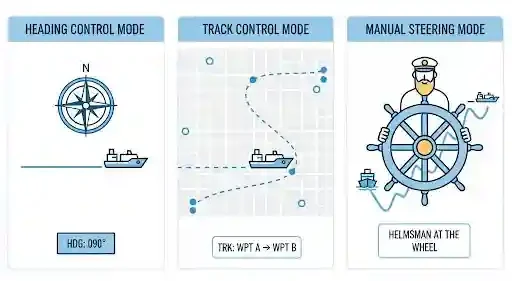
Types of Ship Autopilot Operation

Types of Ship Autopilot Operation
  1. Heading Control Mode: The autopilot maintains a selected compass heading. This is commonly used during open sea navigation
  2. Track Control Mode: When connected to a suitable navigation system, such as an approved electronic chart or GNSS based track system, the autopilot can help keep the vessel along a planned track. This requires additional position and track information
  3. Manual Steering Mode: The helmsman controls the steering manually. The autopilot is not responsible for making automatic course corrections in this mode

The exact modes available depend on the vessel’s equipment and installation.

Important settings

Modern autopilots have a number of settings which can be adjusted to improve performance.

  • Rudder – How sensitive the autopilot will be when adjusting the rudder
  • Counter Rudder – Helps reduce overshoot when nearing set heading
  • Yaw – How much the heading can change before correction
  • Weather – Helps the autopilot to find a balance between keeping the ship on course and reducing excessive rudder movements due to waves

These can be adjusted according to the manufacturer’s instructions and the conditions of the ship.

Benefits

  • Reduces the workload of the helmsman
  • Helps keep the heading more consistent
  • Can reduce unwanted rudder movements when adjusted correctly
  • Can help navigate efficiently in suitable conditions
  • The officer of the watch can focus on keeping an eye on the navigation, traffic and safety

Limitations and Safety

While autopilots make steering easier there are some limitations. They may not react correctly to sudden disturbances, failures or fast changes in navigational conditions.

The officer of the watch should:

  • Keep a proper lookout and constantly be aware of the ships movements
  • Follow COLREGs and bridge procedures
  • Switch to manual as needed
  • Test steering gear and related systems as per bridge procedures
  • React immediately to any alarms from the autopilot or sudden rudder movements
  • Don’t rely on autopilot if there is a need to manually steer frequently or instantly

Always follow the manufacturer’s instructions and safety procedures.

Conclusion

An autopilot is an essential piece of equipment for modern navigation. Using heading devices, a controller and steering gear it is able to constantly detect any course changes and make appropriate corrections by adjusting the rudder. The closed loop feedback system means the ship will stay on a consistent heading and makes steering less of a workload. However to navigate safely the system must be operated correctly, regularly maintained and monitored by the bridge team.

Frequently Asked Questions (FAQs)

The main function is to automatically keep the ship on the set heading by controlling the

rudder.

They operate on a closed loop feedback control principle. Comparing the set heading with the actual heading and making corrections.

A standard heading mode autopilot will only control the steering. Extra functions may be provided by a separate navigation or propulsion system.


Yes, the ship can be manually steered using the steering system and helmsman.

No, the officer of the watch is responsible for navigating safely and must constantly be aware of the vessel.

Disclaimer :- The opinions expressed in this article belong solely to the author and may not necessarily reflect those of Merchant Navy Decoded. We cannot guarantee the accuracy of the information provided and disclaim any responsibility for it. Data and visuals used are sourced from publicly available information and may not be authenticated by any regulatory body. Reviews and comments appearing on our blogs represent the opinions of individuals and do not necessarily reflect the views of Merchant Navy Decoded. We are not responsible for any loss or damage resulting from reliance on these reviews or comments.

Reproduction, copying, sharing, or use of the article or images in any form is strictly prohibited without prior permission from both the author and Merchant Navy Decoded.

DIWALI SALE

Decoded Discount Alert! up to 50% OFF

DIWALI SALE

Decoded Discount Alert! up to 50% OFF

Use Coupon Code Deep50

Days
Hours
Seconds
0
Would love your thoughts, please comment.x
()
x