Hi this is Team Merchant Navy Decoded !!!
Please fill the below form with your query and we will get back to you in next 12 hours.
Rest assured your data is safe with us !!!🙂
Ask Your Query| For Beginner | For Professional |
|---|---|
| GME | Engine Side |
| G.P. Rating | Deck Side |
| ETO | G.P. Rating |
| IMUCET & Sponsorship | Combo Offers |
| Free Course | MEO |
| Free Course |
| For Beginner | For Professional |
|---|---|
| GME | Engine Side |
| G.P. Rating | Deck Side |
| ETO | G.P. Rating |
| IMUCET & Sponsorship | Combo Offers |
| Free Course | MEO |
| Free Course |
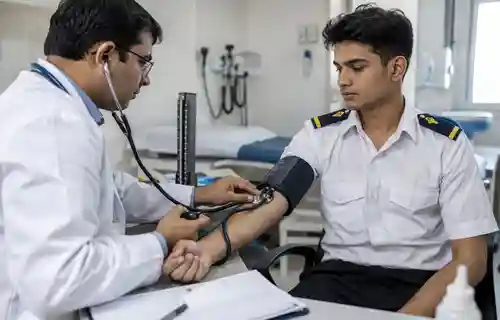
The ETO medical test is not a formality. Before an Electro-Technical Officer can begin a seafaring career, the candidate must meet the medical fitness standards applicable to Indian seafarers. For ETO aspirants, the two questions that create the most confusion are usually eyesight and colour vision: how much unaided vision is required, whether spectacles are allowed, and what happens if colour vision is abnormal.
This guide explains the current Indian framework in simple terms, separates official requirements from academy or shipping-company policy, and shows what to check before you spend heavily on an ETO course. As of 12 September 2026, the DGMA Maritime Health Branch identifies the Merchant Shipping (Medical Examination) Rules, 2000, as amended, as the principal framework for Indian seafarer medical certification and states that pre-sea and in-service eyesight standards follow the applicable STCW framework.
An ETO works around electrical distribution systems, automation, alarms, generators, motors, control equipment and, on some ships, high-voltage systems. The job can involve machinery spaces, ladders, confined areas, night work and emergency duties. A medical condition that affects vision, hearing, mobility, coordination or the ability to respond safely can therefore become a shipboard safety issue.
The medical examination is designed to answer a practical question: can the candidate perform routine and emergency duties at sea safely and reliably? The assessment is broader than a normal pre-employment check-up.
For a new ETO candidate, the key rule is the pre-sea eyesight standard. The official pre-sea category for electrical/electronic officers requires distance vision without visual aids of either:
The same official framework requires normal colour vision tested using the Ishihara test chart. The eyesight standards are set out in the Merchant Shipping (Medical Examination) Rules, 2000 and the Merchant Shipping (Medical Examination) Amendment Rules, 2016.
Unaided means the pre-sea distance-vision result is assessed without spectacles or contact lenses. A student should not assume that reaching 6/6 after wearing glasses automatically makes them eligible for ETO entry. The pre sea requirement itself has an unaided threshold.
Yes, an ETO may be able to serve with spectacles if the seafarer meets the applicable in-service eyesight standard and is certified fit by an approved medical examiner. This is where many articles create confusion: the pre-sea entry table uses an unaided standard, while the STCW in-service table for engineer and electro-technical personnel assesses distance vision with correction permitted within the applicable standard. A candidate should not use the in-service rule to bypass the pre-sea entry requirement.
Practical advice: If you already wear glasses or have a known refractive error, get your unaided vision measured before paying a large, non-refundable course fee.
Normal colour vision is required for the ETO/electrical-electronic officer pre-sea category. The prescribed test is the Ishihara colour-vision test.
Colour vision matters because an ETO may need to identify colour-coded cables, status lamps, alarm indications, panel markings and electronic system information. The test is therefore tied to safe technical work, not to appearance or convenience.
If a candidate does not meet the prescribed normal colour-vision standard, the candidate does not meet the stated pre-sea eyesight requirement for the electrical/electronic officer category. If you suspect a colour-vision deficiency, have it checked early rather than waiting until final admission or company medicals.
The ETO medical test covers more than eyes. The DGMA Maritime Health framework requires medical examiners to assess whether a seafarer is physically fit for sea service. The exact examination and any additional investigation depend on the prescribed framework, the candidate’s history and the medical examiner’s professional judgement.
A diagnosis is not automatically equal to permanent rejection. Maritime medical decisions are based on the severity of the condition, control with treatment, risk of recurrence, likelihood of sudden incapacity and whether the person can perform the required duties safely. The ILO/IMO Guidelines on the Medical Examinations of Seafarers follow the same risk-based approach rather than treating every diagnosis as an automatic ban.
Hearing is relevant because an ETO must understand instructions, communicate with the engine-room team and recognise alarms. The approved examiner assesses whether hearing is adequate for safe sea service and may use the tests required under the applicable medical framework.
There is no sensible reason to turn dental fitness into a list of rumours such as “one cavity means rejection.” The real concern is whether a dental condition is active, serious, painful, infected or likely to require urgent treatment while the seafarer is away from shore. Finish obvious dental treatment before the final medical examination whenever possible.
Current DGMA maritime-health guidance requires approved medical examiners to conduct the prescribed investigations and to use appropriate laboratories for outsourced tests. Additional tests may be ordered when needed. The exact test package can also vary with age, sex, medical history, the purpose of the examination and a shipping company’s own joining requirements.
Important distinction: a shipping company or training organisation may ask for extra investigations beyond the statutory seafarer medical. That is an organisation-specific requirement, not automatically a universal DG Shipping rule.
There is no single “rejection list” that should be copied from one shipping company and treated as law. However, some issues commonly create problems because they directly affect the prescribed standards or safe sea service.
Some findings result in temporary unfitness rather than a permanent bar. Treatment, recovery or further specialist assessment may be required before a final fitness decision is made. The correct next step is to ask the approved examiner what failed, what evidence is required and whether re-examination is possible.
Check your unaided eyesight and colour vision early. Do this before paying large non-refundable fees.
Area | What an ETO Aspirant Should Know |
Pre-sea distance vision | Unaided 6/12 in each eye, or 6/9 in the better eye and 6/18 in the other eye. |
Colour vision | Normal colour vision; Ishihara test is prescribed. |
Spectacles | Do not use corrected vision to replace the unaided pre-sea entry requirement. In-service assessment is different. |
Medical examiner | Use a currently DGS-approved Medical Examiner for a valid Indian seafarer medical certificate. |
Other tests | Physical examination plus prescribed investigations; extra company/institute tests may also apply. |
If unfit | Find out whether the issue is temporary, treatable, requires specialist review, or is incompatible with the applicable standard. |
Medical eligibility is only one part of becoming an ETO. You still need the right academic preparation, sponsorship strategy, interview practice and a clear understanding of what companies expect from candidates. SMVD Marine Academy focuses on Merchant Navy career preparation, including ETO-oriented coaching, tests and interview preparation. Its published admission procedure also asks candidates to bring a sight-test certificate showing a passed colour-blindness test and no blurry vision. That is an SMVDM admission requirement and should not be confused with the full statutory seafarer medical conducted by an approved Medical Examiner.
Students who want to understand the academy’s track record can also review the published SMVDM ETO results before deciding whether its preparation model fits their needs.
Merchant Navy Decoded can help you check eligibility, understand ETO career requirements and continue learning beyond the medical stage. Before applying, you can use the ETO Eligibility Calculator to review your academic and basic eligibility profile. You can also access these resources through the Merchant Navy Decoded App, which brings maritime learning, career guidance, company insights, eligibility calculator, and useful seafarer resources together in one place. Download the app on Android or iOS to continue learning throughout your Merchant Navy journey.
For an aspiring ETO, the medical should be checked early, not after the entire admission plan is locked in. The most important entry-level points are clear: the ETO pre-sea eyesight standard is unaided 6/12 in each eye or 6/9 in the better eye and 6/18 in the other eye, and normal colour vision is required on the Ishihara test. General fitness, hearing and other medical factors are then assessed by the approved examiner.
If you have glasses, a known eye problem or any significant medical history, do not guess your eligibility from social media. Use the current DGMA Maritime Health guidance and an approved Medical Examiner, and check any additional institute or company requirements separately. That is the safest way to approach the ETO medical test.
Yes, an ETO may be able to serve with spectacles if the applicable in-service eyesight standard is met and the seafarer is certified fit. This does not remove the unaided eyesight requirement for a new pre-sea ETO candidate.
The prescribed pre-sea standard requires normal colour vision tested using the Ishihara chart. A candidate who does not meet that standard does not meet the stated ETO/electrical-electronic officer pre-sea eyesight requirement.
For the official Indian seafarer medical certificate, use a Medical Examiner currently approved by DGMA/DG Shipping. Check the live DGMA Register of Approved Medical Examiners before booking because approval status can change.
It depends on the reason. Some problems are temporary or treatable and may allow re-examination after treatment or specialist review. Other conditions may be incompatible with the applicable sea-service standard. Ask the approved examiner for the exact reason and next step.
A pre-sea medical examination is required before entering a seafaring career under the Merchant Shipping (Medical Examination) Rules, 2000, as amended, but the exact timing inside an institute or sponsor’s admission process can vary. Some organisations also ask for an earlier sight or colour-vision certificate. Check the current admission instructions and complete the statutory medical with an approved examiner as required.
For ETO pre-sea medical fitness, the published DG Shipping eyesight standard for Electrical/Electronic Officers is: 6/12 in both eyes (unaided), OR 6/9 in the better eye and 6/18 in the other eye (unaided).Normal colour vision is also required.
Example:
If your unaided eyesight is 6/12 & 6/12 → you satisfy the eyesight requirement.
If it is 6/9 & 6/18 → you also satisfy the eyesight requirement.
But if your eyesight is, for example, 6/18 & 6/18, 6/24 & 6/18, or worse, and the problem is due to a correctable refractive error such as myopia, hypermetropia or astigmatism, you should first consult a DG Shipping-approved Medical Examiner. If advised and medically suitable, you may consider LASIK or another suitable refractive procedure to bring your eyesight within the required standard.
Disclaimer :- The opinions expressed in this article belong solely to the author and may not necessarily reflect those of Merchant Navy Decoded. We cannot guarantee the accuracy of the information provided and disclaim any responsibility for it. Data and visuals used are sourced from publicly available information and may not be authenticated by any regulatory body. Reviews and comments appearing on our blogs represent the opinions of individuals and do not necessarily reflect the views of Merchant Navy Decoded. We are not responsible for any loss or damage resulting from reliance on these reviews or comments.
Reproduction, copying, sharing, or use of the article or images in any form is strictly prohibited without prior permission from both the author and Merchant Navy Decoded.
Decoded Discount Alert! up to 50% OFF
Use Coupon Code Deep50