Hi this is Team Merchant Navy Decoded !!!
Please fill the below form with your query and we will get back to you in next 12 hours.
Rest assured your data is safe with us !!!🙂
Ask Your Query| For Beginner | For Professional |
|---|---|
| GME | Engine Side |
| G.P. Rating | Deck Side |
| ETO | G.P. Rating |
| IMUCET & Sponsorship | Combo Offers |
| Free Course | MEO |
| Free Course |
| For Beginner | For Professional |
|---|---|
| GME | Engine Side |
| G.P. Rating | Deck Side |
| ETO | G.P. Rating |
| IMUCET & Sponsorship | Combo Offers |
| Free Course | MEO |
| Free Course |
A ship can carry enough fuel, food, and spare parts for a long voyage, but water is different: people need it every single day, for drinking, cooking, washing, and everything in between, with no shore tap to fill back on mid-ocean. Getting it wrong isn’t a minor inconvenience. Waterborne outbreaks on ships are well documented, and most of them trace back to the same handful of failure points: contaminated bunker water, poor storage, or a treatment system nobody was actually monitoring.
This post covers where a ship’s drinking water actually comes from, how it’s produced and stored on board, how it’s treated and tested, and the standards that govern all of it.
A vessel typically relies on a mix of sources, not just one:-
Most ships lean heavily on onboard production simply because bunkering water quality varies enormously port to port, and producing it fresh from seawater gives the crew far more control over what actually goes into the tanks.
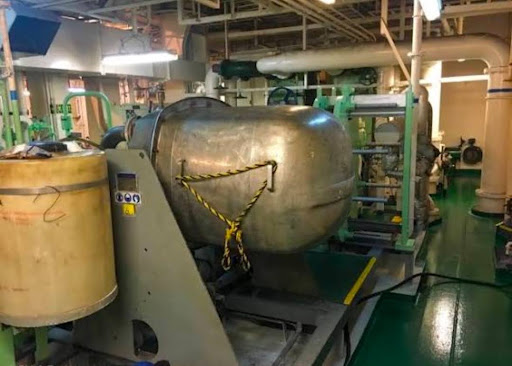
An evaporator produces fresh water by boiling seawater and collecting the condensed vapour.Â
Because it runs on waste heat, evaporator output is tied to engine load plenty of production at sea under normal load, far less (or none) at anchor or manoeuvring, when there isn’t enough waste heat available to run it properly.
An RO plant works on a completely different principle: forcing seawater through a semi-permeable membrane at high pressure typically 60–70 bar so that water molecules pass through while dissolved salts are largely rejected.
Many ships carry both systems, precisely because their operating conditions don’t overlap well; the evaporator covers normal sea passage efficiently, and RO fills the gap when the ship isn’t generating enough waste heat to run it.
|  | Evaporator | Reverse Osmosis |
Principle | Vacuum assisted boiling and condensation | High pressure membrane filtration |
Energy source | Waste heat (jacket cooling water) | Electrical power(high pressure pump) |
Best suited for | Normal sea passage; Engine at load | Port,anchor,low engine load |
Water quality out | Very pure but flat needs mineralising | Good quality some dissolved solids typically remain safe to drink readily |
Water produced or bunkered doesn’t go straight to a tap it goes into dedicated potable water tanks, and how those tanks are built and positioned matters as much as how the water was made.
Key requirements:-
Limited space on ships means potable water systems sometimes end up closer to less desirable neighbours than anyone would prefer a heat source, a waste line which is exactly why the physical separation and coating requirements are treated as non-negotiable rather than best-effort.
Water doesn’t stay safe just because it started clean. Distribution pipework, storage time, and biofilm growth all work against it, so treatment continues well past the point of production.
Common treatment methods:-Â
None of these replace each other. A well-run system typically layers more than one, precisely because no single method catches everything on its own.
Shipboard drinking water isn’t governed by one single rulebook; several frameworks apply together, and different flag states and trades bring in additional layers on top.
Standard | What it covers |
WHO guidelines for drinking water quality | Baseline chemical, physical and microbial quality parameters |
WHO guide to ship sanitation | Ship specific guidance covering production, storage and distribution risk |
MLC 2006 | Requires safe drinking water in sufficient quantity for crew, enforceable since 2013 |
USPH/CDC Vessel Sanitation Program(VSP) | Applies to vessel calling at US ports |
ISO 15748 | Technical standard specifically for shipboard potable water treatment equipment |
Testing frequency is typically daily for simple checks like residual chlorine and pH, with fuller microbial testing done on a scheduled interval or whenever a fault, complaint, or new bunkering event gives reason to check sooner.
A few things don’t fit neatly into sources, production, or treatment, but matter just as much in practice.
Bunkering water carries real risk. Waterborne outbreaks have been directly linked to poor-quality shore water taken on without proper precaution. Good practice means using the ship’s own dedicated, clean hose rather than whatever’s offered, flushing it before connecting, keeping the hose end off the deck, and sampling the water before it’s accepted into the tanks rather than after.
Legionella is a genuine, known risk in shipboard water systems, particularly in warm, stored water in accommodation systems like showers and hot water lines the same risk profile land-based hotels and hospitals manage, just in a more confined space with less redundancy if something goes wrong.
Desalinated water is subtly corrosive. Both evaporator and RO output lack the natural mineral content that normally protects piping from corrosion, which is part of why remineralisation isn’t just a taste issue it protects the distribution system too.
A documented water safety plan matters as much as the equipment itself. Standards and treatment systems only work if someone’s actually following a written plan : Sampling schedule, dosing records, tank cleaning intervals rather than relying on informal habits that varies by who’s on watch.
Drinking water on a ship isn’t a single system it’s a chain, and the multi-barrier idea running through WHO guidance exists specifically because that chain is only as strong as its weakest link. Source it carefully, whether from shore or from an evaporator or RO plant running properly. Store it in tanks built and positioned to keep it clean. Treat it continuously, not just once. And test it against real standards rather than assuming it’s fine because nobody’s complained yet. Get all four right, together, and it stops being a risk anyone on board has to think about day to day which is exactly the point.
An evaporator boils seawater under vacuum using waste heat (typically from main engine jacket cooling water) and condenses the vapour into fresh water. Reverse osmosis forces seawater through a semi-permeable membrane at high pressure to filter out salts. Evaporators depend on engine load for their heat source; RO plants run on electrical power and can operate at anchor or in port when an evaporator often can’t.
Evaporator output is extremely pure, which makes it both flat-tasting and mildly corrosive to piping, since it lacks the natural mineral content that normally helps protect metal surfaces. Passing it through a mineral bed or dosing it addresses both issues.
It’s the principle of protecting drinking water quality at every stage from the shore source and bunkering process, through onboard treatment and storage, all the way to the tap rather than relying on a single safeguard anywhere in that chain.
Waterborne disease outbreaks on ships have been directly linked to poor-quality shore water. Precautions like using a dedicated clean hose, flushing it before connecting, keeping the hose end off the deck, and sampling before acceptance are standard practice specifically to manage this risk.
Microbial parameters coliforms, E. coli, intestinal enterococci, and heterotrophic plate count along with chemical and physical parameters like residual chlorine, pH, turbidity, and total dissolved solids. Microbial contamination in particular can’t be detected by sight or smell, which is why routine laboratory testing is essential rather than optional.
Disclaimer :- The opinions expressed in this article belong solely to the author and may not necessarily reflect those of Merchant Navy Decoded. We cannot guarantee the accuracy of the information provided and disclaim any responsibility for it. Data and visuals used are sourced from publicly available information and may not be authenticated by any regulatory body. Reviews and comments appearing on our blogs represent the opinions of individuals and do not necessarily reflect the views of Merchant Navy Decoded. We are not responsible for any loss or damage resulting from reliance on these reviews or comments.
Reproduction, copying, sharing, or use of the article or images in any form is strictly prohibited without prior permission from both the author and Merchant Navy Decoded.
Decoded Discount Alert! up to 50% OFF
Use Coupon Code Deep50