Hi this is Team Merchant Navy Decoded !!!
Please fill the below form with your query and we will get back to you in next 12 hours.
Rest assured your data is safe with us !!!🙂
Ask Your Query| For Beginner | For Professional |
|---|---|
| GME | Engine Side |
| G.P. Rating | Deck Side |
| ETO | G.P. Rating |
| IMUCET & Sponsorship | Combo Offers |
| Free Course | MEO |
| Free Course |
| For Beginner | For Professional |
|---|---|
| GME | Engine Side |
| G.P. Rating | Deck Side |
| ETO | G.P. Rating |
| IMUCET & Sponsorship | Combo Offers |
| Free Course | MEO |
| Free Course |
An emergency exit on a ship is a specific route/door for exiting a space in case of an emergency such as fire, flooding, machinery failure etc. An emergency exit differs from a normal door in that it is provided for a specific purpose of escape.
A ship’s modern safety standards require that all enclosed working spaces, particularly those where a crew member would normally be working alone or with only one other person, be provided with at least two means of escape.
Emergency exits are located throughout the ship in all areas where a crew member could possibly find themselves working, resting or passing through.
These include:
cargo control rooms
Each space is laid out so that the nearest exit is a short walk away no matter where a crew member is when an emergency occurs.
Emergency exits on ships are designed according to international safety requirements, particularly the SOLAS (Safety of Life at Sea) Convention. The regulations specify requirements for means of escape from accommodation, machinery spaces and other enclosed areas. The arrangement depends on the type and size of the ship and the space involved.
Escape routes must provide a safe and continuous means of reaching an embarkation deck or another safe area. Their construction, width, access and fire protection are considered during the ship’s design and approval process. Fire Control Plans and onboard safety plans also help the crew identify escape arrangements and emergency access points.
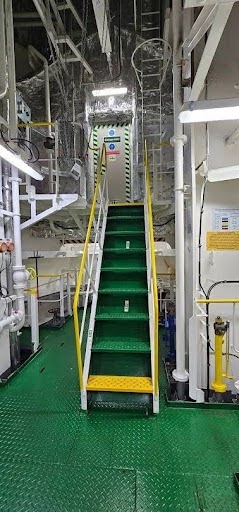
The engine room deserves special attention because it is a large, multi level space filled with machinery, and a fire or flooding here can quickly block a single route out. For this reason, the engine room always has two widely separated escape routes.
Typically, one route leads through the normal engine room entrance and stairways up to the main deck. The second route is an independent escape trunk, a vertical shaft fitted with a ladder that runs from the lower engine room levels straight up to a hatch on the open deck, bypassing the main machinery space entirely. This escape trunk is enclosed by fire resistant boundaries so that smoke and heat from the engine room cannot easily enter it.
The two escape routes are positioned as far apart from each other as practicable, usually at opposite ends of the engine room, so that a single incident cannot block both at once.
An emergency exit is easy to recognise once a crew member knows what to look for:
The core purpose of an emergency exit is to protect life. Specific objectives include:
Knowing that an emergency exit exists is not enough. Crew members must be familiar with the complete escape route from their working and living areas. During safety familiarisation and emergency drills, crew are shown the location of escape routes, emergency exits, muster stations and relevant lifesaving equipment.
Crew members should also understand the ship’s emergency alarm signals and the actions required after an alarm. Regular training helps them recognise alternative routes and avoid confusion when visibility is reduced or normal lighting is unavailable. New crew members should receive safety familiarisation soon after joining the vessel so that they can identify their assigned escape routes before an emergency occurs.
Emergency exits should be used whenever the normal route out of a space is unsafe, blocked, or unavailable. Typical situations include:
Crew are trained to use whichever exit is closer and clearly usable at the time rather than automatically heading for the main entrance out of habit.
Because an emergency exit is only useful if it works when needed, ships maintain strict checks on these routes:
Emergency exits are a quiet but essential part of ship safety. They are rarely used, yet their design, placement and upkeep can make the difference between a safe escape and a tragedy during a real emergency. In spaces like the engine room where two separated escape routes and a dedicated escape trunk are always provided, familiarity with these paths through regular drills is just as important as the equipment itself.
It is a specific route/door for exiting a space in the event of an emergency.
An engine room normally has two widely separated escape routes, one of which is usually a vertical escape trunk leading to an open deck.
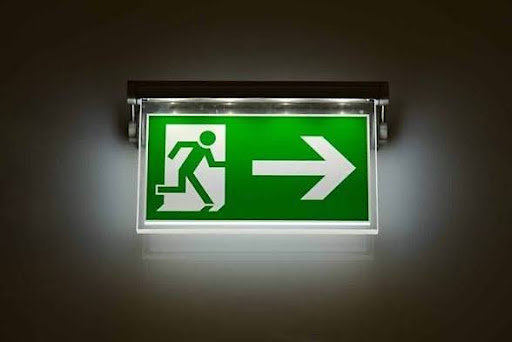
By distinctive colour marking, running man exit signage, low location lighting and photoluminescent strips along the escape path.
Whenever the normal means of exit is blocked, unsafe or unavailable or during drills practising the use of alternate means of exit.
So that one fire, explosion or flooding incident is not able to block both escape routes at the same time.
Disclaimer :- The opinions expressed in this article belong solely to the author and may not necessarily reflect those of Merchant Navy Decoded. We cannot guarantee the accuracy of the information provided and disclaim any responsibility for it. Data and visuals used are sourced from publicly available information and may not be authenticated by any regulatory body. Reviews and comments appearing on our blogs represent the opinions of individuals and do not necessarily reflect the views of Merchant Navy Decoded. We are not responsible for any loss or damage resulting from reliance on these reviews or comments.
Reproduction, copying, sharing, or use of the article or images in any form is strictly prohibited without prior permission from both the author and Merchant Navy Decoded.
Decoded Discount Alert! up to 50% OFF
Use Coupon Code Deep50