Hi this is Team Merchant Navy Decoded !!!
Please fill the below form with your query and we will get back to you in next 12 hours.
Rest assured your data is safe with us !!!🙂
Ask Your Query| For Beginner | For Professional |
|---|---|
| GME | Engine Side |
| G.P. Rating | Deck Side |
| ETO | G.P. Rating |
| IMUCET & Sponsorship | Combo Offers |
| Free Course | MEO |
| Free Course |
| For Beginner | For Professional |
|---|---|
| GME | Engine Side |
| G.P. Rating | Deck Side |
| ETO | G.P. Rating |
| IMUCET & Sponsorship | Combo Offers |
| Free Course | MEO |
| Free Course |
Introduction
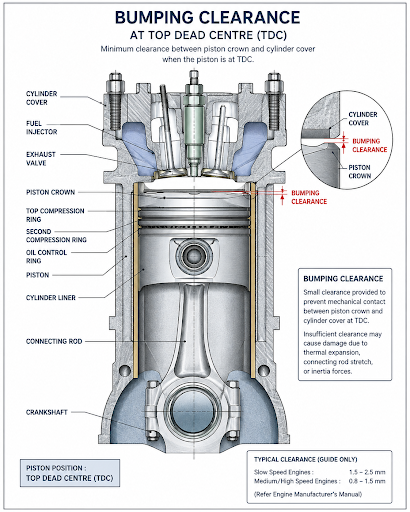
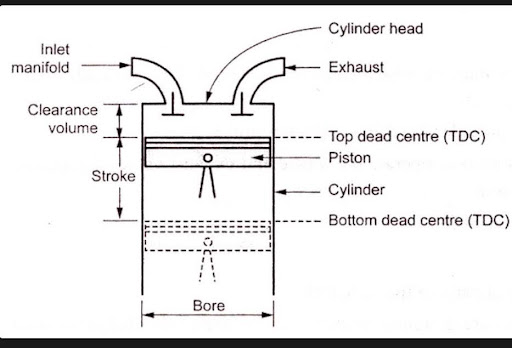
In marine diesel engines, the clearances between the running parts are of great importance, and one of them is bumping clearance. Bumping clearance is the clearance between the top of the piston crown and the cylinder cover at Top Dead Centre (TDC).
The clearance is provided to prevent contact between the piston and the cylinder cover at TDC and it is the clearance that needs to be paid special attention during engine inspection. It is small, but it is vital to ensure that the piston does not come into contact with the cylinder cover as it would lead to serious engine damage. The clearance is necessary for the proper functioning of the engine and control of the compression process.
Bumping clearance also known as piston-to-cylinder cover clearance is the distance between the top of the piston and the underside of the cylinder cover when the piston is at TDC.
The clearance must remain within the manufacturer’s specified limits. It is normally checked during major overhauls, after piston or connecting rod work or whenever abnormal engine performance indicates a possible change in piston position.
The term “bumping” refers to the possibility of the piston physically contacting the cylinder cover if the clearance becomes insufficient.
The main purpose of bumping clearance is to provide sufficient space for the piston to move safely at the top of its stroke.
Important reasons include:
A clearance that is too small can be dangerous, while excessive clearance can also affect engine performance.
If the clearance becomes less than the specified value, there is a risk of the piston contacting the cylinder cover. This can happen because of incorrect assembly, excessive bearing wear, incorrect component dimensions or other changes in the piston and crank mechanism.
Possible consequences include:
Therefore, a low bumping clearance should never be ignored.
Excessive bumping clearance may also create problems. Since the piston does not reach its designed position relative to the cylinder cover, the combustion chamber volume increases.
This can result in:
For this reason, the clearance should not simply be increased to avoid piston contact. It must remain within the manufacturer’s specified range.
The exact procedure depends on the engine manufacturer’s instructions, but a typical procedure involves the following steps:
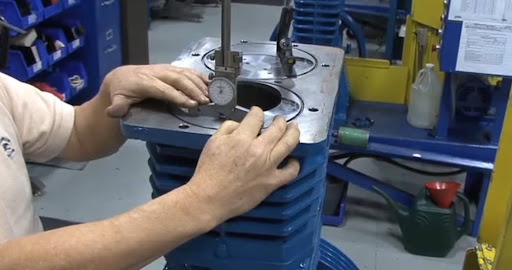
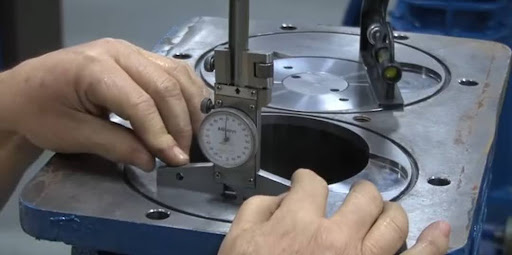
The bumping clearance can be checked using different methods depending on the engine design and manufacturer’s instructions. Common methods include using lead wire (soft solder), a dial gauge or other approved measuring arrangements. In the lead wire method, a suitable piece of soft lead wire is placed at the specified position and the engine is carefully turned so that the piston compresses the wire at TDC. The thickness of the flattened wire is then measured to determine the clearance. The method and measuring locations must always follow the engine manufacturer’s instructions.
Several factors can change the bumping clearance during an engine’s service life:
Regular inspection helps identify these changes before they develop into serious problems.
If the measured bumping clearance is outside the manufacturer’s specified range, the clearance may need to be adjusted during maintenance. The adjustment method depends on the engine design and may involve approved changes to components such as shims, connecting rod arrangements, or bearing related settings. Any adjustment must be carried out according to the manufacturer’s manual. After adjustment, the clearance should be measured again to confirm that it is within the specified limit.
While checking bumping clearance, proper precautions should be followed:
Bumping clearance measurements should be properly recorded during inspections and overhauls. Keeping previous readings allows engineers to compare the latest measurement with earlier values and identify unusual changes. A sudden change may indicate wear, incorrect assembly or another mechanical issue. Maintaining accurate records also helps in planning future maintenance and provides useful information about the condition of the engine.
Bumping clearance is a vital and an important feature of the marine diesel engine. The clearance provision is necessary to ensure that the piston does not contact the cylinder cover at Top Dead Center (TDC) while also maintaining the designed volume of the combustion chamber.
Both low and high clearance may lead to several performance and safety implications and thus should be regularly monitored. The measurement results should be compared to the recommended manufacturer’s specification during servicing to ensure that everything is within the permissible limits. As a result, this can help the engineers to establish potential problems in the engine such as wear and improper assembly long before serious damages occur.
Bumping clearance is the distance between the piston crown and the cylinder cover when the piston is at TDC.
It prevents the piston from striking the cylinder cover and provides the required space for thermal expansion and safe engine operation.
The piston may come into contact with the cylinder cover, potentially causing serious damage to the piston, cylinder cover and other engine components.
Excessive clearance increases the combustion chamber volume and can reduce the effective compression ratio, affecting combustion, efficiency and engine power.
Disclaimer :- The opinions expressed in this article belong solely to the author and may not necessarily reflect those of Merchant Navy Decoded. We cannot guarantee the accuracy of the information provided and disclaim any responsibility for it. Data and visuals used are sourced from publicly available information and may not be authenticated by any regulatory body. Reviews and comments appearing on our blogs represent the opinions of individuals and do not necessarily reflect the views of Merchant Navy Decoded. We are not responsible for any loss or damage resulting from reliance on these reviews or comments.
Reproduction, copying, sharing, or use of the article or images in any form is strictly prohibited without prior permission from both the author and Merchant Navy Decoded.
Decoded Discount Alert! up to 50% OFF
Use Coupon Code Deep50