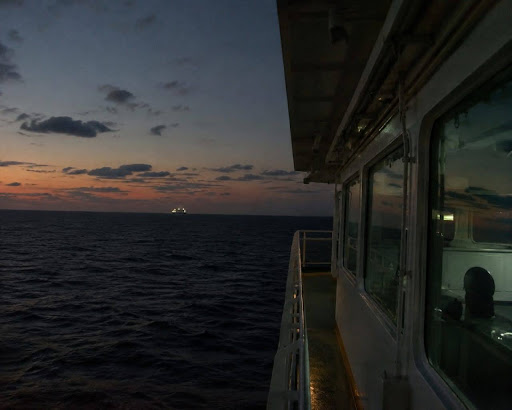
At sea, no painted lanes are telling a vessel where to go and no traffic lights telling two ships who should move first. A vessel may suddenly appear on radar, another may emerge from fog, or two ships may find themselves approaching from different directions with nothing but open water between them. In those situations, there has to be a common set of rules that both sides understand in the same way.
That is what the COLREGs – The International Regulations for Preventing Collisions at Sea provide. For someone learning navigation, it’s tempting to treat the COLREGs as a list of 41 rules to be memorised in order. In practice, that’s not really how they get used. A watchkeeper needs to recognise what kind of situation is developing, decide whether there’s a risk of collision, work out which rule actually applies, and take action early enough for the other vessel to understand what’s happening. That practical side reading a situation and acting on it is what actually matters, far more than reciting the text word for word.
How the COLREGs Are Structured
The COLREGs contain 41 rules across six parts, plus four technical annexes covering detail like exact light positioning.
Part A (Rules 1–3) – General. Application of the rules, responsibility, and key definitions.
Part B (Rules 4–19) – Steering and Sailing. The section most people associate with collision avoidance: lookout, safe speed, risk of collision, overtaking, head-on and crossing situations, and restricted visibility.
Part C (Rules 20–31) – Lights and Shapes. The lights and day shapes vessels are required to display.
Part D (Rules 32–37) – Sound and Light Signals. Whistle signals, manoeuvring and warning signals, restricted-visibility signals, and distress signals.
Part E (Rule 38) – Exemptions, and Part F –Verification of Compliance, covering the IMO Member State Audit Scheme.
You don’t need every rule memorised on day one. What matters early on is knowing roughly where to look, and genuinely understanding the handful of rules that come up again and again on the bridge.
Rule 2: Good Seamanship Still Matters
Before getting into the specific rules, it’s worth starting here, because it frames everything that follows. Rule 2 makes clear that the COLREGs don’t remove a mariner’s responsibility to comply with the rules, or to take whatever precautions are required by ordinary seamanship or by the special circumstances of a given case.
This gets loosely nicknamed the “common sense rule,” which can be misleading if it’s taken to mean a mariner can ignore the COLREGs whenever they think they have a better idea. The opposite is closer to the truth. The normal rules still apply, in the vast majority of situations, exactly as written. Rule 2 becomes important specifically when unusual circumstances develop and strict application of a rule would itself contribute to danger; it exists for that edge case, not as a general escape hatch.
The Rules You’ll Use Again and Again
Rule 5 : Lookout. A proper lookout is one of the real foundations of collision avoidance, and it’s required by sight and hearing as well as by all available means appropriate to the circumstances. In practice, that means radar, AIS, and electronic charts are genuinely useful but they don’t turn the bridge team into passive observers of a screen. A proper lookout means actively building a complete picture of what’s happening around the vessel, not just glancing at a display every so often.
Rule 6 : Safe Speed. There’s no single number that qualifies as “safe” for every situation. Factors include visibility, traffic density, the vessel’s manoeuvrability, background lighting, wind, sea and current conditions, and the limitations of radar where it’s being used. A speed that’s perfectly reasonable in clear weather and open water can be completely inappropriate in heavy fog with several targets around the vessel.
Rule 7 : Risk of Collision. One of the most useful practical ideas in the whole framework is the relationship between bearing and range: if another vessel is getting closer while its relative bearing stays approximately constant, there may be a risk of collision with the classic constant bearing, decreasing range situation. Radar plotting makes this assessment considerably more reliable, particularly with several vessels in the picture. Rule 7 also makes an important point explicitly: when there’s doubt about whether a risk of collision exists, assume that it does. Waiting until a situation looks obviously dangerous leaves far less room to manoeuvre safely.
Rule 8 : Action to Avoid Collision. Once action is needed, it shouldn’t be vague. Rule 8 requires it to be positive, made in ample time, and readily apparent to the other vessel. A tiny, late alteration may technically change your heading, but it does little to actually communicate your intention to the other bridge team — and the goal isn’t just to move away from the collision point, it’s to make the situation clearly resolved for both sides.
The Three Encounters Every Cadet Learns First
Among everything the COLREGs cover, three situations come up constantly: overtaking, head-on, and crossing.
Rule 13 – Overtaking. The overtaking vessel must keep out of the way of the vessel being overtaken. Importantly, she doesn’t suddenly gain priority just because the relative positions shift partway through the manoeuvre the responsibility to keep clear continues until she’s finally past and clear.
Rule 14 – Head-On Situation. When two power-driven vessels are meeting head-on or nearly so, with risk of collision, both alter course to starboard, so they pass on each other’s port side. It’s one of the simplest situations to visualise, since both vessels are making the same, agreed manoeuvre.
Rule 15 – Crossing Situation. When two power-driven vessels are crossing with risk of collision, the vessel that has the other on her own starboard side must keep out of the way. A simple way to remember it: if the other vessel is approaching from your starboard side, you’re normally the give-way vessel but that’s a memory aid, not a substitute for actually assessing the developing situation.
Table of Contents
Give-Way and Stand-On: What They Actually Mean
These two terms get misunderstood constantly, and it’s worth being precise about them. The give-way vessel is expected to take early and substantial action to keep clear. The stand-on vessel should normally maintain course and speed, so both vessels’ intentions stay predictable – Rules 16 and 17 deal with this specifically.
But “stand-on” doesn’t mean “do nothing regardless of what happens.” If it becomes apparent the give-way vessel isn’t taking appropriate action, the stand-on vessel may need to act to avoid collision herself. The point of the COLREGs is ultimately to prevent the collision, not to establish who was technically in the right after it’s already happened.
Restricted Visibility: When the Situation Changes
Fog is the easiest example, but heavy rain, snow, or any other condition that meaningfully reduces visibility brings Rule 19 into play. This situation is genuinely different, because the vessels involved may not be in sight of each other at all which means the normal in-sight encounter rules (give-way, stand-on, the specific starboard-side logic) can’t simply be applied the same way.
Rule 19 requires every vessel to proceed at a safe speed adapted to the prevailing conditions, with a vessel detecting another by radar expected to assess whether a risk of collision exists and take appropriate avoiding action generally avoiding an alteration toward a vessel forward of the beam unless overtaking. This is also why the bridge team needs to stay ready for a situation to develop quickly: radar may show a target well before the crew can see it, and a fog signal may be the only real indication another vessel is even nearby.
Lights, Shapes and Sound Signals
The COLREGs aren’t only about deciding which vessel manoeuvres they also give vessels a shared visual and audible language, so intentions and status are readable before anyone’s close enough to ask.
At night, navigation lights help identify what a vessel is and what she’s doing – a vessel engaged in fishing, one restricted in her ability to manoeuvre, and one not under command each carry distinctly different light configurations, specifically so another bridge team can read the situation at a glance in the dark. During daylight, shapes : Balls, cones, diamondsdo the equivalent job. Knowing these configurations isn’t just an exam exercise; they’re part of how a bridge team actually interprets the traffic around it in real time.
Sound signals add another layer entirely. Specific patterns of short and prolonged blasts each carry a standardised meaning, communicating manoeuvring intentions and warnings, and in restricted visibility they become one of the few ways vessels can make each other’s presence known without relying on radio.
Yes. Rule 1 states that the COLREGs apply to vessels on the high seas and connected waters navigable by seagoing vessels; they’re not written only for large commercial ships. A small craft can still create a genuine collision risk, and the responsibilities under the rules apply to her just as much as to anything larger.
One detail worth knowing: a sailing vessel using her engine is treated as a power-driven vessel for the purposes of the relevant provisions, regardless of whether her sails happen to still be hoisted. She doesn’t retain sailing-vessel priority just because the sails are up.
Conclusion
The COLREGs can look intimidating laid out as 41 numbered rules in a textbook. On the bridge, collision avoidance usually comes down to a much smaller set of ideas working together: maintain a proper lookout, proceed at a safe speed, identify risk of collision early, know whether you’re in an overtaking, head-on, or crossing situation, and take action that’s positive and timely. None of that replaces good seamanship and sound judgment it operates alongside it.
The sea has no painted lanes, but it does have a common language to prevent accidents.
The give-way vessel is responsible for taking early and substantial action to keep clear. The stand-on vessel normally maintains course and speed so both vessels’ intentions stay predictable but she may still need to take avoiding action herself if it becomes apparent the give-way vessel isn’t doing what’s required.
Rule 7 requires using all available means, including a steady or nearly steady relative bearing combined with decreasing range the classic indication of a possible collision course. Radar plotting makes this considerably more reliable with multiple vessels in the picture, and when there’s genuine doubt, the rule requires assuming the risk exists rather than assuming it away.
Under Rule 15, when two power-driven vessels are crossing with risk of collision, the vessel that has the other on her own starboard side must keep out of the way.
Yes, significantly. Rule 19 governs conduct in or near restricted visibility separately, since vessels may not be in sight of each other at all. It requires proceeding at a safe speed for the conditions and carefully assessing any radar-detected target for collision risk, generally avoiding a turn toward a vessel forward of the beam unless overtaking.
Yes. The rules apply broadly to vessels within their scope, not just large commercial ships; a kayak or small craft still carries the same responsibilities for lookout, safe speed, and collision avoidance as a supertanker.
Disclaimer :- The opinions expressed in this article belong solely to the author and may not necessarily reflect those of Merchant Navy Decoded. We cannot guarantee the accuracy of the information provided and disclaim any responsibility for it. Data and visuals used are sourced from publicly available information and may not be authenticated by any regulatory body. Reviews and comments appearing on our blogs represent the opinions of individuals and do not necessarily reflect the views of Merchant Navy Decoded. We are not responsible for any loss or damage resulting from reliance on these reviews or comments.
Reproduction, copying, sharing, or use of the article or images in any form is strictly prohibited without prior permission from both the author and Merchant Navy Decoded.