Hi this is Team Merchant Navy Decoded !!!
Please fill the below form with your query and we will get back to you in next 12 hours.
Rest assured your data is safe with us !!!🙂
Ask Your Query| For Beginner | For Professional |
|---|---|
| GME | Engine Side |
| G.P. Rating | Deck Side |
| ETO | G.P. Rating |
| IMUCET & Sponsorship | Combo Offers |
| Free Course | MEO |
| Free Course |
| For Beginner | For Professional |
|---|---|
| GME | Engine Side |
| G.P. Rating | Deck Side |
| ETO | G.P. Rating |
| IMUCET & Sponsorship | Combo Offers |
| Free Course | MEO |
| Free Course |
A Programmable Logic Controller (PLC) is considered an industrial digital computer that is used for automating any machinery and controlling industrial processes via continually receiving information from input devices, processing the information and activating output devices accordingly. The PLC is applied in most of the industries and ships because of its high speed, reliability and easiness.

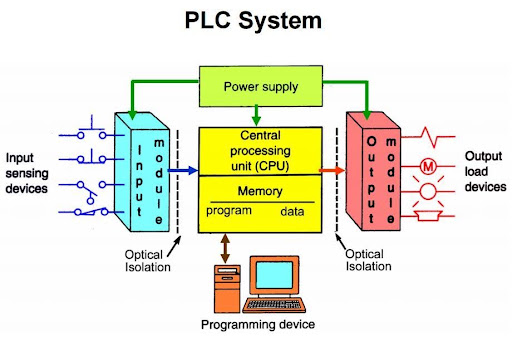
A PLC consists of several key components that work together to control industrial equipment:
The CPU is the brain of the PLC.
The input module receives signals from field devices such as:
These signals are converted into a format that the CPU can understand.
The output module sends commands from the CPU to field devices including:
The PLC memory stores:
The power supply provides stable electrical power to the PLC and its internal circuits.
A computer with PLC programming software is used to create, modify and upload programs into the PLC.
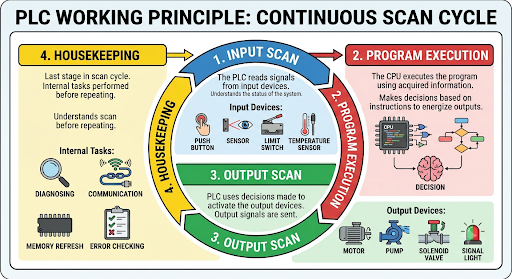
The PLC works on a continuous scan cycle, which consists of the following steps:
The PLC reads the signals from the input devices like push buttons, sensors, limit switches, pressure switches and temperature sensors among others. This enables it to understand the status of the system.
The CPU executes the program by using the information acquired from the input devices. It makes decisions based on the program instructions in order to energize certain outputs.
3. Output Scan
The output scan is the stage whereby the PLC uses the decisions made to activate the output devices. The activated devices may include motors, pumps, solenoid valves, relays, alarms and lights amongst others.
4. Housekeeping
This is the last stage in a PLC scan cycle. It consists of the internal tasks performed by the PLC before it goes back to the first stage. Some of the tasks are diagnosing, communication, memory refresh and error checking.
All the four stages of scanning take place within milliseconds and are repeated over and over again in order to control industrial processes in real time.
Despite their benefits, PLCs also have some limitations.
A programmable logic controller (PLC) works by continually scanning inputs, executing the program stored in its memory, and updating the outputs. This ensures that the PLC runs with high efficiency and it is extremely versatile and reliable such that it has become an integral part of modern industrial processes and marine engineering.
A PLC is used to monitor input signals, process them according to a stored program and control output devices automatically.
The four stages are Input Scan, Program Execution, Output Scan and Housekeeping.
Ladder Logic (LAD) is the most widely used programming language along with Function Block Diagram (FBD) and Structured Text (ST).
PLCs are used in engine room automation, boiler control, refrigeration systems, ballast water systems, cargo handling equipment and pump control systems.
PLCs are faster, more reliable, easier to program, require less wiring, simplify troubleshooting and can be easily modified for different applications.
A PLC employs programmable logic while relay circuits use electromechanical relays and require extensive wiring for control circuits.
Yes, a PLC can be reprogrammed to make it suitable for different industrial applications.
The PLC cannot execute a program and the controlled process is halted until the power supply is restored.
A PLC can scan a program in a matter of milliseconds depending on the CPU power and the program size.
They offer reliable, accurate and flexible control of industrial processes with less maintenance.
Disclaimer :- The opinions expressed in this article belong solely to the author and may not necessarily reflect those of Merchant Navy Decoded. We cannot guarantee the accuracy of the information provided and disclaim any responsibility for it. Data and visuals used are sourced from publicly available information and may not be authenticated by any regulatory body. Reviews and comments appearing on our blogs represent the opinions of individuals and do not necessarily reflect the views of Merchant Navy Decoded. We are not responsible for any loss or damage resulting from reliance on these reviews or comments.
Reproduction, copying, sharing, or use of the article or images in any form is strictly prohibited without prior permission from both the author and Merchant Navy Decoded.
Decoded Discount Alert! up to 50% OFF
Use Coupon Code Deep50