Hi this is Team Merchant Navy Decoded !!!

Please fill the below form with your query and we will get back to you in next 12 hours.

Rest assured your data is safe with us !!!🙂

Ask Your Query

Hydrodynamic Lubrication: Working Principle, Components, Advantages & Marine Applications

Effective lubrication is essential for the safe and efficient operation of every rotating machine aboard a ship, including the main engine crankshaft, turbine shafts, and pumps. Because hydrodynamic lubrication uses a pressurised oil sheet to completely separate moving surfaces, it is thought to be the most effective lubrication method for high-speed rotating gear. This greatly lowers wear, friction, and heat generation by preventing direct metal-to-metal contact.

Marine diesel engines, turbines, generators, propulsion shaft bearings, stern tube bearings, compressors, pumps, and gearboxes all make extensive use of hydrodynamic lubrication. Critical machinery would wear out quickly, overheat, and eventually fail without this lubrication schedule. Therefore, marine engineers who are in charge of operating and maintaining shipboard gear must comprehend the fundamentals of hydrodynamic lubrication.

What is Hydrodynamic Lubrication?

Hydrodynamic Lubrication

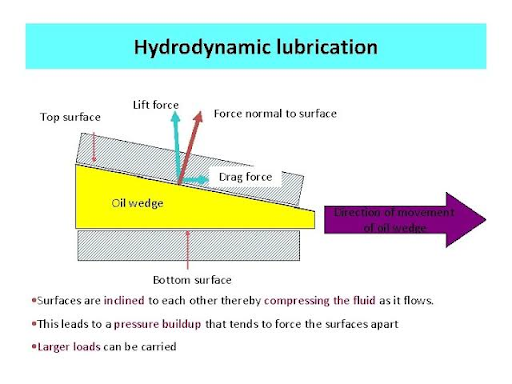
A continuous layer of lubricant totally separates two moving surfaces in a hydrodynamic lubrication regime. The relative motion of the surfaces and the wedge-shaped oil layer between them naturally produce the pressure needed to maintain the load.

By keeping a sufficiently thick oil film, hydrodynamic lubrication prevents direct contact, in contrast to boundary lubrication, where surface asperities may still come into touch. Because the moving shaft practically “floats” on the lubricant, it operates smoothly and effectively with little friction.

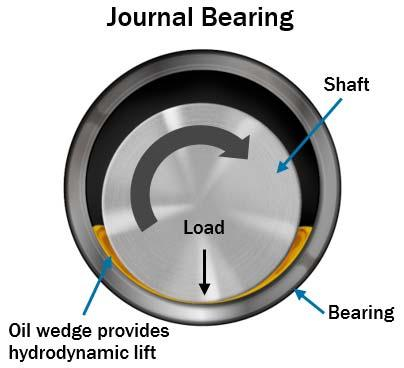
Journal bearings, which are found in practically all big marine diesel engines, are based on this idea.

Table of Contents

Principle of Hydrodynamic Lubrication

Hydrodynamic lubrication operates according to Reynolds’ Theory of Fluid Film Lubrication.

Hydrodynamic Lubrication

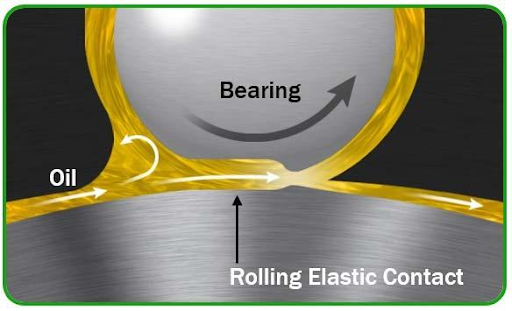
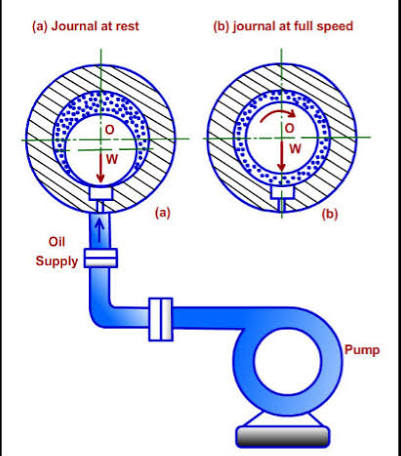
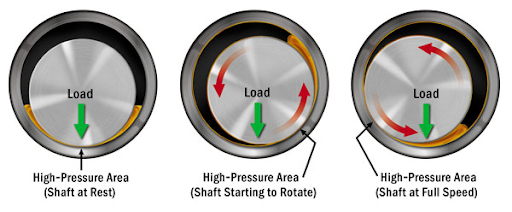
Initially, when a shaft is stationary, it rests directly on the bearing surface. As rotation begins, the lubricant is dragged into the narrowing clearance between the shaft and bearing. This creates a wedge-shaped oil film where pressure gradually builds up.

As shaft speed increases, the oil pressure becomes high enough to support the external load. The shaft then lifts away from the bearing surface and rotates entirely on the oil film.

This continuous oil film:

  • Supports the machine load
  • Prevents metal-to-metal contact
  • Reduces friction
  • Dissipates heat
  • Minimizes wear

The pressure generated is purely a result of shaft rotation and does not require an external hydraulic pressure source.

Working of Hydrodynamic Lubrication

The operation can be explained in four stages:

  1. Stationary Condition

When the machine is stopped, the shaft rests directly on the bearing due to gravity. No lubricating film exists, and slight metal contact occurs.

  1. Starting Condition

As the shaft begins rotating, lubricant adheres to its surface and is dragged into the bearing clearance. A thin lubricant film starts forming.

  1. Pressure Generation

Because the bearing clearance narrows in the direction of shaft rotation, the lubricant becomes compressed, creating a hydrodynamic pressure that increases continuously.

  1. Full Film Lubrication

Once sufficient pressure is developed, the shaft is completely separated from the bearing by the oil film. Friction now occurs within the lubricant itself rather than between metal surfaces.

Main Components of a Hydrodynamic Lubrication System

A complete hydrodynamic lubrication system consists of several essential components.

Main Components of a Hydrodynamic Lubrication System

A complete hydrodynamic lubrication system consists of several essential components.

Journal Bearing

Journal Bearing

The journal bearing supports the rotating shaft and provides the surface where the lubricating oil film develops.

It is generally manufactured from soft bearing materials such as:

  • White metal (Babbitt)
  • Bronze
  • Copper-lead alloys
  • Aluminum alloys

These materials provide good conformability, embed dirt particles, and reduce the risk of seizure.

Rotating Shaft (Journal)

Rotating Shaft

The shaft rotates inside the bearing at high speed.

Its rotation drags lubricating oil into the converging clearance, generating the pressure required to support the machine load.

Lubricating Oil

The lubricant serves several functions:

  • Forms the oil film
  • Reduces friction
  • Removes heat
  • Prevents corrosion
  • Flushes away contaminants
  • Dampens vibration

Marine engines generally use mineral-based lubricating oils with additives to improve oxidation resistance, viscosity stability, and anti-wear performance.

Lubricating Oil Pump

The oil pump supplies a continuous flow of clean lubricating oil to the bearing.

Although hydrodynamic pressure is created by shaft motion, a continuous oil supply is necessary to maintain lubrication and cooling.

Oil Filter

Filters remove contaminants such as:

  • Carbon particles
  • Metal wear debris
  • Dirt
  • Water contamination

Clean oil ensures a stable lubricating film and extends bearing life.

Oil Cooler

Friction generates heat even during full-film lubrication.

Oil coolers maintain the lubricant within its recommended operating temperature, preserving viscosity and lubrication performance.

Factors Affecting Hydrodynamic Lubrication

Several parameters influence the formation and stability of the oil film.

Shaft Speed

Higher rotational speed increases oil film thickness and hydrodynamic pressure.

However, excessively high speeds may increase oil churning losses.

Lubricant Viscosity

Viscosity determines the lubricant’s resistance to flow.

  • High viscosity improves film strength.
  • Low viscosity reduces friction but may fail to support heavy loads.

Selecting the correct viscosity is therefore critical.

Bearing Clearance

Proper radial clearance allows adequate oil film formation.

Too little clearance restricts oil flow, while excessive clearance reduces pressure generation.

Applied Load

As machine load increases, the oil film becomes thinner.

Extremely high loads may break down the oil film, leading to boundary lubrication.

Temperature

Higher temperatures reduce lubricant viscosity.

Reduced viscosity weakens the oil film and increases the possibility of bearing wear.

Advantages of Hydrodynamic Lubrication

Hydrodynamic lubrication offers numerous operational advantages.

  • Eliminates metal-to-metal contact
  • Extremely low coefficient of friction
  • Minimal wear
  • Long bearing life
  • High load-carrying capacity
  • Reduced operating temperature
  • Low maintenance requirements
  • Quiet operation
  • Improved machinery efficiency
  • Lower power losses

Because of these advantages, hydrodynamic bearings are preferred in high-speed marine machinery.

Limitations

Despite its effectiveness, hydrodynamic lubrication has certain limitations.

  • Requires sufficient shaft speed before the oil film develops.
  • Ineffective during machine start-up and shutdown.
  • Sensitive to lubricant contamination.
  • Performance depends heavily on correct viscosity.
  • Requires continuous oil supply.
  • High temperatures reduce lubrication effectiveness.

For these reasons, anti-wear additives and proper maintenance remain essential.

Marine Applications

Hydrodynamic lubrication is extensively used throughout the engine room.

Major applications include:

  • Main engine crankshaft bearings
  • Connecting rod bearings
  • Camshaft bearings
  • Intermediate shaft bearings
  • Stern tube bearings
  • Steam turbine bearings
  • Turbocharger bearings
  • Pumps
  • Compressors
  • Gearboxes
  • Electric generators
  • Reduction gears

These machines operate continuously under heavy loads, making hydrodynamic lubrication indispensable.

Maintenance of Hydrodynamic Lubrication Systems

Proper maintenance ensures reliable lubrication performance.

Routine practices include:

  • Checking lubricating oil pressure.
  • Monitoring oil temperature.
  • Maintaining proper oil level.
  • Replacing filters periodically.
  • Testing lubricant viscosity.
  • Inspecting bearings for abnormal wear.
  • Monitoring vibration levels.
  • Checking oil contamination.
  • Cleaning oil coolers.
  • Following the Planned Maintenance System (PMS).

Early detection of lubrication problems prevents costly machinery failures.

Common Problems

Some common lubrication failures include:

  • Low oil pressure
  • Contaminated lubricant
  • Excessive bearing clearance
  • Overheating
  • Incorrect oil viscosity
  • Pump failure
  • Oil starvation
  • Bearing seizure
  • Misalignment
  • Excessive machine loading

Most failures can be prevented through regular monitoring and preventive maintenance.

Frequently Asked Questions (FAQs)

A full oil film entirely separates two moving surfaces in hydrodynamic lubrication, preventing metal-to-metal contact.

Lubricant is drawn into a wedge-shaped clearance by the rotating shaft, creating pressure that raises the shaft and sustains the load.

Crankshaft bearings, turbines, compressors, pumps, gearboxes, generators, and propulsion shaft bearings all use it.

A robust oil film that can sustain machine loads while reducing friction is ensured by proper viscosity.

It increases efficiency, saves maintenance costs, minimises wear, increases bearing life, and decreases friction.

Disclaimer :- The opinions expressed in this article belong solely to the author and may not necessarily reflect those of Merchant Navy Decoded. We cannot guarantee the accuracy of the information provided and disclaim any responsibility for it. Data and visuals used are sourced from publicly available information and may not be authenticated by any regulatory body. Reviews and comments appearing on our blogs represent the opinions of individuals and do not necessarily reflect the views of Merchant Navy Decoded. We are not responsible for any loss or damage resulting from reliance on these reviews or comments.

Reproduction, copying, sharing, or use of the article or images in any form is strictly prohibited without prior permission from both the author and Merchant Navy Decoded.

DIWALI SALE

Decoded Discount Alert! up to 50% OFF

DIWALI SALE

Decoded Discount Alert! up to 50% OFF

Use Coupon Code Deep50

Days
Hours
Seconds
0
Would love your thoughts, please comment.x
()
x