Hi this is Team Merchant Navy Decoded !!!

Please fill the below form with your query and we will get back to you in next 12 hours.

Rest assured your data is safe with us !!!🙂

Ask Your Query

Central Cooling System in Ships

Central Cooling System

A Central Cooling System (CCS) is a closed-loop freshwater cooling system used on ships to remove excess heat from the main engine, auxiliary engines, lubricating oil, compressors, and other engine room machinery. Instead of using seawater directly to cool each piece of equipment, the system circulates treated freshwater through the machinery, while seawater is only used to cool the freshwater in a central heat exchanger (central cooler). This design reduces corrosion, scaling, and maintenance while improving the efficiency and reliability of the machinery.

Why is a Central Cooling System Used?

Marine engines and auxiliary machinery generate a significant amount of heat during operation. If this heat is not removed efficiently, machinery temperatures can rise rapidly, leading to:

  • Overheating
  • Reduced engine efficiency
  • Increased wear of moving parts
  • Lubricating oil degradation
  • Equipment failure
  • Higher maintenance costs

The central cooling system maintains the operating temperature within the recommended limits, ensuring safe and efficient engine operation.

Types of Cooling Systems on Ships

Ships generally use one of the following cooling methods:

  1. Direct Sea Water Cooling System

In this system, seawater is pumped directly through heat exchangers to cool machinery.

Advantages:

  • Simple design
  • Low initial installation cost

Disadvantages:

  • High corrosion
  • Marine fouling
  • Frequent cleaning
  • Scaling inside coolers
  1. Central Cooling System (Freshwater Cooling)

In a central cooling system, freshwater circulates through the machinery in a closed loop, while seawater cools the freshwater through a central cooler.

Advantages:

  • Reduced corrosion
  • Better temperature control
  • Lower maintenance
  • Longer equipment life

Table of Contents

Working Principle of the Central Cooling System

The central cooling system operates using three interconnected circuits:

  1. Sea Water (SW) Circuit
  2. Low Temperature (LT) Freshwater Circuit
  3. High Temperature (HT) Freshwater Circuit

The seawater absorbs heat from the freshwater through the central cooler, while the freshwater removes heat from engines and auxiliary equipment before returning to the cooler.

Components of a Central Cooling System

  1. Sea Water Circuit

The seawater circuit provides the final cooling medium for the entire system.

Main Components

  • Sea Chest
  • Sea Water Pump
  • Sea Water Strainer
  • Central Cooler (Plate Heat Exchanger)
  • Overboard Discharge

Working

  • Seawater is drawn through the sea chest.
  • It passes through the sea water strainer.
  • The seawater enters the central cooler.
  • Heat from freshwater is transferred to seawater.
  • Warm seawater is discharged overboard.
  1. Low Temperature (LT) Freshwater Circuit

The LT circuit cools machinery that requires relatively lower operating temperatures.

Equipment Cooled by LT System

  • Air Compressors
  • Lubricating Oil Coolers
  • Fuel Oil Coolers
  • Auxiliary Engines
  • Air Conditioning Compressors
  • Hydraulic Oil Coolers
  • Charge Air Coolers

Typical LT water temperature ranges from 36°C to 40°C, depending on the vessel design and manufacturer.

  1. High Temperature (HT) Freshwater Circuit

The HT circuit cools equipment operating at higher temperatures.

Equipment Cooled by HT System

  • Main Engine Jacket Water
  • Cylinder Heads
  • Cylinder Liners
  • Fresh Water Generator Heating Circuit
  • Diesel Generator Jacket Water (on some vessels)

Typical HT outlet temperature is maintained between 80°C and 90°C using temperature control valves, depending on engine maker recommendations.

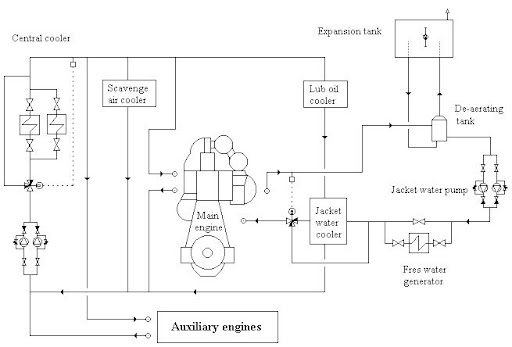
Central Cooling System Flow Diagram

Expansion Tank

The expansion tank is installed at the highest point of the cooling system.

Functions

  • Maintains water level
  • Compensates for thermal expansion
  • Removes trapped air
  • Provides make-up water
  • Maintains system pressure

Freshwater makeup is generally supplied from the distilled water tank or freshwater filling system.

Temperature Control Valve

A three-way temperature control valve regulates the HT water temperature.

Functions

  • Maintains engine outlet temperature
  • Mixes cooled LT water with HT water when required
  • Prevents overcooling
  • Ensures optimum engine operating temperature

Proper temperature regulation improves fuel efficiency and reduces engine wear.

Plate Type Central Cooler

Modern ships commonly use plate heat exchangers as central coolers.

Advantages

  • High heat transfer efficiency
  • Compact design
  • Easy maintenance
  • Lower seawater consumption
  • Titanium plates provide excellent corrosion resistance

Advantages of Central Cooling System

The central cooling system offers several operational benefits:

  • Lower maintenance costs
  • Reduced seawater corrosion
  • Less marine fouling
  • Improved engine efficiency
  • Stable operating temperatures
  • Reduced pipe corrosion
  • Longer machinery life
  • Lower spare part consumption
  • Better reliability for unattended engine rooms (UMS)

Disadvantages of Central Cooling System

Despite its advantages, the system also has some limitations:

  • Higher initial installation cost
  • More complex piping arrangement
  • Additional pumps and valves
  • Requires regular water treatment
  • Failure of the central cooler can affect multiple systems

Water Treatment in the Central Cooling System

The freshwater circulating in the system must be chemically treated to prevent:

  • Corrosion
  • Scale formation
  • Cavitation
  • Bacterial growth
  • Sludge formation

Routine testing includes:

  • pH
  • Chloride content
  • Nitrite level
  • Conductivity
  • Glycol concentration (where applicable)

Common Problems and Troubleshooting

Problem

Possible Cause

Remedy

High HT Temperature

Fouled central cooler

Clean heat exchanger

Low Cooling Water Pressure

Pump wear or leakage

Inspect pump and seals

Expansion Tank Overflow

Overfilling or thermal expansion

Check level and vent

Low LT Temperature

Faulty temperature control valve

Inspect or replace valve

High Differential Pressure

Blocked plate cooler

Clean plates

Corrosion in System

Poor water treatment

Correct chemical dosing

Safety Precautions

Always follow these precautions:

  • Use treated freshwater only.
  • Never mix untreated seawater into the closed circuit.
  • Depressurize the system before opening heat exchangers.
  • Wear PPE when handling chemicals.
  • Monitor temperatures continuously.
  • Inspect for leaks after maintenance.

Frequently Asked Questions (FAQs)

A central cooling system is a closed-loop freshwater cooling arrangement in which seawater cools the freshwater through a central heat exchanger, and the freshwater cools the ship’s machinery.

The HT (High Temperature) circuit cools the main engine jacket water and operates at higher temperatures, while the LT (Low Temperature) circuit cools auxiliary machinery such as lubricating oil coolers, charge air coolers, and compressors.

Freshwater minimizes corrosion, scaling, and marine growth inside engine cooling passages, improving equipment life and reducing maintenance.

The expansion tank compensates for thermal expansion, maintains water level, removes trapped air, and provides makeup water to the closed cooling circuit.

Plate heat exchangers provide excellent heat transfer efficiency, occupy less space, are easy to maintain, and often use titanium plates that resist seawater corrosion.

Disclaimer :- The opinions expressed in this article belong solely to the author and may not necessarily reflect those of Merchant Navy Decoded. We cannot guarantee the accuracy of the information provided and disclaim any responsibility for it. Data and visuals used are sourced from publicly available information and may not be authenticated by any regulatory body. Reviews and comments appearing on our blogs represent the opinions of individuals and do not necessarily reflect the views of Merchant Navy Decoded. We are not responsible for any loss or damage resulting from reliance on these reviews or comments.

Reproduction, copying, sharing, or use of the article or images in any form is strictly prohibited without prior permission from both the author and Merchant Navy Decoded.

DIWALI SALE

Decoded Discount Alert! up to 50% OFF

DIWALI SALE

Decoded Discount Alert! up to 50% OFF

Use Coupon Code Deep50

Days
Hours
Seconds
0
Would love your thoughts, please comment.x
()
x