Hi this is Team Merchant Navy Decoded !!!
Please fill the below form with your query and we will get back to you in next 12 hours.
Rest assured your data is safe with us !!!🙂
Ask Your Query| For Beginner | For Professional |
|---|---|
| GME | Engine Side |
| G.P. Rating | Deck Side |
| ETO | G.P. Rating |
| IMUCET & Sponsorship | Combo Offers |
| Free Course | MEO |
| Free Course |
| For Beginner | For Professional |
|---|---|
| GME | Engine Side |
| G.P. Rating | Deck Side |
| ETO | G.P. Rating |
| IMUCET & Sponsorship | Combo Offers |
| Free Course | MEO |
| Free Course |
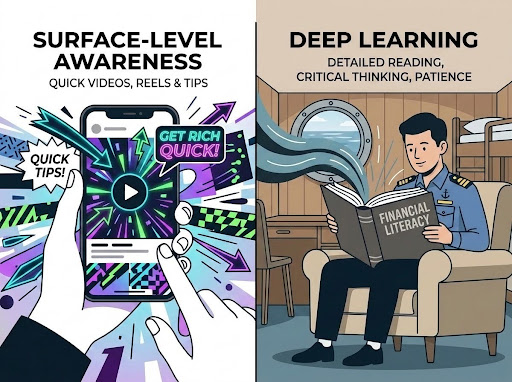
Many seafarers want to grow their money, but most begin their finance journey through short videos, reels, tips, and random advice. A reel can create awareness, but it cannot give full understanding. Your money is earned through long duty hours, discipline, risk, and months away from family. That money deserves proper learning before investing. Investing is not only about finding the best fund or stock. It is about understanding goals, risk, time period, behaviour, and patience.
Videos are useful for basic awareness. They can explain simple topics like SIP, mutual funds, compounding, inflation, insurance, and tax. But short videos are often made to catch attention quickly. They may not explain full risk, cost, lock-in, tax impact, or suitability. A video can start your learning, but it should not become your final decision-maker. Before investing real money, a seafarer should watch, read, ask questions, understand the product, and then invest carefully.
Random tips can be dangerous because the person giving advice may not know your financial situation. Your salary pattern, contract gap, family responsibility, loan pressure, and risk comfort may be completely different. A fund or stock that suits someone else may not suit you. SEBI says investors should understand investment goals, objectives, and risk appetite before investing in securities markets. So, do not invest only because a reel or friend says it is good.
Seafarers often earn well during contract, but earning well and investing well are different skills. A wrong investment may not look serious in the beginning, but it can disturb long-term goals later. Learning helps you understand risk, time period, liquidity, tax, and product purpose. It also helps you avoid emotional decisions. A seafarer who learns before investing can ask better questions and avoid blindly trusting social media, friends, relatives, agents, or bank staff.
A high salary is useful, but it does not automatically create wealth. Many seafarers earn well but still face pressure because money gets spent on lifestyle, EMIs, random products, and poor investments. Investing needs discipline, not only income. A person with a smaller salary but better planning may build stronger wealth than a high earner who invests blindly. The goal is not only to earn more. The goal is to manage, protect, and grow money wisely.
Before investing, seafarers should learn basic topics like saving, emergency fund, insurance, mutual funds, SIP, compounding, inflation, taxation, risk, and nomination. They should also understand the difference between protection and investment. SEBI provides investor education material on topics like securities markets, KYC, mutual funds, ETFs, REITs, and investor protection. This shows that financial learning is a step-by-step process. You do not need to learn everything in one day, but you should start properly.
Quick advice can sound simple, but investing is personal. A product may be good, but it must match your goal. Money needed after 6 months should not be treated like money needed after 15 years. Before investing, ask: What is the purpose? What is the risk? What is the cost? Can I stay invested? What happens if the market falls? Good investing is not about quick tips. It is about clear thinking and correct decision-making.
A video can explain one idea quickly. It can help you understand the meaning of SIP, mutual fund, inflation, or compounding. But one video cannot cover all situations. It may not explain whether the product suits your income pattern, family needs, tax situation, or risk comfort. Treat videos like an introduction, not a final answer. Use them to understand the topic, then read more, compare, ask questions, and verify before investing your hard-earned salary.
Reading builds patience and clarity. A video may motivate you, but reading helps you think deeply. When you read, you slow down and understand the reason behind an investment decision. Reading also helps you learn concepts that reels may skip, such as risk, behaviour, time horizon, diversification, and cost. For seafarers, reading can be done slowly during free time. Even one chapter a week can improve financial thinking over time.
Investing is not only about numbers. It is also about behaviour. Many people know they should save, but still spend too much. Many know they should stay invested, but panic during market falls. Many know loans can create pressure, but still take unnecessary EMIs. Seafarers should understand their own money habits first. During contract, income may feel strong. During leave, expenses may rise quickly. Without good money behaviour, even high salary can disappear.
Money decisions are affected by fear, greed, pressure, family expectations, lifestyle comparison, and social media influence. A seafarer may buy a costly car because others are buying. He may invest in a risky product because someone showed high returns. He may stop investing during a market fall because of fear. This is why emotional control matters. Good investing requires patience. The best financial decision is not always the most exciting one. It is often the most disciplined one.
Good investors do not chase every trend. They understand risk, stay patient, and avoid emotional decisions. They know that wealth is usually built slowly, not overnight. Seafarers should learn how good investors think before copying what they buy. Investing is not gambling. It is a planned process of putting money to work for future goals. A strong investor asks why, how long, how risky, and how suitable before making any decision.
Patience is one of the most important qualities in investing. Many seafarers want quick results after starting a SIP or mutual fund. But long-term investing needs time. Markets may rise and fall. Returns may look slow in the beginning. If you keep stopping, switching, or withdrawing without reason, your plan becomes weak. A seafarer understands patience at sea. The same patience is needed in money management. Wealth is built through time, discipline, and consistency.
Seafarers can start with beginner-friendly books to build financial thinking. Books like The Psychology of Money can help with money behaviour. The Intelligent Investor can teach long-term investing principles. One Up On Wall Street can explain how investors think about businesses. Common Sense on Mutual Funds can help readers understand mutual fund investing. A Random Walk Down Wall Street can explain market behaviour. You do not need to finish all quickly. Read slowly and understand properly.
Watching 100 reels may create excitement, but one good book can build clarity. Reels give quick points. Books explain the full thought process. A seafarer does not need to become a finance expert in one month. The goal is to become a better decision-maker. Read one chapter, understand it, note the lesson, and apply it. Slow learning is better than fast confusion. Strong financial knowledge is built through repeated learning, not random scrolling.
Start with the meaning of mutual funds. Then learn about SIP, NAV, fund categories, equity funds, debt funds, hybrid funds, index funds, riskometer, expense ratio, exit load, and taxation. SEBI explains mutual funds as an investment vehicle where money from investors is pooled and invested by a fund manager in assets like stocks, bonds, or other securities. Learn one topic at a time. Do not jump directly to selecting the “best fund.”
Before buying insurance, seafarers should understand one basic point: insurance is mainly for protection. Investment is for growth. Do not mix both blindly. First learn term insurance, health insurance, nominee details, claim process, premium, exclusions, and policy conditions. Many seafarers buy policies because someone promises returns or tax benefits. That can be risky. Before buying any policy, ask: What is this product protecting? What are the charges? What are the conditions? Does my family actually need this?
Tax learning is important because seafarers may have salary, NRE or NRO accounts, TDS, AIS, Form 26AS, refund, and residential status questions. Do not wait until the last moment to understand tax. Learn basic income tax terms step by step. Keep documents organised. Understand what appears in AIS and Form 26AS. If the case is complex, take professional help. But even with professional help, basic tax knowledge protects you from confusion, wrong filing, and unnecessary notices.
Asking questions protects money. Before investing, ask what the product is, how it works, what the risk is, what the charges are, whether there is a lock-in, how taxation works, and whether the product matches your goal. If someone cannot explain clearly, do not invest in a hurry. A genuine advisor should be able to explain benefits and risks. Your money is not small. It is earned with sacrifice. Ask before you invest.
Blind advice is dangerous because it ignores your personal situation. A product may be suitable for someone with stable income, low loans, and long-term goals, but unsuitable for a seafarer with family responsibilities and contract gaps. AMFI clearly states that mutual fund schemes are not guaranteed or assured return products and may involve risks, including possible loss of principal. So, never invest only because someone says returns will be good. Understand risk first.
A simple learning plan can start with one topic per week. Week one: saving and emergency fund. Week two: insurance. Week three: mutual fund basics. Week four: SIP and compounding. Week five: inflation and long-term goals. Week six: tax basics. After that, learn fund selection and portfolio review. Do not rush. Learning slowly is better than investing blindly. Keep notes. Discuss with serious people. Avoid random tips groups. Build knowledge before building a portfolio.
For seafarers, financial planning is not only about selecting one product. It is about understanding your goals, knowing the risks, protecting your future, and making disciplined financial decisions. Download Sailor Pro app – Built for Seafarers, an Initiative by Merchant Navy Decoded, to stay more organised and confident in your financial planning. You can also follow finance_for_seafarers on Instagram and join the WhatsApp channel Financial Management for Seafarer for practical money guidance created especially for seafarers.
Seafarers should learn investing because their money is hard-earned and wrong financial decisions can affect long-term goals, family security, and financial freedom.
Finance videos are good for basic awareness, but they are not enough for complete understanding. Reading, asking questions, and checking product details are also important.
No. Seafarers should not invest only from reels, tips, or random advice. They should understand risk, cost, goal, and suitability first.
Seafarers should learn saving, emergency fund, insurance, mutual funds, SIP, compounding, inflation, risk, taxation, nomination, and goal-based investing.
Beginner investors can read books like The Psychology of Money, The Intelligent Investor, One Up On Wall Street, Common Sense on Mutual Funds, and A Random Walk Down Wall Street.
Money behaviour matters because fear, greed, lifestyle pressure, and panic can affect investment decisions more than knowledge alone.
Yes, seafarers can learn mutual funds step by step by understanding fund types, SIP, NAV, riskometer, expense ratio, exit load, and taxation.
Seafarers should start with one topic at a time. First learn saving, then insurance, then mutual funds, SIP, compounding, inflation, and tax basics.
Blind advice is risky because the advisor or friend may not know your income pattern, contract gaps, family responsibility, loans, goals, or risk comfort.
The best way is to watch for awareness, read for understanding, ask questions, check risks, and invest only after matching the product with your goals.
Disclaimer :- The opinions expressed in this article belong solely to the author and may not necessarily reflect those of Merchant Navy Decoded. We cannot guarantee the accuracy of the information provided and disclaim any responsibility for it. Data and visuals used are sourced from publicly available information and may not be authenticated by any regulatory body. Reviews and comments appearing on our blogs represent the opinions of individuals and do not necessarily reflect the views of Merchant Navy Decoded. We are not responsible for any loss or damage resulting from reliance on these reviews or comments.
Reproduction, copying, sharing, or use of the article or images in any form is strictly prohibited without prior permission from both the author and Merchant Navy Decoded.
Decoded Discount Alert! up to 50% OFF
Use Coupon Code Deep50