Hi this is Team Merchant Navy Decoded !!!
Please fill the below form with your query and we will get back to you in next 12 hours.
Rest assured your data is safe with us !!!🙂
Ask Your Query| For Beginner | For Professional |
|---|---|
| GME | Engine Side |
| G.P. Rating | Deck Side |
| ETO | G.P. Rating |
| IMUCET & Sponsorship | Combo Offers |
| Free Course | MEO |
| Free Course |
| For Beginner | For Professional |
|---|---|
| GME | Engine Side |
| G.P. Rating | Deck Side |
| ETO | G.P. Rating |
| IMUCET & Sponsorship | Combo Offers |
| Free Course | MEO |
| Free Course |
Many seafarers start mutual fund investing after hearing one common line: “This fund is giving good returns.” But this is not the right way to choose a mutual fund. Not every mutual fund is suitable for every investor. Different mutual funds are made for different goals, risk levels, and time periods. A fund that is useful for long-term wealth creation may not be suitable for emergency money. A fund that gives more stability may not give high growth. So, the real question is not “Which fund gave the highest return?” The real question is “Which mutual fund matches my goal?”
Seafarers should choose a mutual fund by first understanding the purpose of the money. Is the money for retirement? Is it for children’s education? Is it for buying a house? Is it for emergency use? Is it for long-term wealth creation? Every goal needs a different approach. AMFI explains that mutual funds can be classified based on structure, portfolio, investment objective, and theme, including equity, debt, hybrid, money market, ETFs, overseas funds, and other categories. This means every mutual fund has a different role.

Many seafarers make the mistake of selecting funds only by checking recent returns. This can be risky because high recent returns do not always mean the fund is suitable. Some funds may perform well during one market phase but may fall sharply later. A fund should be selected based on goal, time horizon, risk level, liquidity need, and suitability. AMFI clearly states that mutual fund schemes are not guaranteed or assured return products, and mutual fund investments can involve risks, including possible loss of principal.
There are many types of mutual funds, and each type serves a different purpose. The main categories include equity funds, debt funds, hybrid funds, index funds, sector funds, international funds, and solution-oriented funds. AMFI notes that, as per SEBI categorization, mutual fund schemes are broadly classified into equity schemes, debt schemes, hybrid schemes, solution-oriented schemes, and other schemes such as index funds, ETFs, and fund of funds. For seafarers, understanding these categories is important before investing.
Equity mutual funds invest mainly in equity and equity-related instruments, which means they participate in the growth of companies and the stock market. These funds may be useful for long-term goals such as retirement planning, children’s higher education, home planning, or wealth creation. However, equity funds also carry market risk. Their value can go up and down. Seafarers should not invest short-term or emergency money in equity funds because a market fall can disturb urgent financial needs.
Seafarers may consider equity mutual funds when the goal is long-term and they are comfortable with market ups and downs. For example, if a seafarer is planning for retirement after many years, children’s higher education, or long-term wealth creation, equity funds may be useful after understanding the risk. But if the money is needed within a few months or one year, equity funds may not be suitable. Equity investing needs patience, discipline, and enough time for market cycles.
Debt mutual funds invest mainly in debt instruments such as bonds, government securities, corporate debt, and money market instruments. These funds are generally considered more stable than equity funds, but they are not risk-free. Debt funds can face interest rate risk, credit risk, and liquidity risk depending on the type of securities inside the fund. For seafarers, debt funds may be considered for goals where stability is more important than high growth, but the exact debt fund type should be checked carefully.
Seafarers may consider debt mutual funds when the goal needs relatively lower volatility compared to equity funds. For example, money required for short-term planning, planned expenses, or temporary parking may need more stability. However, not all debt funds are the same. Some debt funds may carry higher risk than beginners expect. Before choosing any debt fund, seafarers should check the fund type, portfolio quality, duration, riskometer, exit load, and taxation. Debt funds should not be treated as guaranteed-return products.
Hybrid mutual funds invest in a mix of equity and debt. The equity portion gives growth potential, while the debt portion may provide some stability. This can be useful for seafarers who do not want full equity risk but also do not want very low growth. However, hybrid funds are also available in different types. Some hybrid funds may have higher equity exposure, while others may have higher debt exposure. So, the word “hybrid” does not automatically mean safe.

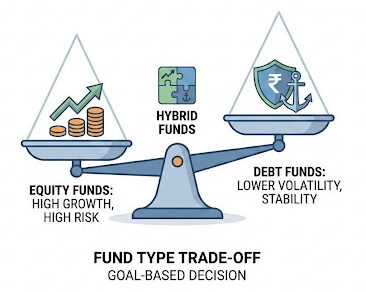
Equity funds are mainly for long-term growth but come with higher market risk. Debt funds are generally used for stability, but they still have risks such as interest rate and credit risk. Hybrid funds create a middle route by combining equity and debt. For seafarers, the choice depends on goal and time period. Retirement money may need growth. Emergency money needs liquidity and stability. Medium-term goals may need a balanced approach. The fund type should always follow the purpose of the money.
Index funds are mutual funds that follow a market index such as Nifty 50 or Sensex. These funds do not actively try to beat the market. They try to track the index. Index funds can be simple for beginner investors because the strategy is easier to understand. They may also have lower costs compared to many active funds. However, index funds are still market-linked. If the market index falls, the value of the index fund can also fall.
Index funds can be useful for beginner seafarers who want a simple equity mutual fund option and do not want to depend heavily on active fund selection. Since the fund follows an index, the investment style is easier to understand. But seafarers should still check the index being followed, expense ratio, tracking error, risk level, and investment horizon. Index funds may be simple, but they are not risk-free. They should be used only for suitable long-term goals.
Sector mutual funds invest mainly in one sector, such as banking, technology, pharma, energy, or infrastructure. These funds can perform well when that sector is doing well, but they can also carry higher risk because the investment is concentrated. If that sector underperforms, the fund may struggle. For seafarers, sector funds should not be the first step in mutual fund investing. They are more suitable for investors who understand the sector, risk, timing, and portfolio role.
International mutual funds invest outside India or give exposure to global markets. They may help diversify beyond Indian companies, but they also carry additional risks such as currency movement, global market risk, country-specific risk, and taxation complexity. Seafarers may find international funds attractive because they work globally, but these funds should not be selected casually. They may be considered only after understanding basic mutual funds, Indian portfolio allocation, risk capacity, and the purpose of international exposure.
For short-term goals, seafarers should focus on safety and liquidity, not high returns. Money needed for documents, medical expenses, family needs, children’s school fees, travel, exams, or near-term plans should not be placed in high-risk funds. Short-term money should be kept in options that are easier to access and relatively stable. Some debt-oriented or liquid categories may be explored after checking risk, but the main idea is simple: do not take high market risk with money needed soon.
For long-term goals, seafarers may consider growth-oriented funds depending on risk comfort and time horizon. Long-term goals can include retirement, children’s higher education, house planning, and wealth creation. Equity funds, index funds, or suitable hybrid funds may be considered for such goals after understanding market risk. The longer the time period, the better the ability to handle short-term volatility. However, fund selection should still be done carefully. Long-term investing does not mean blindly choosing the highest-return fund.
Emergency money should not be invested in high-risk mutual funds. Seafarers may face contract gaps, medical needs, family emergencies, urgent travel, document renewals, or unexpected expenses. This money should be safe, liquid, and easily accessible. Emergency money is not meant for high returns. It is meant for financial protection and peace of mind. Before investing in long-term funds, seafarers should first build a separate emergency fund. This helps avoid withdrawing investments during a bad market phase.
The simplest way to choose a mutual fund is to match the fund with the goal. If the goal is long-term wealth creation, equity or index funds may be considered after understanding risk. If the goal needs stability, debt funds may be more suitable. If the goal needs a balance between growth and stability, hybrid funds may be considered. If the goal is sector exposure or global exposure, sector and international funds require extra understanding. The goal should decide the fund, not recent returns.
Before investing, seafarers should check the mutual fund risk level. SEBI explains that the Riskometer is a tool used in the mutual fund industry to show the risk level of a mutual fund scheme, and asset management companies are required to display it. It shows risk from low to very high. This is useful for seafarers because it gives a quick understanding of how risky a scheme may be before investing. Risk should never be ignored.
Before investing in any mutual fund, seafarers should check the fund category, objective, risk level, expense ratio, exit load, portfolio, fund manager style, taxation, lock-in period, and investment horizon. They should also check whether the fund matches their goal. A good fund for one investor may not be good for another. Seafarers should also keep nominee details updated and maintain investment records properly because they may be onboard for months and may not always have easy access to documents.
A simple mutual fund plan starts with emergency money first. After that, insurance protection should be reviewed. Then the seafarer should write down goals such as retirement, children’s education, house planning, family security, or wealth creation. Each goal should have a time period. Short-term goals need more stability. Long-term goals may allow more growth-oriented funds. After that, the seafarer can choose the fund category, start investing, and review the plan from time to time without reacting emotionally to every market movement.
For seafarers, mutual fund investing is not only about selecting one scheme. It is about understanding goals, managing risk, protecting family, and making disciplined financial decisions. Download Sailor Pro app Built for Seafarers, an Initiative by Merchant Navy Decoded, to stay more organised and confident in your financial planning. You can also follow finance_for_seafarers on Instagram and join the WhatsApp channel Financial Management for Seafarer for practical money guidance created especially for seafarers.
The main types of mutual funds include equity funds, debt funds, hybrid funds, index funds, sector funds, international funds, and solution-oriented funds.
There is no single best mutual fund for every seafarer. The best fund depends on the goal, time period, risk comfort, and liquidity need.
Equity mutual funds can be useful for long-term goals such as retirement, children’s education, and wealth creation, but they carry market risk.
Debt mutual funds are generally more stable than equity funds, but they are not risk-free. They may carry interest rate risk, credit risk, and liquidity risk.
Hybrid funds can be useful for investors who want a mix of growth and stability, but the equity and debt allocation should be checked carefully.
Equity funds mainly invest in company stocks and focus on growth. Debt funds invest in bonds or debt instruments and are generally used for stability.
Index funds can be simple for beginner seafarers because they follow a market index, but they are still market-linked and can fall when the market falls.
Sector funds should be selected carefully because they focus on one sector and can carry higher concentration risk. They are usually not the first choice for beginners.
For short-term goals, seafarers should focus on stability and liquidity instead of high returns. High-risk equity funds may not be suitable for short-term needs.
For long-term wealth creation, equity funds, index funds, or suitable hybrid funds may be considered based on the seafarer’s risk comfort and time horizon.
Disclaimer :- The opinions expressed in this article belong solely to the author and may not necessarily reflect those of Merchant Navy Decoded. We cannot guarantee the accuracy of the information provided and disclaim any responsibility for it. Data and visuals used are sourced from publicly available information and may not be authenticated by any regulatory body. Reviews and comments appearing on our blogs represent the opinions of individuals and do not necessarily reflect the views of Merchant Navy Decoded. We are not responsible for any loss or damage resulting from reliance on these reviews or comments.
Reproduction, copying, sharing, or use of the article or images in any form is strictly prohibited without prior permission from both the author and Merchant Navy Decoded.
Decoded Discount Alert! up to 50% OFF
Use Coupon Code Deep50