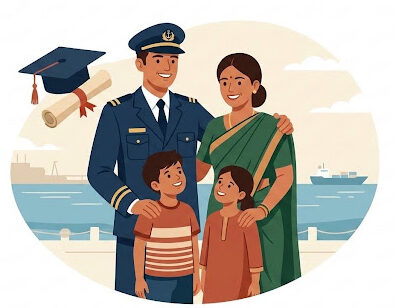
A seafarer works for years at sea so the family can have a better future. Many Indian seafarers spend long months away from home, facing tough working conditions, only to support their children’s education and career. But many seafarers do not know that their own sea service may also help their son or daughter after completing certain approved courses. This support comes through the SWFS Family Benefit Scheme for Indian Seafarers.
What is the SWFS Family Benefit Scheme?
The SWFS Family Benefit Scheme is a welfare scheme for eligible Indian seafarers. It provides financial assistance when the seafarer’s son or daughter successfully completes an eligible course. The official scheme document says assistance may be provided for successful completion of a pre-sea training course or a postgraduate degree or diploma by the seafarer’s son or daughter.
Why This Scheme Matters for Seafarer Families
Education and maritime training can be expensive. A seafarer may spend years at sea to support the child’s future, but many families may not know that SWFS support may be available after the child completes an eligible course. This scheme is important because it recognises the seafarer’s contribution and supports the next generation. It is not only about money. It is about helping seafarer families move ahead through education, training, and career development.
Who Can Get This Benefit?
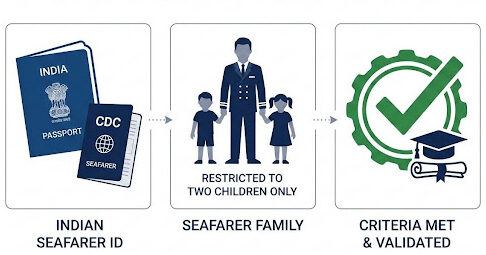
This benefit is connected with the eligible Indian seafarer and the seafarer’s son or daughter. The official scheme says it is applicable to Indian seafarers who fulfil the conditions, and the benefit is restricted to two children only. The seafarer should have an Indian CDC, should have qualifying sea service, and should have joined an Indian flag vessel or been engaged through a registered RPS company on an Indian or foreign flag vessel.
Support for Pre-Sea Training Courses
One important part of the scheme is support for children entering the maritime field. The scheme covers cases where the seafarer’s son or daughter successfully completes a pre-sea training course such as GP Rating, CCMC, Deck Cadet, Engine Cadet, including ETO, from a DG Shipping-approved institute and obtains an Indian CDC for joining the seafaring profession.
This can be useful for seafarer families whose children also want to build a career at sea.
Support for Postgraduate Courses
The scheme is not only for maritime courses. It also covers cases where the seafarer’s son or daughter successfully completes a two-year full-time postgraduate degree or diploma in any discipline other than the maritime stream. The course should be from a UGC-approved university, deemed university, or AICTE-approved institute.
This is important because many seafarer children may choose careers outside shipping, such as management, science, commerce, technology, or other professional fields.
How Much Financial Support is Given?
As per the updated SWFS information on the DGMA page, the Family Benefit Scheme provides ₹50,000 on completion of a pre-sea training course from a on the DGMA page, the Family Benefit Scheme provides ₹50,000 on completion of a pre-sea training course from a DGS-approved training institute and obtaining CDC. For completion of course on or after 27 January 2026, this amount is shown as ₹1,00,000. For a two-year full-time non-maritime postgrad, the amount is ₹25,000, and ₹50,000 for completion on or after 27 January 2026.
Sea Service Requirement for Seafarers
The seafarer’s own sea service record is very important. Tpage says the seafarer should have a minimum six months of sea service after 1 April 2014.
This means the scheme is not based only on the child completing a course. The parent seafarer must also meet the required SWFS eligibility conditions. That is why seafarers should keep CDC, sea service records, sign-on and sign-off details, and RPSL or company details safely arranged.
Application Deadline After Course Completion
The application deadline says the application must be submitted within 12 months of course completion.
This means families should not delay after the child completes the course. Once the course certificate is received, the seafarer should check the SWFS form, arrange documents, and submit the application within the allowed time. Missing the timeline can create problems even if the family is otherwise eligible.
Documents Families Should Keep Ready
The official scheme form asks for a self-attested copy of the latest CDC book of the applicant seafarer and copies of certificates. For postgraduate claims, the form refers to the course certificate, mark sheet, institute or university approval, and bank details. For pre-sea training claims, it refers to certification from a DGS-approved institute and the Indian CDC obtained by the son or daughter.
Families should keep these documents ready before applying.
Why Indian CDC Matters
Indian CDC is important for both the seafarer and, in pre-sea cases, the child entering the seafaring profession. The scheme requires the applicant seafarer to have an Indian CDC. For pre-sea training support, the son or daughter should come from a DGS-approved institute and obtain Indian CDC for pursuing the seafaring profession.
This is why CDC records should never be treated casually. They are important proof in welfare claims.
Common Mistakes Families Should Avoid
Common mistakes include not knowing about the scheme, missing the 12-month deadline, not checking institute approval, not keeping CDC copies ready, not saving course certificates, and depending only on verbal information. Another mistake is assuming every course is covered. This scheme has specific course conditions. Pre-sea training must be from a DGS-approved institute, and postgraduate courses must meet the approved university or AICTE conditions. Always check the official SWFS form before applying.
Table of Contents
Final Advice for Indian Seafarers
The SWFS Family Benefit Scheme for Indian Seafarers can support a seafarer’s child after completing eligible education or training. It can help in two important areas: pre-sea training for entering the maritime profession and two-year full-time postgraduate education outside the maritime stream. But the benefit depends on eligibility, sea service, Indian CDC, course approval, documents, and timely application. A seafarer’s welfare should not stop with salary. It should also help the family’s future.
Take the Next Step
For seafarers, family planning is not only about salary, allotment, and contracts. It is also about knowing welfare schemes that may support children’s education and future. Sailor Pro App – Built for Seafarers, an Initiative by Merchant Navy Decoded, can help seafarers stay more organised with important maritime updates and guidance. You can also follow Merchant Navy Decoded for practical information created especially for Indian seafarers and their families.
It is a welfare scheme that provides financial assistance to eligible Indian seafarers when their son or daughter completes an eligible pre-sea training course or postgraduate course.
The scheme covers eligible pre-sea training courses from DGS-approved institutes and two-year full-time postgraduate courses outside the maritime stream from approved universities or AICTE-approved institutes.
The eligible Indian seafarer can apply if they meet the sea service, Indian CDC, employment channel, child/course, and document requirements.
Disclaimer :- The opinions expressed in this article belong solely to the author and may not necessarily reflect those of Merchant Navy Decoded. We cannot guarantee the accuracy of the information provided and disclaim any responsibility for it. Data and visuals used are sourced from publicly available information and may not be authenticated by any regulatory body. Reviews and comments appearing on our blogs represent the opinions of individuals and do not necessarily reflect the views of Merchant Navy Decoded. We are not responsible for any loss or damage resulting from reliance on these reviews or comments.
Reproduction, copying, sharing, or use of the article or images in any form is strictly prohibited without prior permission from both the author and Merchant Navy Decoded.