Hi this is Team Merchant Navy Decoded !!!
Please fill the below form with your query and we will get back to you in next 12 hours.
Rest assured your data is safe with us !!!🙂
Ask Your Query| For Beginner | For Professional |
|---|---|
| GME | Engine Side |
| G.P. Rating | Deck Side |
| ETO | G.P. Rating |
| IMUCET & Sponsorship | Combo Offers |
| Free Course | MEO |
| Free Course |
| For Beginner | For Professional |
|---|---|
| GME | Engine Side |
| G.P. Rating | Deck Side |
| ETO | G.P. Rating |
| IMUCET & Sponsorship | Combo Offers |
| Free Course | MEO |
| Free Course |
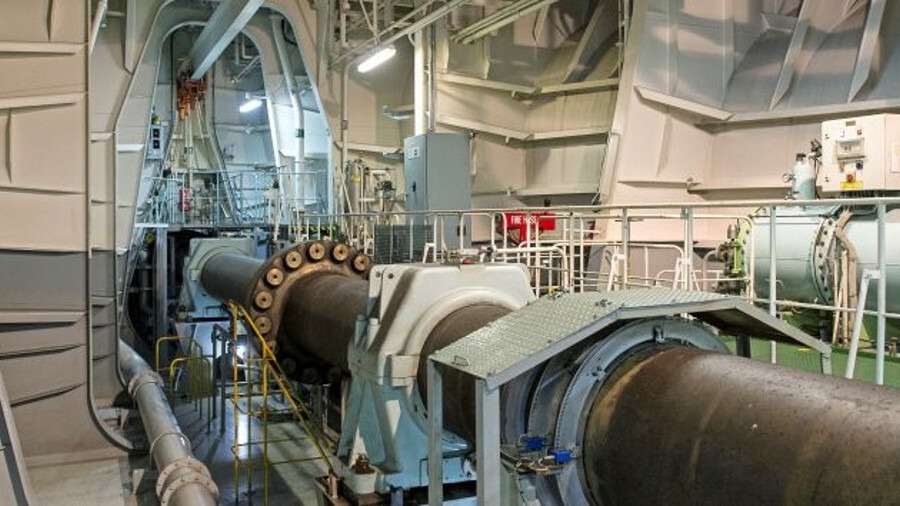
The stern tube is an important ship system fitted at the aft side where the propeller shaft passes through the hull. Its main job is to support the shaft, allow smooth rotation, and prevent seawater from entering the ship or lubricating oil from leaking out.
It may not be as visible as the main engine, but without the stern tube, safe propulsion is not possible. Inside the system, bearings, seals, and lubrication arrangements work together to keep the shaft running safely and efficiently.
For marine engineers, understanding the stern tube is important for daily operation, maintenance, troubleshooting, and dry dock repairs.
The stern tube is the hollow structure fitted at the aft end of the ship through which the propeller shaft passes before connecting to the propeller outside the hull.
In simple words, it forms the passage between the inside of the ship and the sea, allowing the tail shaft to rotate safely. Since this area is directly exposed to seawater from outside and connected to machinery space from inside, it has to be designed carefully.
The stern tube is not just an empty pipe. It houses important components like:
Its main job is to support the shaft and allow smooth rotation while keeping seawater out and lubricant in.
The stern tube sealing arrangement is what makes the whole system safe and practical. Without proper sealing, seawater can enter the machinery space side, and stern tube oil can leak out to sea. Both situations are bad—one damages machinery, the other causes pollution.
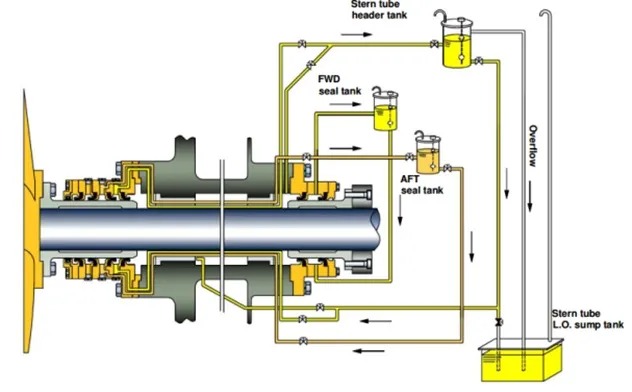
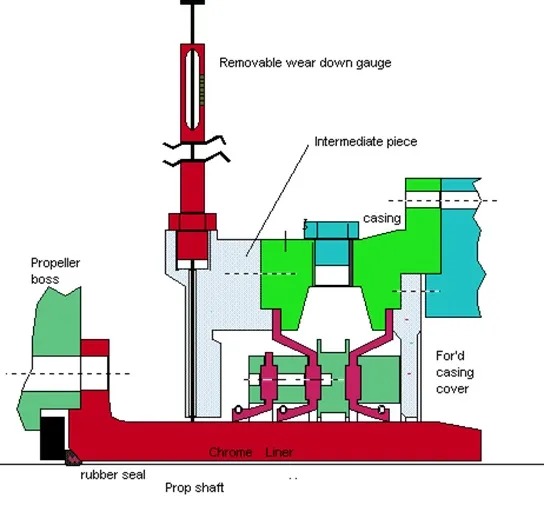
On most ships, the sealing arrangement is provided at both ends of the stern tube:
The aft seal prevents oil from escaping into the sea and also keeps seawater from entering. The forward seal prevents oil from leaking into the engine room or shaft tunnel.
In modern ships, the sealing arrangement is designed in such a way that even if one sealing ring wears out, the system still gets some level of protection before total failure happens. That is why regular monitoring of stern tube oil level and leakage signs is so important onboard.
When we say stern tube seal, we are usually talking about the actual sealing rings fitted around the shaft. These rings remain in contact with the shaft surface and form the barrier between oil and seawater.
These seals are specially designed because they have to handle:
Onboard, stern tube seal problems usually show up in practical ways:
This is why a stern tube seal is not just a static part—it is a working component that requires attention, inspection, and monitoring.
The stern tube working principle is simple when understood step by step. The propeller shaft rotates continuously when the ship is moving. Since this shaft passes through the ship’s hull, it cannot rotate directly in metal contact. It needs proper support, lubrication, and sealing for safe operation.
In simple words, the stern tube provides a safe passage for the rotating shaft while keeping it smooth, protected, and leak-free. Even though the principle is simple, it is very important because failure of lubrication, bearing damage, or seal leakage can lead to serious operational problems.
The stern tube lubrication system may vary depending on ship design, but its main purpose is always the same: to provide proper lubrication between the propeller shaft and bearings, reduce friction, control wear, and ensure smooth shaft rotation. Good lubrication also helps prevent overheating and extends bearing life.
There are three common arrangements used onboard ships:
This is the most common system on conventional merchant ships. Lubricating oil is supplied and maintained at the required level and pressure inside the stern tube. The oil forms a protective film between shaft and bearing surfaces, reducing metal contact and wear.
Advantages:
In some ships, water-lubricated bearings are used instead of oil. Seawater or fresh water passes through the bearing arrangement for cooling and lubrication. Special bearing materials such as rubber, composite, or polymer are used in this system.
Advantages:
In modern ships, some stern tube designs use an air lubrication or air seal support arrangement. Compressed air is supplied between seal chambers to create a barrier between seawater and lubricating oil. This helps reduce leakage risk and improves seal performance.
Advantages:
The stern tube bearing is the part that actually supports the rotating shaft. Without it, the shaft would not remain properly aligned and smooth rotation would not be possible.
In simple language, the bearing carries the shaft load and reduces wear during rotation.
Depending on the arrangement, stern tube bearings may be:
On oil-lubricated ships, white metal bearings are common. These bearings need clean lubrication and proper clearance. If lubrication quality drops or alignment is poor, bearing wear increases.
A worn stern tube bearing does not always fail dramatically at first. Often, it gives signs:
That is why experienced engineers never ignore early symptoms.
This is one of the most important practical topics. Stern tube bearing clearance simply means the gap between the shaft and the bearing surface.
Now this may sound like a small detail, but onboard this small detail can become a huge issue.
If the clearance is too small:
If the clearance is too large:
This is why bearing clearance is checked carefully during dry dock or major maintenance. Engineers compare the measured value with maker’s limits and also with past records.
One important practical point: a single clearance value is useful, but the trend over time is even more useful. A gradual increase in clearance tells you that wear is progressing.
This is the most common practical method. Hydraulic jack is used to slightly lift the shaft and measure movement with a dial gauge.
Procedure:
Used in some cases when access is available. Feeler gauge is inserted between shaft and bearing surface to check gap.
Measured clearance is compared with previous records to check wear trend over time.
A single clearance reading is useful, but the trend over time is more important. If clearance increases gradually, it shows bearing wear is progressing and maintenance planning is required.
A bulk carrier reported stern tube oil loss of around 50 liters per day. That is not something you ignore.
The header tank pressure setting was incorrect, and over time this damaged the seal lip.
Seal condition matters, but pressure management matters just as much. Many engineers focus only on the seal and miss the system behind it.
In another case, the stern tube bearing temperature kept rising gradually.
Seawater was entering through the aft seal, contaminating the stern tube oil.
The bearing was badly damaged and had to be replaced. The ship required emergency dry docking.
Contaminated oil is not a minor issue. Once water enters the system, lubrication quality drops, wear increases, and the cost can escalate very fast.
The stern tube may look like a passive mechanical arrangement, but in practice it is a critical reliability system. It works continuously under load, under stress, and in direct exposure to seawater conditions.
To handle it properly, an engineer must understand:
That is what separates someone who memorizes definitions from someone who can actually solve problems onboard.
Because in the engine room, the real job is not just repairing damaged parts. The real job is spotting failure early enough to stop it before it happens.
Disclaimer :- The opinions expressed in this article belong solely to the author and may not necessarily reflect those of Merchant Navy Decoded. We cannot guarantee the accuracy of the information provided and disclaim any responsibility for it. Data and visuals used are sourced from publicly available information and may not be authenticated by any regulatory body. Reviews and comments appearing on our blogs represent the opinions of individuals and do not necessarily reflect the views of Merchant Navy Decoded. We are not responsible for any loss or damage resulting from reliance on these reviews or comments.
Reproduction, copying, sharing, or use of the article or images in any form is strictly prohibited without prior permission from both the author and Merchant Navy Decoded.
Decoded Discount Alert! up to 50% OFF
Use Coupon Code Deep50