Hi this is Team Merchant Navy Decoded !!!
Please fill the below form with your query and we will get back to you in next 12 hours.
Rest assured your data is safe with us !!!🙂
Ask Your Query| For Beginner | For Professional |
|---|---|
| GME | Engine Side |
| G.P. Rating | Deck Side |
| ETO | G.P. Rating |
| IMUCET & Sponsorship | Combo Offers |
| Free Course | MEO |
| Free Course |
| For Beginner | For Professional |
|---|---|
| GME | Engine Side |
| G.P. Rating | Deck Side |
| ETO | G.P. Rating |
| IMUCET & Sponsorship | Combo Offers |
| Free Course | MEO |
| Free Course |
in their early twenties. That is a major financial advantage because a young seafarer has one of the most powerful wealth-building tools on his side: time. Unfortunately, many sailors do not use this advantage wisely. Some spend heavily on lifestyle upgrades. Some keep most of their money idle in a savings account. Others delay investing because they believe they will start later when their salary becomes bigger. But in personal finance, waiting for the perfect time can become costly.
Compounding works best when money gets enough time to grow. It does not require magic. It requires patience, discipline, and consistency. When a seafarer understands this early, his financial journey can become much stronger and more secure.
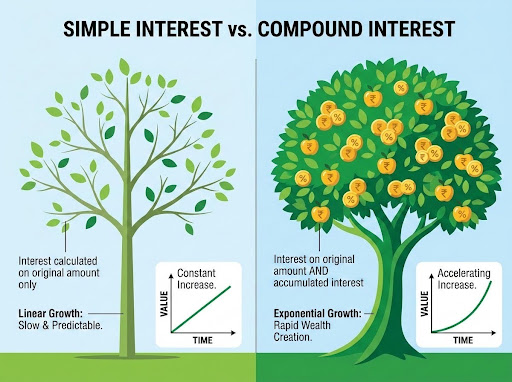
Simple interest and compound interest are two different ways money can grow. Simple interest means interest is calculated only on the original amount. Compound interest means interest or return is calculated on the original amount and also on the interest already earned. In simple words, simple interest grows slowly. Compound interest can grow faster over time because your money starts earning on its previous earnings.
Seafarers usually have a different income pattern compared to people working on shore. During contract, income may be strong. During sign-off, income may stop or reduce. This makes money planning very important. A seafarer cannot depend only on salary forever. At some stage, every sailor wants stability, family security, retirement comfort, and freedom from unnecessary financial pressure. For that, money should not only be earned. It should also be saved, invested, and allowed to grow over time. SEBI’s investor education material explains that compounding helps money grow because interest is earned not only on the original amount but also on accumulated interest.
Many seafarers start earning earlier than many shore-based workers. This early income can become a big advantage if used properly. If a seafarer starts saving and investing early, money gets more time to grow. But if early income is spent only on lifestyle, expensive purchases, unnecessary EMIs, or things that lose value quickly, the long-term benefit becomes weak. Early income is powerful only when it is connected with early discipline.
Simple interest is interest calculated only on the original amount. For example, if you invest ₹1,00,000 at 5% simple interest, you may earn ₹5,000 every year. After one year, your total becomes ₹1,05,000. After two years, it becomes ₹1,10,000. After three years, it becomes ₹1,15,000. The interest remains the same every year because it is calculated only on the first ₹1,00,000.
Suppose a seafarer keeps ₹1,00,000 in an option that gives 5% simple interest every year.
Year 1: ₹1,00,000 + ₹5,000 = ₹1,05,000
Year 2: ₹1,05,000 + ₹5,000 = ₹1,10,000
Year 3: ₹1,10,000 + ₹5,000 = ₹1,15,000
This is simple and easy to understand. The growth is stable, but it does not speed up much.
Simple interest grows slowly because interest does not earn more interest. Every year, the interest is calculated only on the original amount. This type of growth can be useful when safety and predictability are more important than high growth. But for long-term wealth creation, simple interest may not be enough, especially when inflation increases the cost of living over time. For seafarers, simple-interest-type growth may help with short-term money parking, but long-term goals usually need better planning.
Compound interest works differently. In compound interest, the interest earned gets added back to the total amount. After that, future interest is calculated on the bigger amount. This is why people say compound interest means your interest also earns interest. At first, the difference may look small. But over many years, the difference between simple interest and compound interest can become very big.
Suppose a seafarer invests ₹1,00,000 and it grows at 5% per year with compounding.
After Year 1: ₹1,00,000 becomes ₹1,05,000
After Year 2: 5% is calculated on ₹1,05,000, so it becomes ₹1,10,250
After Year 3: 5% is calculated on ₹1,10,250, so it becomes ₹1,15,762.50
Here, the return is not calculated only on the first ₹1,00,000. It is calculated on the growing amount.This is the basic power of compounding.
Compound interest builds wealth faster because the base amount keeps increasing. Your money earns returns, and those returns also start earning returns. In the beginning, the growth may look slow. But after several years, the pace can become stronger. This is why compounding rewards patience. For seafarers, this lesson is very important. If you invest early and remain invested for a long period, time can do a lot of the heavy lifting for you.
The main difference is simple. Simple interest grows only on the original money. Compound interest grows on the original money plus the interest already earned. Simple interest is like a straight road. Growth is steady but slow. Compound interest is like a snowball. It starts small, but if it keeps rolling for years, it can become much bigger. For long-term goals, compound growth can be more powerful than simple growth.
Time is the most important part of compounding. The longer your money stays invested, the more chance it gets to grow. Many young seafarers think, “I will start investing later.” But later can become expensive. When you start late, you may need to invest a much bigger amount to reach the same financial goal. SEBI’s investor education material says investing early is beneficial for long-term wealth creation and allows investors to benefit from the power of compounding.
A seafarer who starts investing at 22 has more time than someone who starts at 35 or 40. The early starter can build wealth slowly and steadily. The late starter may feel more pressure because fewer years are left for compounding to work. This does not mean older seafarers cannot invest. They can and should plan properly. But the message is simple: start as early as possible according to your financial condition. Starting early does not mean starting big. It means starting with discipline.
The Rule of 72 is a simple finance shortcut. It helps estimate how many years your money may take to double.
The formula is:
72 ÷ expected annual return = approximate years to double money
SEBI explains the Rule of 72 with an example where money growing at 9% may take around 8 years to double. This is only an estimate, not a guarantee.
The Rule of 72 helps seafarers understand how time and return work together.
For example:
If return is 6%, money may double in around 12 years.
If return is 9%, money may double in around 8 years.
If return is 12%, money may double in around 6 years. These are only basic estimates. Real investment returns can change depending on market conditions, product type, risk, and time period. Still, the Rule of 72 is useful because it teaches one simple lesson: time and discipline matter.
A seafarer’s early earning years are extremely valuable. During this phase, responsibilities may be lower compared to later stages of life. With age, family expenses, children’s education, home loans, medical needs, and other responsibilities may increase. That is why early income should not be spent only on lifestyle. Buying good things is not wrong. Enjoying life is not wrong. But spending your entire early salary without saving or investing can hurt your future. A better approach is balance. Spend where needed, save for safety, and invest for the future.
Many seafarers delay investing because they think they need a big amount to begin. This is not true. You can start small and increase your investment later as your income grows. What matters more is the habit. When you build the habit of saving and investing early, your financial discipline improves. For example, a young seafarer can start with a small monthly SIP in a suitable mutual fund after understanding the risk and goal. Over time, as income increases, the SIP amount can also be increased. Small steps can lead to big results when given enough time.
Compounding works only when you give your investments enough time. If you keep stopping, withdrawing, or changing plans again and again, the benefit may reduce. Staying invested does not mean investing blindly. It means investing with a clear goal and allowing your money time to grow. A seafarer should review investments from time to time, but should not panic with every short-term market movement. Long-term discipline is important.
Many seafarers use mutual funds for long-term investing. Mutual funds can help with wealth creation, but they are not guaranteed return products. AMFI clearly states that mutual fund schemes are not guaranteed or assured return products, and mutual fund investments involve risks including possible loss of principal. So, do not treat mutual funds like fixed deposits. Understand the fund category, risk level, time period, and goal before investing. Emergency money should remain safe and easily available. Long-term money can be invested according to your risk level and goals.
The best way to use compounding is to connect your money with a clear goal.
Ask yourself:
Is this money for retirement?
Is it for children’s education?
Is it for buying a home?
Is it for financial freedom?
Is it for long-term wealth creation?
Once the goal is clear, the investment choice becomes easier. A short-term goal needs safer options. A long-term goal may allow more growth-oriented investments. The aim is not to chase quick money. The aim is to build wealth slowly, wisely, and consistently.
Common mistakes include delaying investment, spending early income only on lifestyle, stopping investments too often, withdrawing money without reason, investing without a goal, and expecting quick returns. Another mistake is investing emergency money in risky products. Emergency money should be kept separate. If you invest emergency money and suddenly need cash during a market fall, you may be forced to withdraw at the wrong time. Compounding needs time. If you keep disturbing the investment, the effect becomes weak.
A simple compounding plan can start with your first salary. First, save money for emergencies.
Second, take proper insurance if your family depends on your income.
Third, identify long-term goals like retirement, children’s education, home planning, and financial freedom.
Fourth, start investing with a comfortable amount.
Fifth, increase the investment amount as salary grows.
Sixth, stay patient and review your plan regularly. The aim is simple: earn, save, invest, stay patient, and let time work.
For practical financial guidance, explore Sailor Pro app – Built for Seafarers, an Initiative by Merchant Navy Decoded, to stay more organised and confident in your financial planning.
You can also follow finance_for_seafarers on Instagram and join the WhatsApp channel Financial Management for Seafarer for practical money guidance created especially for seafarers.
Simple interest is interest calculated only on the original amount invested or saved.
Compound interest is interest calculated on the original amount plus the interest already earned.
Simple interest grows only on the original money. Compound interest grows on the original money and also on the interest already earned.
For long-term wealth creation, compound interest can be more powerful. For short-term safety and predictable growth, simple interest-type options may be useful.
Compound interest is important because many seafarers start earning early. If they invest early and stay disciplined, money gets more time to grow.
The Rule of 72 is a simple formula used to estimate how many years money may take to double. Divide 72 by the expected annual return.
If the expected return is 9%, then 72 divided by 9 equals 8. This means money may double in around 8 years as an estimate.
Starting early gives money more time to grow. Time is one of the biggest advantages in compounding.
Yes, seafarers can start with a small SIP after understanding the fund, risk, goal, and time period. The amount can be increased later as income grows.
No. Compounding explains how money can grow over time, but market-linked investments like mutual funds do not guarantee returns.
Disclaimer :- The opinions expressed in this article belong solely to the author and may not necessarily reflect those of Merchant Navy Decoded. We cannot guarantee the accuracy of the information provided and disclaim any responsibility for it. Data and visuals used are sourced from publicly available information and may not be authenticated by any regulatory body. Reviews and comments appearing on our blogs represent the opinions of individuals and do not necessarily reflect the views of Merchant Navy Decoded. We are not responsible for any loss or damage resulting from reliance on these reviews or comments.
Reproduction, copying, sharing, or use of the article or images in any form is strictly prohibited without prior permission from both the author and Merchant Navy Decoded.
Decoded Discount Alert! up to 50% OFF
Use Coupon Code Deep50