Hi this is Team Merchant Navy Decoded !!!

Please fill the below form with your query and we will get back to you in next 12 hours.

Rest assured your data is safe with us !!!🙂

Ask Your Query

Shore Jobs for Deck Officers in Core Shipping

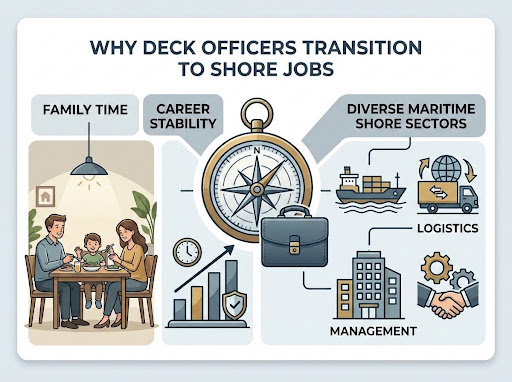
Many deck officers reach a point in their career where they start thinking about moving from ship to shore. This can happen at any rank, whether someone is a Deck Cadet, Third Officer, Second Officer, Chief Officer, or Master. The good thing is that deck officers have many shore career options within core shipping. Their sailing experience is not limited only to navigation. It also builds strong skills in administration, cargo work, safety, communication, documentation, people management, and coordination.

Introduction

Core shipping refers to shore jobs that remain directly connected with vessels, voyage operations, safety, cargo, crewing, training, marine technology, and ship-management support. For deck officers who want to move ashore but still remain connected with the maritime industry, core shipping can offer several practical career paths. These roles allow officers to use their sea experience in a structured shore environment. The right option depends on rank, interest, personality, upskilling, and long-term career goals.

Why Deck Officers Choose Shore Jobs

Why Deck Officers Choose Shore Jobs

Deck officers handle many responsibilities onboard. They are involved in navigation, cargo planning, port operations, safety drills, documentation, audits, emergency response, and communication with shore teams. They also coordinate with agents, terminals, surveyors, port authorities, charterers, ship managers, and company representatives. This gives them a practical understanding of how ships operate. Shore roles often need the same operational judgement, communication skills, and decision-making ability. That is why deck officers can be valuable in many core shipping careers.

Vessel Routing and Voyage Optimisation

Vessel routing and voyage optimisation are strong shore options for deck officers who enjoy navigation and weather planning. A vessel has to move from one port to another, but the best route depends on weather, wind, currents, storms, fuel efficiency, safety, charter-party requirements, and commercial priorities. A vessel-routing professional supports the Master from shore by analysing weather data, voyage requirements, vessel performance, and operational conditions. This role helps companies save fuel, reduce delays, and improve voyage safety.

Why Deck Officers Fit Vessel Routing

Deck Officers Fit Vessel Routing

Deck officers are suitable for vessel routing because they understand navigation, passage planning, bridge procedures, weather routing, and voyage challenges. Second Officers usually have practical experience in passage planning, ECDIS, weather reports, and voyage monitoring. Masters bring command-level judgement and real decision-making experience. Different companies may use titles such as voyage optimisation, routing analyst, vessel performance support, or marine operations support. The work remains connected with navigation, weather, data, safety, and commercial voyage performance.

Commercial Shipping Career for Deck Officers

Commercial shipping is another strong option for deck officers who want to move ashore. Deck officers have cargo knowledge, and this becomes valuable on the commercial side of shipping. They understand cargo handling, loading, discharging, port operations, vessel suitability, documentation, and voyage requirements. Commercial shipping roles may include pre-fixture operations, post-fixture operations, chartering support, voyage operations, cargo operations, and commercial operations. This field is suitable for officers who want to understand the business side of shipping.

Pre-Fixture and Post-Fixture Roles

Pre-Fixture and Post-Fixture Roles

In pre-fixture work, the focus is on checking whether a vessel is suitable for a cargo or voyage before the deal is fixed. In post-fixture work, responsibility starts after the vessel has been fixed and involves voyage follow-up, documentation, coordination, laytime support, and commercial communication. Deck officers can do well because they understand what is possible onboard, what can create delays, and what operational issues may arise during a voyage. Practical shipboard experience becomes a strong advantage here.

Table of Contents

QHSE or HSQE Career Options

QHSE or HSQE stands for Quality, Health, Safety, and Environment. It is one of the most common shore career options for deck officers. Shipping companies need safety and compliance teams to create procedures, monitor vessel performance, conduct audits, investigate incidents, review reports, and ensure ships follow company and international standards. Deck officers are suitable for HSQE because they understand onboard safety, emergency procedures, navigation risks, cargo safety, inspections, compliance requirements, and documentation from real shipboard experience.

Who Should Choose HSQE?

Who Should Choose HSQE

HSQE is suitable for deck officers who are disciplined, detail-oriented, safety-conscious, and interested in improving safety culture across vessels. A Second Officer, Chief Officer, or Master can move into safety, quality, audit, or compliance roles depending on experience and interest. The work may involve vessel follow-up, audit preparation, incident investigation, corrective actions, procedure review, and safety campaigns. Officers who enjoy documentation, systematic work, and practical safety improvement can build a stable long-term shore career in this field.

Marine Surveys and Audits

Marine surveys are another practical shore option for deck officers. Survey roles may include cargo surveys, vessel condition surveys, navigation-related inspections, safety checks, internal audits, external audits, and operational inspections. Many Captains and Chief Officers work as auditors and surveyors because they understand vessel operations deeply. Their experience helps them identify unsafe practices, documentation gaps, cargo-related issues, operational weaknesses, and compliance problems. Surveying can offer respect, independence, and strong industry exposure, but it requires accuracy and professional judgement.

Why Surveying Suits Deck Officers

Why Surveying Suits Deck Officers

A good surveyor must have attention to detail, strong reporting skills, and practical understanding of shipboard operations. Deck officers who are observant, disciplined, confident, and good at documentation can explore this field seriously. Their onboard experience helps them understand cargo operations, safety requirements, port procedures, and vessel conditions. Surveying and auditing are not only about checking items on a list. They require factual observation, clear reporting, professional communication, and the ability to make responsible comments based on evidence.

Business Analyst Roles in IT and Marine Tech

Marine technology is creating new opportunities for deck officers. Many IT and marine-tech companies build software for shipping companies, but software developers may not always understand how ships actually operate. They need someone who can explain real shipping processes in simple and practical language. This is where deck officers can work as Business Analysts. A Business Analyst understands the business process and converts it into clear requirements for developers, designers, and technology teams working on maritime software products.

How Deck Officers Add Value in Marine Tech

How Deck Officers Add Value in Marine Tech

Deck officers can explain navigation workflows, cargo operations, voyage reporting, documentation processes, port procedures, safety requirements, and vessel communication systems. For officers interested in technology but not full-time coding, Business Analyst roles can be a strong option. This career allows them to use maritime experience while learning how digital products are built for shipping. There are already mariners working in IT and marine-tech companies in such roles, especially in software connected with vessel operations, reporting, safety, and performance.

Training and Maritime Faculty Careers

Training is a natural shore career option for deck officers who enjoy teaching and guiding others. Deck officers can work in maritime training institutes, simulator centres, company training departments, or exam-preparation platforms. They can train students and officers in navigation, cargo operations, bridge procedures, safety, COLREGs, passage planning, watchkeeping, and competency exam preparation. This role suits officers who enjoy mentoring, explaining concepts, and helping juniors grow. A good trainer can make a strong impact on future seafarers.

Why Training Can Be Meaningful

Why Training Can Be Meaningful

Training may not always offer the highest salary in the beginning, but it can provide satisfaction, respect, and long-term growth if the person becomes a strong faculty member or trainer. Officers who can connect theory with real onboard examples often become valuable in this field. Students and junior officers learn better when trainers explain not only what the rule says, but why it matters at sea. For deck officers who enjoy sharing knowledge, training can become a meaningful shore career path.

Data Management Career in Shipping

Data management is an upcoming field for deck officers. Many people think vessel data is only related to engine machinery, but navigation and operations also generate large amounts of data. This includes voyage performance, weather data, route data, speed, fuel efficiency, operational reports, ETA updates, port stay records, and navigation inputs. Deck officers can understand this data better because they know how ships move and operate. They understand practical reasons behind delays, speed changes, deviations, and port challenges.

Data Skills for Deck Officers

Data Skills for Deck Officers

If a deck officer learns tools like Advanced Excel, Power BI, basic Python, or data analysis, they can enter roles connected with voyage data, vessel routing, performance analysis, marine operations analytics, and maritime data management. This is a strong opportunity for young officers who are ready to upskill and combine sea experience with digital knowledge. Companies need people who can connect raw data with real vessel operations. Deck officers who understand both sides can become valuable in modern shipping.

Crewing Career for Deck Officers

Crewing is another important shore option for deck officers. It involves crew planning, joining coordination, sign-on and sign-off arrangements, documentation, crew communication, welfare support, and coordination with vessels, principals, and manning teams. Deck officers often fit well in crewing because they develop administrative and people-management skills during sailing. They are used to paperwork, certificates, compliance requirements, communication, and coordination with different stakeholders. This role suits officers who are patient, organised, and comfortable handling coordination pressure.

Why Crewing Is Important

Crewing may not always look glamorous from the outside, but it is one of the most important departments in any shipping company. A vessel cannot operate smoothly without the right crew at the right time. A strong crewing professional helps manage availability, documents, joining plans, relief, communication, and seafarer support. Officers who are good with people and can handle pressure may grow well in this field. Crewing is practical, people-focused, and closely connected with real vessel operations.

How to Choose the Right Shore Job

How to Choose the Right Shore Job

The right shore job depends on personality and interest. If you like cargo and commercial work, commercial shipping may suit you. If you are interested in safety and compliance, HSQE can be a good path. If you enjoy teaching, training may be better. If you like technology and analysis, data management or Business Analyst roles can be strong options. If you enjoy coordination and people management, crewing can be practical. Deck officers should choose based on fit, not only salary.

Final Advice for Deck Officers

Your sea experience has value, but you must present it properly for the shore career you want. With the right planning, deck officers can build strong and stable careers within core shipping after moving ashore. Sailor Pro app, an initiative by Merchant Navy Decoded, helps seafarers explore practical shore career guidance, maritime learning, and industry-focused insights so they can prepare for better opportunities at sea and ashore.

Frequently Asked Questions (FAQs)

Deck officers can explore vessel routing, voyage optimisation, commercial shipping, HSQE, marine surveys, audits, Business Analyst roles, training, data management, and crewing.

Yes, deck officers can move ashore while staying connected with shipping through roles in safety, commercial operations, routing, crewing, training, surveys, and marine tech.

Yes, vessel routing is suitable for deck officers because they understand navigation, passage planning, weather routing, bridge procedures, and voyage monitoring.

Yes, deck officers can enter commercial shipping because they understand cargo operations, port work, documentation, vessel suitability, and voyage execution.

Yes, HSQE is one of the most common and practical shore careers for deck officers who are safety-conscious, disciplined, and good with documentation.

Yes, deck officers can work in marine surveys, cargo surveys, vessel condition surveys, audits, inspections, and operational survey roles.

Yes, deck officers can work as Business Analysts in IT or marine-tech companies by explaining real shipping processes to developers and product teams.

Yes, training can be a meaningful career for deck officers who enjoy teaching navigation, cargo operations, safety, bridge procedures, COLREGs, and competency topics.

Deck officers should improve communication, documentation, report writing, Advanced Excel, Power BI, safety knowledge, commercial awareness, and role-specific technical skills.

Deck officers should build a shore-focused CV, improve LinkedIn, learn relevant tools, understand the target role, speak to industry professionals, and present sea experience properly.

Disclaimer :- The opinions expressed in this article belong solely to the author and may not necessarily reflect those of Merchant Navy Decoded. We cannot guarantee the accuracy of the information provided and disclaim any responsibility for it. Data and visuals used are sourced from publicly available information and may not be authenticated by any regulatory body. Reviews and comments appearing on our blogs represent the opinions of individuals and do not necessarily reflect the views of Merchant Navy Decoded. We are not responsible for any loss or damage resulting from reliance on these reviews or comments.

Reproduction, copying, sharing, or use of the article or images in any form is strictly prohibited without prior permission from both the author and Merchant Navy Decoded.

DIWALI SALE

Decoded Discount Alert! up to 50% OFF

DIWALI SALE

Decoded Discount Alert! up to 50% OFF

Use Coupon Code Deep50

Days
Hours
Seconds
0
Would love your thoughts, please comment.x
()
x