Hi this is Team Merchant Navy Decoded !!!
Please fill the below form with your query and we will get back to you in next 12 hours.
Rest assured your data is safe with us !!!🙂
Ask Your Query| For Beginner | For Professional |
|---|---|
| GME | Engine Side |
| G.P. Rating | Deck Side |
| ETO | G.P. Rating |
| IMUCET & Sponsorship | Combo Offers |
| Free Course | MEO |
| Free Course |
| For Beginner | For Professional |
|---|---|
| GME | Engine Side |
| G.P. Rating | Deck Side |
| ETO | G.P. Rating |
| IMUCET & Sponsorship | Combo Offers |
| Free Course | MEO |
| Free Course |
A purifier does its job at extreme speed; the bowl spins somewhere in the range of 8,000 to 10,000 RPM depending on make and model, driven from a motor running at a fraction of that speed through a gear or belt arrangement. Anything spinning that fast, continuously, separating oil, water, and sludge under real centrifugal force, is going to need a proper teardown on a planned schedule, not just when something finally fails.
Â
Before Any of It: Isolation and Permits
None of this starts without the basics done properly first.
Before pulling anything apart, it’s worth having the drive chain straight, since both the vertical and horizontal shaft sections depend on understanding it.
The electric motor drives a horizontal shaft through a friction clutch (or, on some designs, an elastic drive belt instead of a shaft at all). That horizontal shaft carries a worm, meshing with a worm wheel on the vertical shaft, which steps the speed up significantly and carries the bowl at the top. The worm is typically hardened steel; the worm wheel is usually phosphor bronze, chosen specifically to wear against the harder worm rather than the other way around.
The friction clutch matters more than it looks: it lets the heavy bowl assembly come up to speed gradually rather than shock-loading the motor and gearing on every start.
The vertical shaft is the component actually carrying the bowl, supported by bearings top and bottom, running inside an oil bath that lubricates it automatically as long as oil level is correctly maintained.
Warning signs that it’s time to open this up: excessive vibration, unusual noise, hot bearings, oil leakage, or a general drop in separation performance. Waiting for an obvious symptom before scheduling this work is generally the wrong call most overhauls happen on a planned interval rather than reactively.
Alignment matters here more than almost anywhere else in the machine. A vertical shaft running even slightly out of true doesn’t just wear faster it transmits vibration into the whole frame, accelerating wear on components that had nothing to do with the original problem.
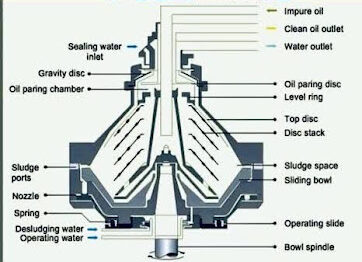
The water chamber, sitting above the disc stack, is where the purifier actually separates oil from water using nothing more than a density difference and a carefully sized disc.
How it actually works: the gravity disc’s inner diameter sets where the oil-water interface sits inside the bowl. Get that diameter wrong, or fit the wrong size disc for the oil being processed, and the consequences go in a very specific direction depending on the error:
Gravity disc issue | Result |
Diameter too large | Oil-water interface shifts outward; oil escapes through the water outlet |
Diameter too small | Interface shifts inward; water escapes through the oil outlet |
Choosing the right disc isn’t guesswork – It’s calculated from the oil’s density and the desired throughput, typically using a nomogram provided in the purifier’s manual rather than picked by habit or carried over from the last fuel grade without checking.
During overhaul, check:-
If water washing is used ahead of the purifier a common technique for removing acids and salts from straight mineral oils the injected water rate (commonly 3–5% of oil flow) continuously renews this water seal, which is worth keeping in mind when troubleshooting a seal that keeps failing despite looking fine on inspection.
The bowl is the heart of the machine, the rotating assembly actually doing the separation and it comes apart in a specific order that shouldn’t be improvised.
Before starting the purifier back up, a few checks are worth treating as mandatory:
A purifier overhaul isn’t really four separate jobs – The vertical shaft, horizontal shaft, water chamber, and bowl all depend on each other working correctly at once. A worn worm wheel throws off the vertical shaft’s smooth running. A shaft running slightly out of true undermines the precision the water chamber depends on. A gravity disc sized without checking the manual defeats the separation the whole bowl exists to do. Treat the overhaul as one connected system rather than a checklist of parts to swap, rotate everything by hand before trusting it to run at speed, and a purifier will keep doing genuinely demanding, high-speed work reliably between one planned overhaul and the next.
An electric motor drives a horizontal shaft, which turns a worm meshing with a worm wheel on the vertical shaft, stepping speed up significantly to spin the bowl. A friction clutch sits between the motor and horizontal shaft specifically to let the heavy bowl assembly come up to speed gradually, rather than shock-loading the motor and gearing on every start.
Too large a diameter shifts the oil-water interface outward, letting oil escape through the water outlet. Too small a diameter shifts it inward, letting water escape through the oil outlet. The correct size is calculated from the oil’s density and desired throughput using the manufacturer’s nomogram, not chosen by habit.
Â
The shaft runs at very high rotational speed carrying the bowl assembly, so even a slight misalignment shows up as vibration that’s transmitted through the whole frame, accelerating wear on components well beyond the shaft itself.
Disc stacking order and orientation affect the flow pattern of oil through the bowl during separation. Reassembling them in a different order can compromise separation efficiency even though the discs themselves look identical.
That every fitting is correctly seated, the bowl hood is properly locked using the correct tool, the assembly rotates freely by hand without noise or binding, and any removed safety devices are refitted followed by a gradual start-up to full speed before introducing oil feed or operating water.
Disclaimer :- The opinions expressed in this article belong solely to the author and may not necessarily reflect those of Merchant Navy Decoded. We cannot guarantee the accuracy of the information provided and disclaim any responsibility for it. Data and visuals used are sourced from publicly available information and may not be authenticated by any regulatory body. Reviews and comments appearing on our blogs represent the opinions of individuals and do not necessarily reflect the views of Merchant Navy Decoded. We are not responsible for any loss or damage resulting from reliance on these reviews or comments.
Reproduction, copying, sharing, or use of the article or images in any form is strictly prohibited without prior permission from both the author and Merchant Navy Decoded.
Decoded Discount Alert! up to 50% OFF
Use Coupon Code Deep50