Hi this is Team Merchant Navy Decoded !!!

Please fill the below form with your query and we will get back to you in next 12 hours.

Rest assured your data is safe with us !!!🙂

Ask Your Query

Principle of Purifier

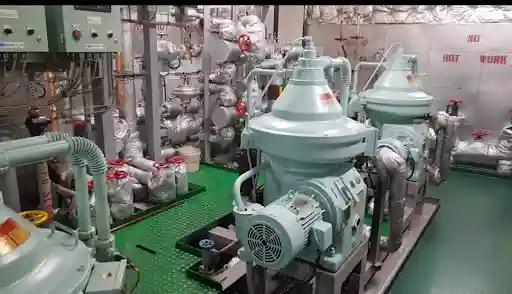
A purifier looks, from the outside, like a box bolted to the engine room floor. What’s actually happening inside :  It’s separating oil from water and solid contaminants at bowl speeds of 6,000 to 18,000 RPM  is elegant physics, and the two manufacturers you’ll meet most often on board, Alfa Laval and Mitsubishi, solve the same underlying problem with meaningfully different mechanisms.

This post covers the actual working principle behind separation itself, then goes through how each manufacturer implements its construction, control, and how desludging actually happens on each.

Principle of Purifier

The Basic Principle: Speeding Up What Gravity Would Do Eventually

Oil, water, and solid contaminants separate on their own eventually, given enough time sitting still  that’s just gravity settling, and it’s far too slow to be useful on a ship burning tonnes of fuel a day.

A centrifuge speeds that same separation up by generating a force many thousands of times stronger than gravity. Spin a mixture fast enough, and the denser components (water, solids) get thrown outward toward the bowl periphery far faster than gravity alone could ever manage, while the lighter oil stays closer to the centre. Same physical principle as gravity settling  just accelerated to a speed that’s actually practical for continuous shipboard use.

Two variants of the same machine, built for different jobs:

Type

Separates

Outlets 

Typical use 

Purifier 

Oil, water and solids together 

Oil, water and sludge 

Fuel oil, where water contamination is expected and routine

Clarifier 

Oil and solids only 

Oil and sludge (no water outlet)

Lubricating oil, where water content is normally minimal 

A clarifier is mechanically simpler because it never has to manage an oil-water interface, no gravity disc, no interface to get wrong  which is exactly why it can run at a higher throughput than a purifier doing the same basic job.

The Disc Stack: Why It's There at All

Disc Stack

A bare spinning bowl would separate liquids eventually, but the settling distance particles need to travel before reaching the bowl wall would still be too long to be practical. The disc stack – A tall pile of conical discs, spaced apart by caulks  solves that by splitting the bowl’s volume into dozens of thin separation channels.

Each channel dramatically shortens the distance a droplet of water or a solid particle actually has to travel before it hits a disc surface and is directed the rest of the way to the periphery. More discs, more channels, and the same bowl volume achieves far more effective separation area than an empty bowl ever could.

Table of Contents

The Oil-Water Interface and the Gravity Disc

In a conventional purifier, the point where oil and water actually separate from each other, the interface  is set by the gravity disc, fitted above the disc stack. Its inner diameter is what fixes where that interface physically sits inside the bowl.

Get the disc size wrong, and the failure direction is predictable:-

Gravity disc issue 

What happens 

Diameter too large 

Interface shifts outward oil is pushed towards the water outlet and lost

Diameter too small 

Interface shifts inwards water escapes through the oil outlet 

The correct disc is selected using the oil’s density and the desired throughput, worked out from a nomogram in the manufacturer’s manual  not carried over from the last fuel grade without checking, since density genuinely varies between bunkers.

Alfa Laval: Working Principle

Alfa Laval Working Principle

Alfa Laval’s conventional purifiers (the P-series and similar gravity-disc designs) use a sliding bowl bottom held shut during normal operation by valve springs. Spring force keeps the bowl bottom sealed against the bowl body while oil is being fed and separated continuously.

Alfa Laval also produces the ALCAP system, a genuinely different approach that removes the gravity disc entirely. Instead of a fixed physical interface set by a disc, ALCAP uses a flow control disc paired with a water transducer monitoring water content in the outgoing clean oil. A control unit reads that signal continuously and automatically opens a water drain valve when needed, adjusting the separation in real time rather than relying on a disc sized for one assumed density.

ALCAP’s real advantage shows up specifically with high-density fuels  it’s built to handle oil with densities approaching 0.991, where a conventional gravity disc becomes difficult to size correctly since oil and water density are so close together at that point. It also removes a specific, well-known human error: Fitting the wrong gravity disc for the fuel actually on board.

Mitsubishi Selfjector: Working Principle

Mitsubishi Selfjector Working Principle

Mitsubishi’s Selfjector range still uses a conventional gravity disc, selecting the correct one remains just as important here as on a conventional Alfa Laval unit, and the manual is explicit that it’s one of the most important steps in setting the machine up correctly.

Where Selfjector genuinely differs is in how the bowl bottom is controlled. Instead of relying on spring force alone, it uses a pilot valve to control the admission and release of operating water, governing exactly when and how the sliding bowl bottom opens and closes.

That distinction, Valve springs on Alfa Laval’s conventional design versus a pilot valve on Mitsubishi’s Selfjector  is the detail that most often comes up when comparing the two mechanically, and it’s worth keeping straight rather than assuming both work identically underneath.

How Desludging Actually Happens

Regardless of which manufacturer’s logic is controlling it, the underlying desludging sequence follows the same basic shape:-

  1. Normal operation – The sliding bowl bottom is held sealed shut (by spring force, by operating water pressure, or a combination, depending on design), and sludge collects in the space around the bowl periphery as oil is continuously fed and separated
  2. Desludge triggered –  On a timer, or on a signal from monitoring equipment, the closing force holding the bowl bottom shut is released
  3. Bowl opens momentarily – The sliding bowl bottom drops, uncovering discharge ports at the periphery
  4. Sludge is ejected – Centrifugal force flings the accumulated sludge (and, depending on discharge type, some oil) out through those ports
  5. Bowl recloses – Closing water (or spring force) reseats the sliding bowl bottom, sealing the bowl again, and normal separation resumes

Partial vs. total discharge is really just a difference in how long that bowl stays open. A short opening ejects sludge only, disturbing normal separation minimally. A longer, full opening ejects the sludge along with a larger charge of oil  used when changing between oil grades, or when the bowl needs a more thorough clean than a routine partial discharge provides. On the Mitsubishi Selfjector specifically, that duration is controlled by how long desludging water is supplied through the pilot valve; the mechanism deciding partial versus total discharge is a timing difference, not a fundamentally different process.

Different roles 

The three roles operating water plays, easy to conflate if you haven’t separated them out:

  • Sealing water – Admitted at start-up to form the initial water seal at the bowl periphery before oil is introduced
  • Opening water – Used (on designs that use water rather than spring release alone) to help open the sliding bowl bottom for desludging
  • Closing water – Reseats and holds the sliding bowl bottom shut during normal running

Automatic control systems – most modern installations, whether Alfa Laval’s or Mitsubishi’s, run under an automated control unit handling desludge timing, water admission, and (on ALCAP-type systems) real-time interface monitoring, specifically so the unit can run reliably in an unmanned engine room without someone manually triggering every cycle.

Bowl speed context – This entire separation principle only works because the bowl is spinning fast enough (commonly 6,000–18,000 RPM depending on model) to generate the centrifugal force the whole process depends on. Shaft alignment, worm and worm wheel condition, and bearing health all exist to keep that speed stable and vibration-free, because the separation principle itself has zero tolerance for a bowl that isn’t actually spinning true.

Conclusion

Strip away the manufacturer-specific hardware, and every purifier is doing the same basic thing: using centrifugal force to accelerate separation, gravity would eventually do on its own, with a disc stack shrinking the settling distance needed and a controlled bowl bottom periodically clearing out what accumulates. Alfa Laval and Mitsubishi solve the same mechanical problem holding the bowl shut, then opening it on demand  with genuinely different hardware, springs on one, a pilot valve on the other, and Alfa Laval’s own ALCAP system goes a step further by removing the gravity disc question entirely. Understanding the shared principle underneath both is what makes either manufacturer’s specific procedure make sense, rather than memorising two unrelated sets of steps.

Frequently Asked Questions (FAQs)

A purifier separates oil, water, and solids together, with three outlets including a water discharge, and needs a gravity disc (or equivalent) to manage the oil-water interface. A clarifier only separates oil and solids, with no water outlet and no interface to manage, which lets it run at a higher throughput for the same bowl size typically used for lubricating oil rather than fuel.

Alfa Laval’s conventional design holds the sliding bowl bottom shut using valve springs. Mitsubishi’s Selfjector range uses a pilot valve to control the admission and release of operating water, governing when the bowl bottom opens and closes rather than relying primarily on spring force.

ALCAP removes the gravity disc entirely, replacing it with a flow control disc and a water transducer that continuously monitors water content in the clean oil outlet. A control unit automatically adjusts water discharge in response, rather than relying on a disc sized in advance for one assumed oil density particularly useful for high-density fuels approaching 0.991.

It comes down to how long the bowl bottom stays open. A partial discharge is a brief opening that ejects sludge only. A total discharge keeps the bowl open longer, ejecting sludge along with a larger charge of oil  typically used when changing oil grades or when a more thorough clean is needed than routine partial discharge provides.


The disc’s inner diameter sets where the oil-water interface sits inside the bowl. Too large a diameter pushes the interface outward, letting oil escape through the water outlet; too small pushes it inward, letting water escape through the oil outlet. The correct size is calculated from oil density and desired throughput, not assumed from a previous fuel grade.

Disclaimer :- The opinions expressed in this article belong solely to the author and may not necessarily reflect those of Merchant Navy Decoded. We cannot guarantee the accuracy of the information provided and disclaim any responsibility for it. Data and visuals used are sourced from publicly available information and may not be authenticated by any regulatory body. Reviews and comments appearing on our blogs represent the opinions of individuals and do not necessarily reflect the views of Merchant Navy Decoded. We are not responsible for any loss or damage resulting from reliance on these reviews or comments.

Reproduction, copying, sharing, or use of the article or images in any form is strictly prohibited without prior permission from both the author and Merchant Navy Decoded.

DIWALI SALE

Decoded Discount Alert! up to 50% OFF

DIWALI SALE

Decoded Discount Alert! up to 50% OFF

Use Coupon Code Deep50

Days
Hours
Seconds
0
Would love your thoughts, please comment.x
()
x