Hi this is Team Merchant Navy Decoded !!!

Please fill the below form with your query and we will get back to you in next 12 hours.

Rest assured your data is safe with us !!!🙂

Ask Your Query

PID Controller & PLC Used On Board Ship

Modern ships are no longer operated entirely through manual control. From maintaining boiler water level and steam pressure to controlling engine parameters, tank levels, temperatures and flow rates, automation plays a critical role in safe and efficient ship operation. At the heart of many of these automated systems are two important technologies: PID controllers and PLCs (Programmable Logic Controllers).

For a marine engineer, understanding these systems is not just about theory. PID control and PLC logic are encountered regularly in the engine room, automation systems, boiler control, pumps, compressors and propulsion machinery.

What is a PID Controller?

PID Controller & PLC

PID stands for Proportional, Integral and Derivative.

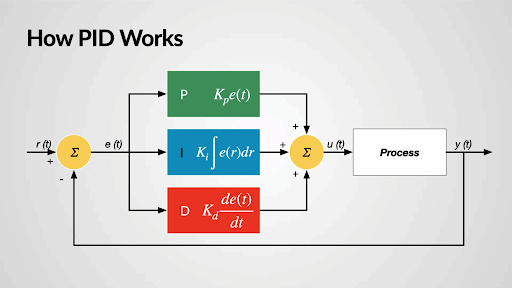
A PID controller is a feedback control system that continuously compares the desired value (set point) with the actual measured value (process variable) and calculates how much corrective action is required.

The difference between the desired and actual value is called the error.

For example, suppose the desired boiler drum water level is:

Set Point = 60%

But the actual measured level is:

Process Value = 55%

The controller detects a 5% error and sends an appropriate output to the feed-water control system.

This process continuously repeats:

This closed-loop operation allows the system to automatically maintain the desired operating condition.

The uploaded reference describes PID as one of the most widely used forms of feedback control and notes that PID controllers are used across control applications, including complex automation systems.

The Three Elements of PID Control

The PID controller consists of three control actions.

1. Proportional Control — P

The proportional component responds to the present error.

The larger the error, the greater the controller’s corrective output.

For example:

If the boiler water level falls significantly below the set point, the proportional action increases the feed-water valve opening.

Simple idea:

More error = More corrective action

However, proportional control alone normally cannot completely eliminate steady-state error.

The reference material notes that proportional control can reduce rise time and reduce steady-state error, but does not necessarily eliminate it.

2. Integral Control — I

Integral action responds to the accumulated error over time.

Even if the error is small, if it continues for a period of time, the integral component keeps increasing the corrective action until the steady-state error is removed.

Simple idea:

Error continuing over time = Increasing correction

This makes integral control particularly useful when the system needs to return precisely to its set point.

However, excessive integral action can negatively affect the transient response and may contribute to overshoot or oscillation.

3. Derivative Control — D

Derivative action responds to the rate at which the error is changing.

It essentially asks:

“How quickly is the error changing?”

If the system is approaching the set point very rapidly, derivative action can reduce the controller’s response and help prevent excessive overshoot.

Simple idea:

Fast-changing error = Anticipatory correction

According to the reference material, derivative control can improve stability, reduce overshoot and improve transient response.

Table of Contents

PID in One Simple Example

Imagine a ship’s cooling-water temperature needs to be maintained at:

Set Point = 80°C

The temperature sensor measures:

Actual Temperature = 75°C

The PID controller detects the error:

Error = 80 − 75 = 5°C

The controller then determines the appropriate output based on:

  • P: How large is the current error?
  • I: How long has this error existed?
  • D: How quickly is the temperature changing?

The controller then sends an output to an actuator such as a control valve.

The valve position changes the cooling/heating process, the temperature changes, and the sensor sends the new value back to the controller.

This happens continuously.

What is a PLC?

PLC stands for Programmable Logic Controller.

A PLC is an industrial computer designed to control machinery and processes.

Instead of using large amounts of conventional hard-wired relay logic, a PLC can use programmable logic to monitor inputs, execute a control program and operate outputs.

A simplified PLC system looks like:

Sensors → PLC Inputs → PLC Program → PLC Outputs → Actuators

Inputs can include:

  • Temperature sensors
  • Pressure switches
  • Level transmitters
  • Flow transmitters
  • Limit switches
  • Emergency switches
  • Motor feedback

Outputs can include:

  • Solenoid valves
  • Contactors
  • Control valves
  • Pumps
  • Fans
  • Motors
  • Alarms

This makes PLCs extremely useful in shipboard automation.

PID vs PLC: Are They the Same?

No. This is one of the most important concepts for cadets to understand. A PID controller is a control algorithm, whereas a PLC is a programmable control device/system.

A PLC can execute many different types of logic, including:

  • Sequential logic
  • Interlocking
  • Timers
  • Counters
  • Alarm logic
  • Start/stop logic
  • PID control
  • Communication functions

Therefore, a PLC can contain a PID control function as part of its program.

Think of it this way:

PLC = The platform/controller

PID = One of the control algorithms running within the system

Three-Element Boiler Water Level Control

One of the most important marine applications of process control is boiler drum water-level control.

A boiler drum is not as simple as maintaining a fixed water level using only one sensor.

The reference material explains the swell and shrink effect that occurs because changes in steam demand affect steam bubbles and the apparent water level inside the drum.

What is swell?

When steam demand suddenly increases, drum pressure can fall. Water flashes into steam, increasing the volume of steam bubbles.

The apparent drum level may therefore rise, even though the actual quantity of water is decreasing.

This is called Swell

If a simple level controller sees the rising level and reduces feed-water flow, it could make the actual situation worse.

What is Shrink?

When steam demand decreases, pressure and steam-bubble conditions change.

The apparent drum water level can fall.

This is known as Shrink

A simple level-control system could respond incorrectly if it only considers drum level.

This is why more advanced boiler control systems use multiple measurements.

Three-Element Boiler Control

Three-Element Boiler Control

A three-element control system uses:

  1. Drum water level
  2. Steam flow
  3. Feed-water flow

These measurements provide the controller with much more information about what is actually happening inside the boiler. The reference material explains that incorporating steam flow and feed-water flow helps overcome the problems associated with swell and shrink.

This is a great example of how control engineering theory becomes practical marine engineering.

Why PID Controllers Are Important on Ships

Ships operate continuously and often under changing loads.

A vessel may experience:

  • Changing engine load
  • Changing steam demand
  • Variation in ambient temperature
  • Changing cooling-water conditions
  • Changes in fuel demand
  • Different tank levels
  • Variable flow requirements

Manual adjustment of every parameter would be inefficient and potentially unsafe.

Automatic control allows machinery to respond continuously to these changes.

PID control provides:

  1. Better Stability: The system attempts to maintain the desired operating condition.
  2. Better Accuracy: The controller continuously compares actual performance with the set point.
  3. Reduced Human Intervention: Engineers do not need to manually adjust every control valve continuously.
  4. Faster Response: The control system can respond automatically when operating conditions change.
  5. Improved Safety Abnormal conditions can trigger alarms, trips or automatic protective actions when integrated with the overall automation system.

PID Controller Parameters: Kp, Ki and Kd

The performance of a PID controller depends heavily on its tuning parameters:

Kp — Proportional Gain

Ki — Integral Gain

Kd — Derivative Gain

Changing these parameters affects characteristics such as:

  • Rise time
  • Overshoot
  • Settling time
  • Steady-state error
  • System stability

The reference material specifically notes that the effects of changing Kp, Ki and Kd are interdependent, so the summarized relationships should be treated as a guide rather than an absolute rule.

Frequently Asked Questions (FAQs)

PID stands for Proportional, Integral and Derivative. It is a feedback control method used to maintain a process variable close to its desired set point.

A PLC (Programmable Logic Controller) is a programmable industrial control device, while PID is a control algorithm. A PLC can execute PID control along with logic, sequencing, alarms and interlocks.

PID control can be used for applications such as boiler water-level control, temperature control, pressure control and flow control, depending on the ship’s automation system.

It is a boiler control system that uses three measurements: drum water level, steam flow and feed-water flow. It helps address the swell and shrink effects associated with changes in steam demand.

Proper tuning of Kp, Ki and Kd helps achieve the desired response, stability and accuracy. Poor tuning can result in excessive overshoot, oscillation or slow system response.

Disclaimer :- The opinions expressed in this article belong solely to the author and may not necessarily reflect those of Merchant Navy Decoded. We cannot guarantee the accuracy of the information provided and disclaim any responsibility for it. Data and visuals used are sourced from publicly available information and may not be authenticated by any regulatory body. Reviews and comments appearing on our blogs represent the opinions of individuals and do not necessarily reflect the views of Merchant Navy Decoded. We are not responsible for any loss or damage resulting from reliance on these reviews or comments.

Reproduction, copying, sharing, or use of the article or images in any form is strictly prohibited without prior permission from both the author and Merchant Navy Decoded.

DIWALI SALE

Decoded Discount Alert! up to 50% OFF

DIWALI SALE

Decoded Discount Alert! up to 50% OFF

Use Coupon Code Deep50

Days
Hours
Seconds
0
Would love your thoughts, please comment.x
()
x